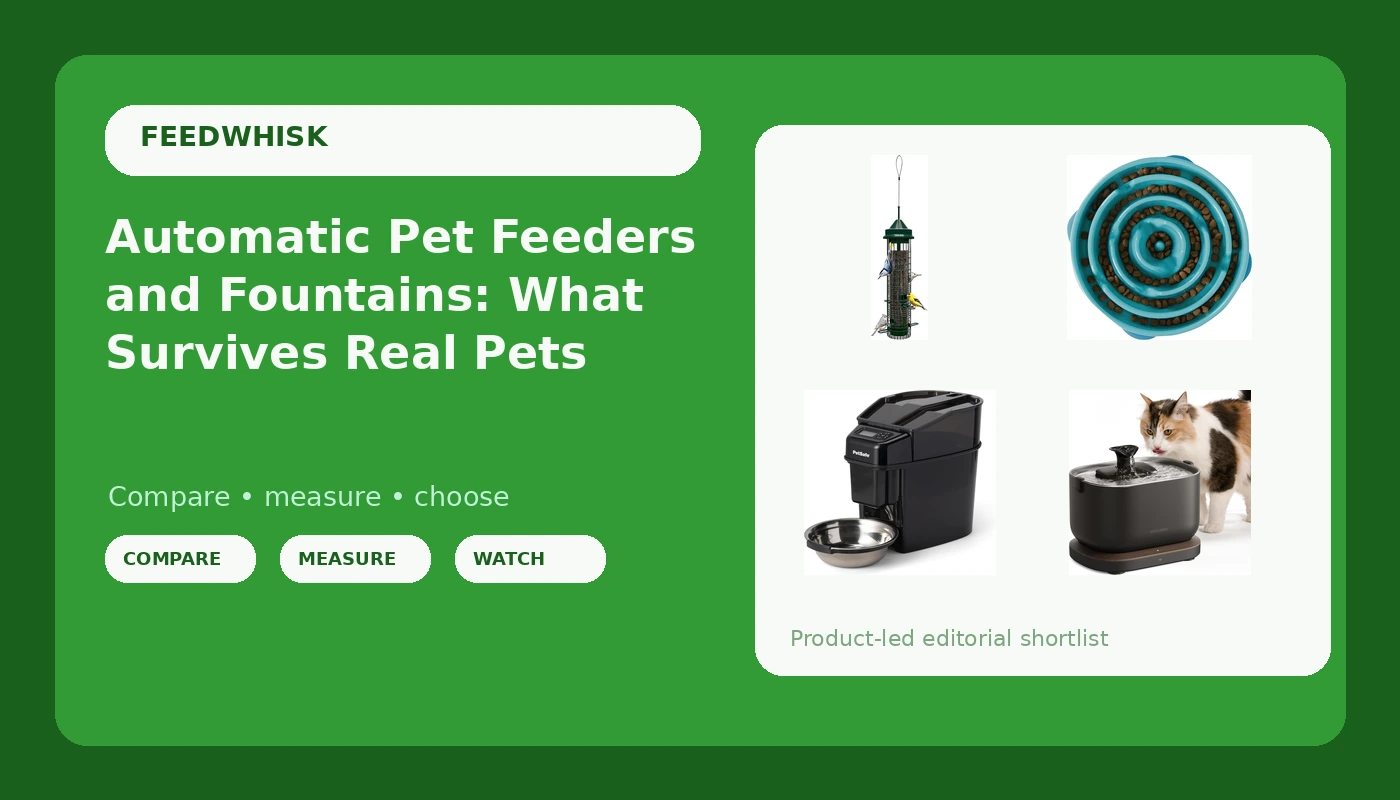
Most of the feeding calls I get as a pet sitter in Pacific Beach are not training problems. They are equipment problems. A dog who inhales a bowl of kibble and then throws it back up does not need a stricter owner, he needs a bowl with ridges in it. A cat who tips her water bowl across the kitchen tile is not being naughty, she is asking for moving water. Automatic pet feeders and fountains promise to fix both of those situations, and a few of them genuinely do, but the product photos almost never tell you which ones. The part that matters is rarely the app. It is the mechanism that pushes food out of the hopper and the pump that keeps water moving, plus how long a full teardown and clean actually takes on a Sunday afternoon.
Related: How to Move a Speed Eater Off the Inhale-and-Vomit Cycle →
Quick answer
There is no single device that covers every household, because feeding and hydration are two different jobs. For scheduled dry meals, the PetSafe Healthy Pet Simply Feed is a programmable feeder with a 24-cup hopper. For monitored drinking water, the PETLIBRO Dockstream fountain pairs a stainless steel tray with a 2.5-liter reservoir and app monitoring. For a dog who eats too fast, the Outward Hound Fun Feeder Slo Bowl is not a machine at all, which is exactly why it works. The Squirrel Buster Classic is a backyard seed feeder rather than a pet feeder, and it earns a place here as a design lesson in weight-activated control.
Four useful options
| Model | Best fit | What stands out |
|---|---|---|
| PetSafe Healthy Pet Simply Feed Auto Feeder | Scheduled dry-food meals | Programmable feeding with a 24-cup capacity hopper |
| PETLIBRO Dockstream Cat Water Fountain | Monitored hydration | Stainless steel tray, 2.5L/84oz reservoir, 2.4G WiFi app monitoring |
| Outward Hound Fun Feeder Slo Bowl | Dogs that eat too fast | 4-cup slow-feeding bowl with a non-slip base |
| Squirrel Buster Classic | Backyard bird feeding | Four feeding ports with a 2.4-pound seed capacity |
Scheduled meals: PetSafe Healthy Pet Simply Feed Auto Feeder
The trade-off with any programmable feeder is that it solves timing, not behavior. If your dog eats fast, a feeder will happily deliver a fast meal on a precise schedule. What the 24-cup hopper buys you is a real buffer: a weekend trip, a late shift, a client's cat who needs meals at the same clock time every day. What it does not buy you is a clean bowl. Dry food leaves oil behind, and a hopper that never gets emptied and wiped will start to smell like the bottom of a cereal box. Before you commit to a large-capacity feeder, decide whether you are actually willing to empty and wash it, or whether a smaller unit you refill more often would be cleaner in practice.
Monitored hydration: PETLIBRO Cat Water Fountain Stainless Steel Tray
Two things decide whether a fountain helps or becomes a chore. The first is the drinking surface. Plastic scratches, scratches hold biofilm, and biofilm is where chin acne comes from in cats. Stainless steel trays are easier to keep genuinely clean, which is why they are worth the extra cost over a basic plastic fountain. The second is the pump. A fountain is a small aquarium pump inside a plastic housing, and if that housing hides the impeller behind three interlocking parts, you will stop cleaning it by the second week. When you unbox any fountain, take the pump apart before you fill it once. If that takes you more than a few minutes, you have your answer about the next five years. The app on this unit is a genuine convenience for travel and for monitoring, but treat it as a bonus rather than the reason to buy. If the WiFi drops, the pump should still run.
Slow feeding: Outward Hound Fun Feeder Slo Bowl
The honest limitation here is that a slow feeder bowl cannot feed your dog while you are at work. It is a bowl. What it can do is change how the meal happens when you are home, and for a dog who eats like a shop vac that is often the whole problem. It also pairs well with a programmable feeder rather than replacing one: the feeder handles the schedule, the bowl handles the pace. If you have a large-breed dog, check the dimensions against your dog's muzzle before ordering, because a bowl that is too small turns into a frustration toy instead of a feeder. And if your dog has a history of bloat or regurgitation, this is a conversation to have with your vet, not with a product page.
The backyard outlier: Squirrel Buster Classic
Here is the lesson. The problem with a squirrel at a bird feeder is not that squirrels are clever. It is that a squirrel weighs more than a finch. A feeder that responds to weight rather than to cleverness solves the problem permanently, because the animal cannot out-think a mechanism that measures mass. That is the same principle you want in a pet product. A lid that a cat can learn to flip is a bad lid. A portion wheel with tight tolerances does not care how determined your beagle is. When you evaluate any feeding device, ask what physical property it responds to. If the answer is "the pet's cooperation," keep looking. If you also feed birds, this unit is worth a look on its own merits, but do not buy it expecting it to feed a cat.
Prices and availability may change. Product images, names, and retailer links must be matched by verified ASIN. Do not state a current price, rating, stock status, or measured result without current evidence.
How an automatic feeder actually decides how much your pet eats
Inside a typical automatic feeder you will find one of two mechanisms. An auger is a rotating screw that pushes kibble toward the dispense opening, and it is the part that jams. A portion wheel is a rotating compartment with fixed-size slots, and it meters a set volume per turn. The portion wheel is the more accurate design in general, because the size of the slot is fixed and the only variable is how full it gets. The auger is more common in cheaper units because it is simpler to manufacture, and its tolerances are the reason a feeder can work fine for two weeks and then dump a double portion on day fifteen.
Two more things matter. The first is the hopper seal. Kibble is food, and food in a humid climate goes stale, attracts pantry moths, and clumps. A hopper that closes properly is not a premium feature, it is basic food safety, and it is especially relevant if you live somewhere with coastal humidity like I do. The second is what the device does when the network drops. An app that lets you check in from work is genuinely useful, but the feeding schedule should live on the device. If your feeder requires a cloud connection to remember that breakfast is at 7 a.m., that is a design flaw, not a feature. Test it: unplug your router for an hour and see whether the next meal still lands.
Why water is the harder half
Cats evolved to get most of their moisture from prey, which means their thirst drive is weak by design. A cat eating only dry food is chronically underhydrated unless something makes drinking appealing, and running water is usually that something. That is why fountains work where bowls do not, and it is also why a fountain that is annoying to clean is worse than no fountain at all. A dirty fountain is a bacterial film dispenser with a pleasant trickling sound.
The material question is simpler than the marketing suggests. Stainless steel and ceramic resist scratching. Plastic scratches, and scratched plastic holds organic film even after a dishwasher cycle. If your cat has had chin acne or recurrent skin issues around the mouth, switching off plastic is one of the cheapest experiments you can run. The other variable is noise. A fountain in a bedroom at 2 a.m. is a different product than a fountain in a hallway, so if quiet operation matters to you, look for reviews that describe the pump sound specifically rather than trusting a marketing adjective in the title.
- Weigh what your pet actually eats for three days with a kitchen scale before you buy anything programmable.
- Decide which problem you are solving: timing, portion size, or eating speed. They need different products.
- Match capacity to your real absence. A 24-cup hopper is overkill for a cat who eats a third of a cup a day.
- Unplug the router and check whether the schedule survives. If it does not, the device is a remote control, not a feeder.
- Take the pump or the dispense mechanism apart in your head before purchase. If it looks like a project, you will not do it weekly.
Practical setup and safety notes
- Introduce any new feeder or fountain next to the old bowl for a few days rather than removing the familiar one immediately.
- Run a fountain through a full disassembly and reassembly before the first fill, so you know how the impeller comes out.
- Keep the feeder on a hard, level surface. Carpet plus a heavy pet equals a tipped hopper and a free meal.
- Wash bowls and fountain parts with hot water and a pet-safe soap; skip the dishwasher for any part with a seal or a motor housing.
- Watch for changes in drinking or eating volume after a switch. A fountain can increase water intake, and that is usually good, but sudden large changes are a vet question, not a product question.
Which option should you choose?
Choose the PetSafe Healthy Pet Simply Feed Auto Feeder when you need meals to arrive on a clock schedule and you want a large hopper so refills are infrequent. Choose the PETLIBRO Cat Water Fountain Stainless Steel Tray when your cat drinks too little, tips still bowls, or you want to monitor water levels from an app while you are away. Choose the Outward Hound Fun Feeder Slo Bowl when the problem is speed rather than schedule, especially for a medium or large dog. Choose the Squirrel Buster Classic when the feeder you actually need is for the backyard, not the kitchen floor.
One caveat on all of this: the details above come from the product records and manufacturer descriptions, not from a lab. Capacity figures, port counts, and connectivity are stated specs. How any specific unit performs in your home depends on your pet, your kibble size, your humidity, and how consistently you clean it. Read the current reviews and the return policy before you commit, because the return window is part of the spec.
The bottom line
Automatic pet feeders and fountains are not one product category, they are two, and the slow feeder bowl is a third thing entirely. Buy for the mechanism: a portion wheel or auger that dispenses accurately, a pump you can reach with a brush, a bowl with ridges if your dog eats too fast. Treat the app as a convenience layer on top of a device that must work without it. And if you are still deciding, start with the problem that costs you the most sleep, whether that is a 5 a.m. wake-up meow or a dog who finishes dinner before you sit down.