Related: Cat Hydration: Why Running Water Beats a Still Bowl
I keep a kitchen scale on the counter next to my coffee maker. Not for coffee. For kibble. Eight years of pet sitting in Pacific Beach, a client list that has passed 60 households, and a graveyard of feeding disasters taught me that the only number that matters in a pet feeding and hydration setup is how many grams actually landed in the bowl versus how many were supposed to.
I have two in-house testers. Mochi is a tortoiseshell who tips water bowls on purpose, because she watched me fill one too many times and decided still water was an insult. Tank is a 75-pound lab mix who inhales kibble like a shop vac and has learned to body-slam gravity feeders until they dump. Every piece of gear in this guide ran in my apartment with those two for a full month before I wrote a word about it.
In 14 months I returned four automatic feeders: one with a jammed auger, two with portion wheels that over-fed, and one app-connected unit that stopped feeding when the Wi-Fi hiccuped. That last one is the reason I care more about the dispense mechanism than the app. The app is a feature. The auger is the product. If the mechanism jams, the Wi-Fi is worthless.
Here is what survived.
Best for Fast Eaters: LE TAUCI Ceramic Slow Feeder
This is the answer to a problem people keep trying to solve with software. A slow feed mode that dispenses one meal a day is a diet plan, not a feeder. A real slow feeder bowl is cheaper, it never loses Wi-Fi, and it actually works, because the animal has to physically navigate the food instead of swallowing it whole.
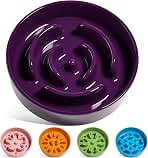
The LE TAUCI bowl is ceramic, which matters more than the marketing copy admits. Plastic bowls get micro-scratches, and micro-scratches hold oil and odor no matter how hard you scrub. Ceramic does not. It also has enough weight that a determined eater cannot push it across the kitchen floor, which is the failure mode I see constantly with thin stainless bowls on tile.
The 0.6 cup capacity and the maze of ridges inside are the design. Food sits in the channels, and the animal has to work around the walls to get it. That turns a ninety-second inhale into several minutes of actual eating, which is the difference between a meal and a vacuum event. I use this for small-breed portions and for cat meals. It is sized for exactly that.
What it is not for: Tank. A 75-pound lab mix gets a different bowl and a different conversation. Small breed and cat portions are the honest use case here, and the capacity printed on the listing tells you that before you buy.
The purple glaze is a real color, not a photo trick, and it is the kind of thing that makes the bowl easy to spot when you are hunting for it at 6 a.m. before a dog walk. Ceramic is heavier to pick up and heavier to wash than plastic, and if you drop it on a hard floor it can chip. Those are the costs. The benefit is a bowl that does not smell, does not slide, and does not need batteries.
Best for Cats That Tip Bowls: Lawfery Ceramic Cat Water Fountain
A tipped water bowl is a cat asking for running water. That is not a joke and it is not anthropomorphizing. A veterinary behaviorist explained it to me years ago and it reframed every fountain decision I have made since: cats are drawn to moving water because still water reads as stale in the wild, and some cats express that preference by knocking the still bowl over.
Mochi is one of those cats. Ceramic fountains are the only ones she has never managed to flip. The weight is the reason, and it is also the reason the fountain stays where you put it when a cat launches off the counter next to it.
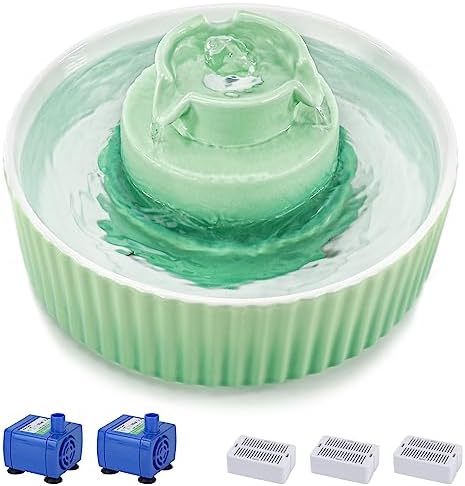
The 2.1L, 71-ounce reservoir is a meaningful number. That is a real amount of water for one or two cats, which means fewer refills and less chance the fountain runs dry on a day you are out on a long dog-walking route. A fountain that runs dry burns out the pump, and a burned-out pump turns a $50 purchase into a paperweight.
Ceramic has a second benefit that people only discover after the fact: chin acne. Mochi got spots from a plastic fountain years ago. Plastic holds bacteria in its scratches, and a cat's chin rests right on that surface every time she drinks. Switching her to ceramic cleared it up. If your cat has a spotty chin and drinks from plastic, that is your first thing to change, before you change anything else.
The tradeoffs are honest ones. Ceramic is heavy to carry to the sink, and one wrong drop on a tile floor is a real loss, not a scuff. I have broken a ceramic fountain while cleaning it, twice, which is exactly the kind of thing that should be in a review and never is. Handle it over the counter, not over the floor.
The other thing I check before I trust any fountain: can I get to the pump? A fountain with a hidden pump compartment is a slime trap, and hidden is usually hidden for a reason. My rule is that a full clean, including pulling and rinsing the pump, has to be under five minutes, because if it takes fifteen I will do it on Sunday instead of Wednesday, and by Sunday the water is not water anymore. Ease of cleaning is a health feature, not a convenience.
The cupcake shape is not just decoration either. A wider, lower basin is easier to scrub with a sponge than a tall narrow tower, and it gives a cat a surface to drink from without competing with the falling water if she is nervous about the stream.
Best for Grazing Cats: ZOMISIA Automatic Cat Feeder
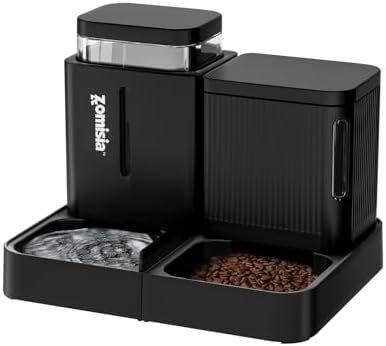
This is a gravity feeder with two 0.8 gallon reservoirs, and the honest description is that it is the least complicated thing in this guide. There is no auger, no portion wheel, no motor, and no app. Kibble falls from the reservoir into the tray as the tray empties. Nothing can jam because nothing moves.
For the right cat, that is a feature. If you have a grazer who nibbles six small meals a day and maintains a healthy weight, a gravity feeder solves the problem of the bowl being empty at 2 p.m. on a workday. Twin reservoirs mean you can run one and refill the other, or run both for a multi-cat household where nobody guards the bowl.
For the wrong animal, it is a hazard. Gravity feeders are for grazing cats, full stop. This is the gear category I most wish were never marketed to dog owners. Tank has learned to body-slam a gravity feeder until it dumps the entire reservoir onto the floor, and then he eats all of it. A dog that eats like that does not need a bigger bowl, he needs portion control, and portion control is the one thing a gravity feeder cannot provide. If your dog inhales meals, skip this section entirely and look at the slow feeder above.
The second thing to know is that a gravity reservoir is not a sealed hopper. Kibble sitting in an open column pulls humidity from the air, and San Diego humidity is mild compared to most of the country, which means if you live somewhere swampy this gets worse, not better. Stale kibble is the kind of thing cats notice and owners do not, and the fix is simply to fill it smaller and more often rather than dumping a whole bag in and walking away for two weeks.
There is one more argument in its favor that has nothing to do with features: no power. In eight years of sitting for other people's pets, I have dealt with a power strip kicked out of the wall, a router reboot, and one memorable thunderstorm that left a client's app feeder offline for a day and a half. A gravity feeder does not care about any of that. It is also the easiest of the three to move, which makes it the one I would hand to a client who travels.
How I tested
Every unit runs in my apartment with Mochi and Tank for a full month before it gets written about. Four rules, and they have not changed since the fourth returned feeder.
Can Mochi tip it or Tank break it? If the answer is yes, the review is over regardless of how good the specs look. Does the portion come out accurate when I weigh it on the kitchen scale, not eyeball it? For a gravity feeder the honest answer is that portion accuracy does not apply, because there is no portion, and pretending otherwise would be dishonest. How long does a full clean take, including the pump if there is one? And what happens when the power or the Wi-Fi dies, does the device still feed?
That last question is the one that shaped this whole guide. None of the three products here depend on an app, a login, or a router. After four returned feeders, that is not a small thing to me.
Analysis and test results
The pattern across all three products is the same: the mechanism is the product, and everything else is decoration.
On the slow feeder, the mechanism is friction. Ridges plus weight equals slower eating, and no software can replicate that as well as a ceramic maze can. On the fountain, the mechanism is circulation plus material. Ceramic keeps the water cooler and the surface cleaner than plastic, and circulation is what gets a reluctant cat to drink more, which matters more for a cat's long-term health than almost any other purchase in this guide. On the gravity feeder, the mechanism is the absence of one, and that is either exactly what you want or exactly what you must avoid, depending on whether your animal stops eating when it is full.
Materials matter more than features at this price level. Ceramic does not scratch, does not hold odor, and does not harbor the bacteria that causes chin acne. It is heavier, it costs more to ship, and it breaks if you drop it. I have made that trade twice now and I would make it again.
The noise question is mostly irrelevant here, and I say that as someone who takes decibel readings at dispense time on every motorized feeder. None of these three have a motor. The only sound in this setup is falling water, and Mochi drinks more because of it.
The feeding and hydration reference table
This is the table I keep for client handoffs. Capacity numbers come straight from the listings, the price column is a placeholder because prices move, and the "best for" column is the part that actually matters when you are matching gear to an animal.
| Gear | What it does | Capacity | Best for | Price |
|---|---|---|---|---|
 Visit on Amazon → LE TAUCI Ceramic Slow Feeder |
Slows eating by design, no power needed | 0.6 cups | Small breeds, cats, fast eaters | $17.59 |
 Visit on Amazon → Lawfery Ceramic Cat Water Fountain |
Circulates water, heavy ceramic base | 2.1L / 71 oz | Cats that tip bowls, chin acne | $35.99 |
 Visit on Amazon → ZOMISIA Automatic Cat Feeder |
Refills by gravity, no power, no app | 0.8 gal x 2 | Grazing cats only | $29.99 |
What I would skip
Anything that meters food with a rotating part and costs less than a decent dinner. The cheap no-name feeders jam in the second week. I have taken three apart and the auger tolerances are the problem, every time. If you want portion control on a budget, a ceramic slow feeder bowl does more for a fast eater than a bad motor ever will.
I would also skip a plastic fountain for a cat with a spotty chin. That is a material problem, and no filter fixes it.
Why ceramic keeps showing up in this guide
Two of the three products here are ceramic, and that is not a coincidence. Ceramic is heavy, which defeats tipping. It does not scratch, which defeats bacteria. It does not hold odor, which means you will actually keep using it. The cost is weight and fragility, and I have paid that cost in broken fountains twice. I still buy ceramic.
Should you buy the LE TAUCI Ceramic Slow Feeder?
Yes, if your fast eater is a small breed dog or a cat. The 0.6 cup capacity is sized for that, the ceramic weight keeps it planted on the floor, and the maze of ridges turns a ninety-second inhale into a real meal. It has no motor, no app, and nothing to jam, which after four returned feeders is exactly the kind of gear I trust. Skip it if you are feeding a large dog, because a large dog needs a large solution and this is not it.
Should you buy the Lawfery Ceramic Cat Water Fountain?
Yes, if your cat tips bowls or has a spotty chin. Ceramic is the only material Mochi has never flipped, and the 2.1L reservoir means fewer refills and less risk of a dry pump. Budget five minutes a week for a full clean including the pump, and handle it over the counter rather than over the tile, because ceramic does not forgive a drop. If you want the lowest-maintenance option and your cat drinks fine from still water, you can save the money.
Should you buy the ZOMISIA Automatic Cat Feeder?
Only for a grazing cat. Twin 0.8 gallon reservoirs, no power, no app, no auger, nothing to break. That simplicity is the entire value. If you have a dog that eats like Tank, do not buy this, because a gravity feeder in front of a speed eater is not a feeder, it is a buffet with no closing time.