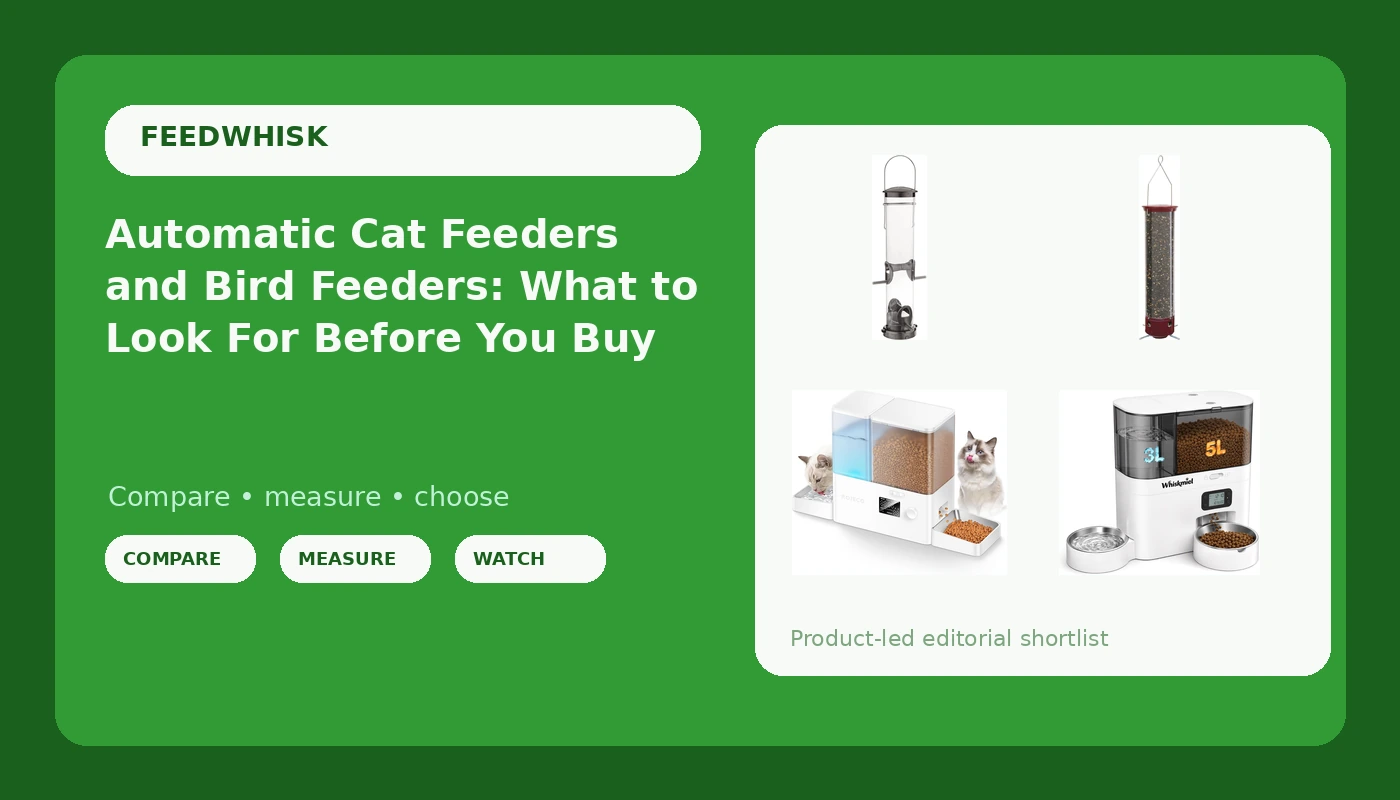
Feeding equipment is the rare purchase where the marketing photo and the daily reality almost never match. An automatic cat feeder and water dispenser promises to end the 5 a.m. wake-up meow; a tube feeder promises a yard full of finches by the weekend. Both promises live or die on the same four details: how food actually moves out of the hopper, how much the reservoir holds, how long a full clean takes, and what the device does when the power, the app, or the weather interferes. I have spent eight years as a pet sitter in Pacific Beach, and I have returned more feeders than I have kept. This is the framework I use before any unit comes into a client's home, and it applies just as well to the feeder hanging outside the window.
Related: How to Set Up a Feeding Station for Two Cats and a Dog →
Quick answer
Match the device to the animal's eating style before you read a single feature bullet. For indoor cats, that means portion control and water volume. For backyard birds, it means seed capacity and how easily the feeder comes apart for washing. No product here is called the quietest, fastest, safest, or best, because those distinctions require measurement conditions a product listing does not provide. The practical answer is simpler: choose a feeder whose dispensing mechanism you understand, whose reservoir matches how long you are actually away, and whose cleaning routine you will genuinely repeat every week. The app is a feature. The mechanism is the product.
Four useful options
| Model | Best fit | What stands out |
|---|---|---|
| 5L Automatic Cat Feeder & 3L Water Dispenser, Button Control | Multi-day feeding and watering from one indoor station | 5L food capacity and 3L water capacity with button control |
| ROJECO Automatic Cat Feeder & Water Dispenser,Button Customizable Feeding | Households that want scheduled meals without depending on a phone | Feeder and dispenser pairing with customizable button-based feeding |
| Aspects 392 Quick-Clean Seed Tube Feeder, Medium - Brushed Nickel | Backyard seed feeding where cleaning speed matters most | Quick-clean design in a medium tube format |
| Droll Yankees YCPD-90M Yankee Dipper Bird Feeder, 5 lb, Burgundy | Larger seed capacity for a busier backyard | 5 lb seed capacity in a burgundy Yankee Dipper design |
The combined indoor station: 5L Automatic Cat Feeder & 3L Water Dispenser, Button Control
The trade-off with a combined unit is that one failure takes out both jobs. If the water side gets slimy or the food side jams, you are hand-feeding and hand-watering until it is sorted, which is exactly the situation the purchase was supposed to prevent. That is why button control is worth more than it looks: a physical button means a feeding time can still be set and confirmed when the Wi-Fi drops, and it means no account creation before the first meal. Capacity is the other half of the math. Five liters of kibble is a lot of meals for one cat and a much shorter runway for two, so measure your actual daily volume rather than trusting the number on the box.
The customizable option: ROJECO Automatic Cat Feeder & Water Dispenser,Button Customizable Feeding
Customizable buttons matter most in households with a routine that is not a round number. A cat on a prescription schedule, or a pair of cats eating at slightly different times, needs portions that can be adjusted without deleting and rebuilding a whole program in an app. The counterpoint is that button programming is only as good as the documentation, and menus on the device are rarely as clear as a phone screen. Read the manual before the first fill, set one meal, and watch it dispense before you trust it with a full day away. If the portion that comes out does not match what you programmed, that is a return, not a workaround.
The cleaning-first seed feeder: Aspects 392 Quick-Clean Seed Tube Feeder, Medium - Brushed Nickel
Bird feeders fail for the same reason cat fountains do: they get gross, and then they stop getting cleaned. Wet seed clumps, hulls pile up under the ports, and a tube that takes fifteen minutes to disassemble becomes a tube that gets rinsed and refilled instead of washed. A quick-clean design shortens that loop, which is a health feature for the birds and a consistency feature for you. The medium tube format also suits mixed seed and smaller songbirds, while larger birds and squirrels will treat a tube feeder as a puzzle to solve. Placement, baffles, and distance from a fence line do as much work as the feeder itself.
The capacity play: Droll Yankees YCPD-90M Yankee Dipper Bird Feeder, 5 lb, Burgundy
A five pound capacity is a commitment as much as a convenience. It buys you days between refills, and it also means that when seed does go stale or damp, you are throwing out more of it at once. In humid coastal air, that argues for filling partway and topping up rather than packing it to the top and leaving it. Match capacity to traffic: a feeder that empties in two days is being used hard, and one that sits half full for a month is a mold risk with a perch attached.
Prices and availability may change. Product images, names, and retailer links are matched to verified listings. No current price, rating, stock status, or measured result is stated here without current evidence.
How portion control actually works
Automatic feeders dispense in one of two broad ways. An auger is a rotating screw that pushes kibble toward the opening, and it is the part that jams when kibble dust, broken pieces, or a single oversized treat gets into the channel. A portion wheel is a rotating compartment that fills and then dumps, and its accuracy depends on how consistently the compartments fill. Neither design is magic, and both depend on the food you put in them. Very small kibble sifts, very large kibble bridges, and a mix with freeze-dried pieces will behave differently than a uniform dry food.
This is why portion accuracy has to be verified rather than assumed. The only honest test is a kitchen scale: program a portion, catch what comes out, weigh it, and repeat across several meals and several days. If the delivered amount drifts, the feeder is guessing, and a cat that is supposed to be on a controlled diet is not on one. Gravity feeders, which refill a bowl from a reservoir, are a different category entirely. They offer no portion control at all, which makes them fine for a free-feeding grazer and a genuine hazard for a dog that eats like a shop vacuum.
Why cleaning and capacity decide the outcome
Every feeder in this guide is a container for something perishable. Kibble absorbs humidity and oils go rancid; seed grows mold when it gets wet. The reservoir you never wash becomes the reason the animal stops eating, and the failure looks like pickiness rather than a maintenance problem. A weekly routine that takes under five minutes is the only routine that survives a busy month, so cleaning access belongs in the same conversation as capacity, not in a footnote.
Water is the same story with higher stakes. Cats are notoriously poor drinkers, and a fountain or dispenser that runs quietly but hides its pump behind a sealed housing will build up biofilm where you cannot see it. If the pump cannot be reached and scrubbed, the device is a slime trap with a nice finish. Pair that with capacity: a 3L reservoir is a real buffer for a weekend away, but it is not a substitute for a mid-trip check if the household has more than one cat.
- Count how long you are actually away, then choose capacity with a margin for a delayed return.
- Confirm the dispensing mechanism and whether you can clear a jam without tools.
- Program one meal first and verify the delivered portion on a kitchen scale.
- Time a full disassembly and wash before the first fill, not after the first mess.
- Decide what the device does when power, Wi-Fi, or weather fails, and plan a backup meal.
Practical guidance
- Set the feeder up a week before you travel, not the night before, so a jam surfaces while you are home.
- Keep the hopper sealed and store the rest of the bag somewhere dry, since humidity is what turns kibble soft.
- Wash water reservoirs and fountains weekly, and reach every surface the water touches, including the pump.
- For bird feeders, clean more often in wet weather and discard clumped seed instead of topping over it.
- Use a baffle and thoughtful placement if squirrels or larger birds are emptying the feeder faster than the birds can.
- Watch the animal, not the app: a cat that stops meeting you at the bowl is telling you something.
Which option should you choose?
Choose the 5L Automatic Cat Feeder & 3L Water Dispenser, Button Control when you want feeding and watering handled from a single station and you would rather press a button than open an app. Choose the ROJECO Automatic Cat Feeder & Water Dispenser,Button Customizable Feeding when your schedule is irregular and you want portions you can adjust directly on the device. Choose the Aspects 392 Quick-Clean Seed Tube Feeder, Medium - Brushed Nickel when the feeder is going in the yard and the wash routine is the part you know you will skimp on. Choose the Droll Yankees YCPD-90M Yankee Dipper Bird Feeder, 5 lb, Burgundy when your backyard traffic is heavy enough that refills are the bottleneck.
One caveat applies across all four: a listing describes a design, not a guarantee of behavior in your home. Portion accuracy, jam resistance, and cleaning time are things you confirm in your own kitchen, with your own food, over your own first month. Keep the packaging and the return window until you have watched a full week of meals land correctly, because that is the only evidence that counts.
The bottom line
Buy for the mechanism and the maintenance routine, and treat connectivity as a bonus rather than a requirement. A feeder that dispenses accurately and comes apart easily will still be in service a year from now, whether it is dropping kibble for a cat or seed for a house finch. Check the capacity against your real schedule, verify the portion once it arrives, and clean it on a cadence you can keep. That combination solves the actual problem, which was never about the app in the first place.