Portion control feeding is the whole job in a two-pet house. One animal needs meals on a clock, and the other needs to stop inhaling them. Get either half wrong and you spend the week cleaning up the consequences: a cat that screams at 4 a.m. because dinner was late, or a dog that brings up undigested kibble on the rug because he ate a cup of food in forty seconds.
I run a tortoiseshell cat named Mochi and a 75-pound lab mix named Tank, and I run both of them on two pieces of gear I have tested for months in my own apartment. The setup is not complicated. A timed feeder handles the cat. A slow feeder bowl handles the dog. The rest is measuring, placement, and a maintenance routine you will actually keep.
Here is how I do it at home, and how I set it up in client houses.
Why you should trust me
I have been pet sitting and walking dogs in Pacific Beach for eight years, with a client list that has passed 60 households. That work is where I learned what a feeding failure actually costs. I watched a diabetic cat miss a meal because a feeder jammed. I have cleaned up after a beagle that chewed through a feeder at 3 a.m. I have returned four automatic feeders over 14 months: one with a jammed auger, two whose portion wheels over-fed by a wide margin, and one app-connected unit that quit feeding when the Wi-Fi hiccuped.
Every unit I recommend now spends a full month in my apartment first, with Mochi and Tank, before it goes into a client's home. I weigh portions on a kitchen scale, I listen for jams, I time the cleaning, and I watch what Tank does to anything he can reach.
How I picked and how I tested
This guide is about a two-part setup, not a shopping spree. The question I answer with every feeder is simple: does the dispense mechanism still work in week four, and does the portion match what I programmed? I check that on a kitchen scale, not by eyeballing a bowl. A portion wheel that runs fat by a wide margin will quietly turn a diet into a weight problem.
For the dog side, the test is different. Tank eats like a shop vac and has learned to body-slam gravity feeders until they dump. So a slow feeder gets judged on three things: does it actually slow him down, does it stay put on a hard floor, and can I clean dried kibble out of the maze without a bottle brush and a bad attitude.
The links below are affiliate links, which is how this site keeps the lights on. It does not change what ends up in my kitchen, because I have to live with the same products my clients do.
The two tools this setup needs
You need a timed feeder for the animal that needs meals on a schedule, and a slow feeder bowl for the animal that eats too fast. That is the whole kit. Everything else in this guide is process.
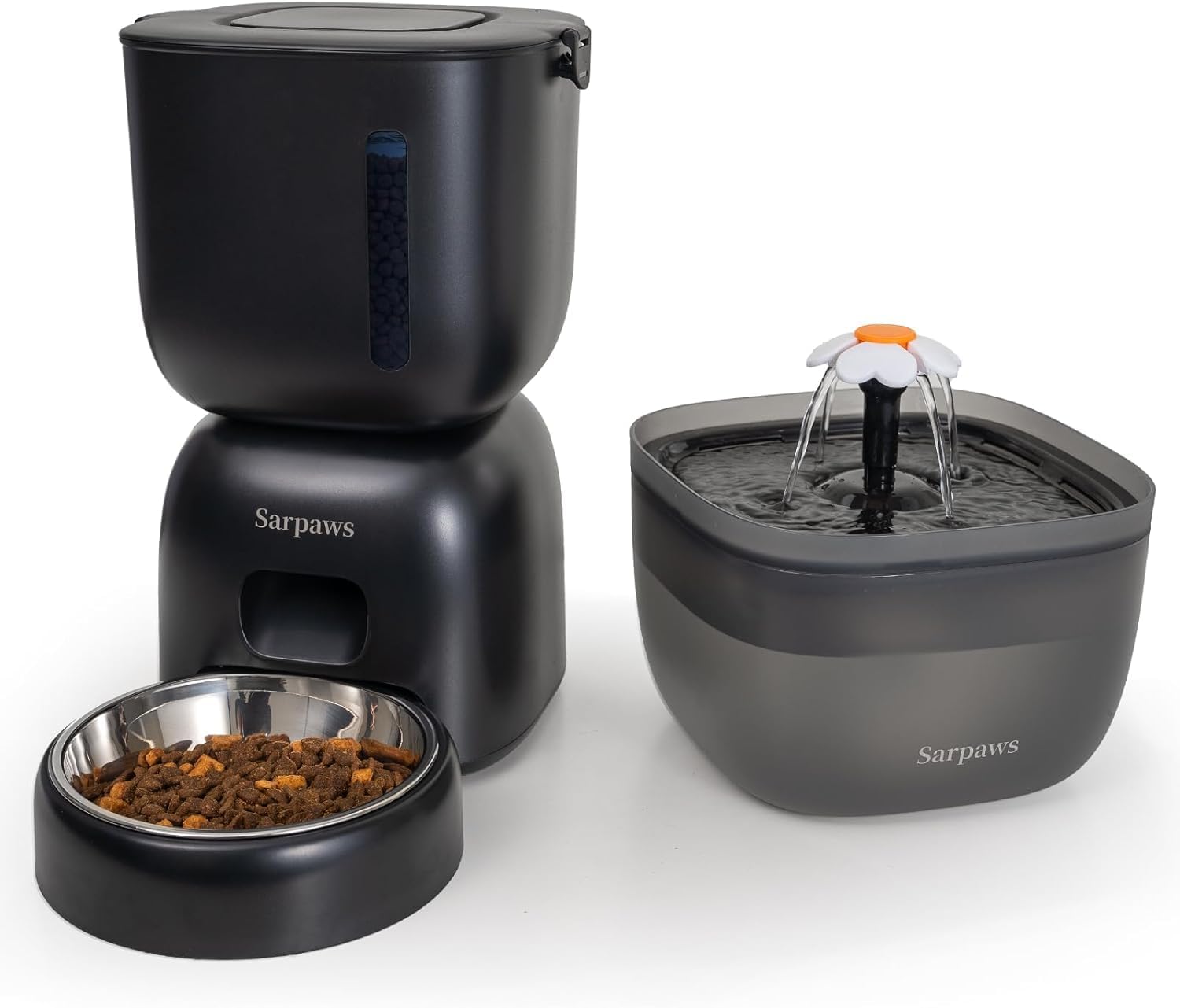
The timed feeder: Automatic Cat Feeder and Water Dispenser FW1, Wire or Battery Cat Food Dispenser Timer Pet Feeder - Locking Lid, Desiccant Bag, Programmable Portion Control, 4 Daily Meals, 10s Voice Recorder
 Visit on Amazon →
This is the unit I keep for Mochi. The parts that matter to me: a locking lid, a desiccant bag in the hopper, programmable portion control, four daily meals, and a 10-second voice recorder. It runs on wire or batteries, which is the feature I care about most after four returned feeders. When the power blinks during a San Diego heat wave, a battery-backed feeder keeps feeding. An app-connected feeder with no battery tray does not.
The locking lid is the answer to a cat like Mochi, who has opened every latch I have ever brought home. The desiccant bag is the answer to humidity, which softens kibble and makes a jam more likely. The voice recorder sounds like a gimmick until you use it. A cat who hears your voice at meal time comes to the bowl instead of sitting on your chest at 5 a.m.
Flaws but not dealbreakers: This is not an app feeder. You program it on the unit, and you change the schedule by walking over and pressing buttons. If you want to change a portion from your office, this is not the product for you. If you want a feeder that keeps working when your router dies, it is.
The four-meal limit is a real limit. Cats who need more frequent small meals for a medical reason need a different plan, not a different feeder setting.
Anyone who wants a cat fed on a schedule without an app account should start here.
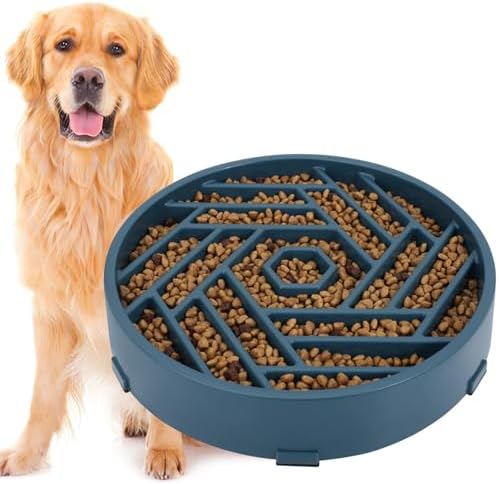
The slow feeder: TOBYTO Slow Feeder Dog Bowls Large Medium Breed,Anti-Choking Slow Eating Dog Food Bowl,Non Slip Pet Slower Food Feeding Bowls Large Puzzle Slow Feeder Bloat Stop Maze Dog Dishes,Black
 Visit on Amazon →
This is the bowl in front of Tank. It is a maze bowl, which means the kibble sits in ridges and channels instead of a pile, and the dog has to work the food out with his tongue and muzzle instead of vacuuming it up. It is built for large and medium breeds, it has a non-slip base, and the whole thing is designed around choking and bloat risk in fast eaters.
For Tank, the difference is not subtle. Same amount of kibble, much slower meal, and none of the post-dinner gulping and pacing that used to make me nervous. If you own a dog that eats like mine, you already know why that matters. Bloat is not a training problem, it is a medical emergency, and pace at the bowl is one of the few things you can actually control.
Flaws but not dealbreakers: A maze bowl is more work to clean than a plain bowl. Kibble dust and saliva collect in the channels, and if you let it dry you will be scraping. I rinse mine right after dinner and run it through a hot wash weekly. The other caveat is that a determined dog can still flip a light bowl. The non-slip base helps on tile and hardwood, but it grips less on carpet. If your dog is a paw-flipper, push it against a wall.
Anyone with a large or medium breed that finishes a meal in under a minute should own one of these.
The actual setup workflow
Now the steps. This is the order I do it in, at home and in client houses.
Step one: Find out how much your pet should actually eat. Ask your vet, read the bag, and then measure with a kitchen scale, because a cup scooped by hand varies a lot depending on how you scoop it. Write the number down. Every setting below depends on it.
Step two: Count the meals you can honestly deliver. The feeder handles four meals a day. Most adult cats do well on two or three. If your cat needs more frequent small meals for a medical reason, that is a conversation with your vet before it is a conversation with me.
Step three: Program the feeder before you put food in it. Set the meal times, set the portions, then fill the hopper. I program first because it is easy to get distracted by a cat winding around your ankles and end up with a feeder that dispenses at the wrong hour.
Step four: Lock the lid and drop in the desiccant bag. The desiccant is what keeps kibble crisp in coastal humidity. Replace it on the schedule the manufacturer gives you. A saturated desiccant bag is decoration.
Step five: Record the voice clip. Ten seconds is longer than you think. Say the pet's name and whatever you say at dinner. Do not shout. The point is a familiar cue, not a fire alarm.
Step six: Decide on power. Wire if the feeder sits near an outlet your pet cannot reach. Batteries if you have a chewer, a cord-chasing cat, or a house where the power blips. I run batteries as the backup even when the unit is plugged in, because the whole point of a timed feeder is that it feeds when you are not there to notice a problem.
Step seven: Place the feeder where the cat can eat without being ambushed. Not next to the dog's bowl. Not in a hallway with foot traffic. Cats will skip a meal to avoid a dog, and a skipped meal looks exactly like a jammed feeder from the outside.
Step eight: Transition over a week. Run the feeder alongside your normal routine for a few days. Check the bowl after each dispense. Weigh one portion on the kitchen scale during the first week, then again a couple of weeks later. Portion accuracy can drift, and a scale catches it before your cat's waistline does.
Step nine: Set up the slow feeder. Put the measured portion into the maze, not a scoop and a guess. Set it on a hard, level surface so the non-slip base can do its job. Feed the dog in a separate room from the cat, at least at first, so nobody trades bowls.
Step ten: Supervise the first three meals on both devices. Watch the feeder dispense. Watch the dog work the maze. This is when you learn whether the kibble size you buy actually moves through the mechanism, and whether your dog's frustration is productive or just frustrating.
Step eleven: Build the weekly maintenance routine. Rinse the slow feeder after meals and wash it weekly. Wipe the feeder's dispense chute. Check the hopper for dust and crumbs. Check the desiccant. Weigh one portion. It takes a few minutes, and it is the difference between a feeder that works for years and one that quits on a Sunday.
Step twelve: Have a backup plan. If your pet is on medication-timed meals or has a medical condition, a feeder is a convenience, not a medical device. Keep a neighbor's number and a manual backup. I have watched a jammed feeder cost a diabetic cat a meal, and no feature list is worth that.
What this guide leaves out
Two things, on purpose.
Gravity feeders. A reservoir on top of a bowl that refills itself is fine for a grazing cat and dangerous for a dog that eats like Tank. A fast dog can empty a gravity feeder in minutes, which defeats the entire point of portion control. If your dog eats fast, the answer is a measured portion and a maze bowl, not a bigger pile.
A "slow feed" mode on an automatic feeder. Dispensing one small meal at a time is a diet plan, not a slow feeder. It changes how often food arrives, not how fast your dog eats it. Those are different problems with different tools, and the bowl is the cheaper fix.
I also left fountains out of this piece, mostly because a fountain is a hydration tool, not a feeding tool, and its cleaning routine deserves its own article. The short version of my position: if you cannot see and reach the pump, do not buy the fountain.
What this all costs
Both pieces here are one-time purchases. The ongoing costs are kibble, batteries if you run the feeder on battery, and replacement desiccant bags. That is it. There is no subscription and no app account required to feed your cat on time.
Compare that to the alternative. A dog that bolts its food is a dog at higher risk for bloat and choking. A cat fed at random hours is a cat that yells at you at 4 a.m. and, in some households, a cat that gets overfed because everyone thinks nobody fed her. Both of those are expensive problems in their own way.
Check current Amazon price on both, then spend your real energy on the setup steps above. The gear is the easy half.
The bottom line
Portion control feeding is a two-part habit. Measure the food, schedule the meals, slow down the fast eater, and keep the whole thing clean enough that you will actually run it next week. A timed feeder with a locking lid and a battery backup covers the cat. A maze bowl covers the dog. Everything else is you, doing the measuring once and the maintenance weekly.
Mochi still tips her water bowl when she thinks I am ignoring her. Some problems are not product problems. But she gets fed on time, Tank eats like a normal dog instead of a shop vac, and I have not cleaned up a 3 a.m. kibble explosion in months. That is the win.