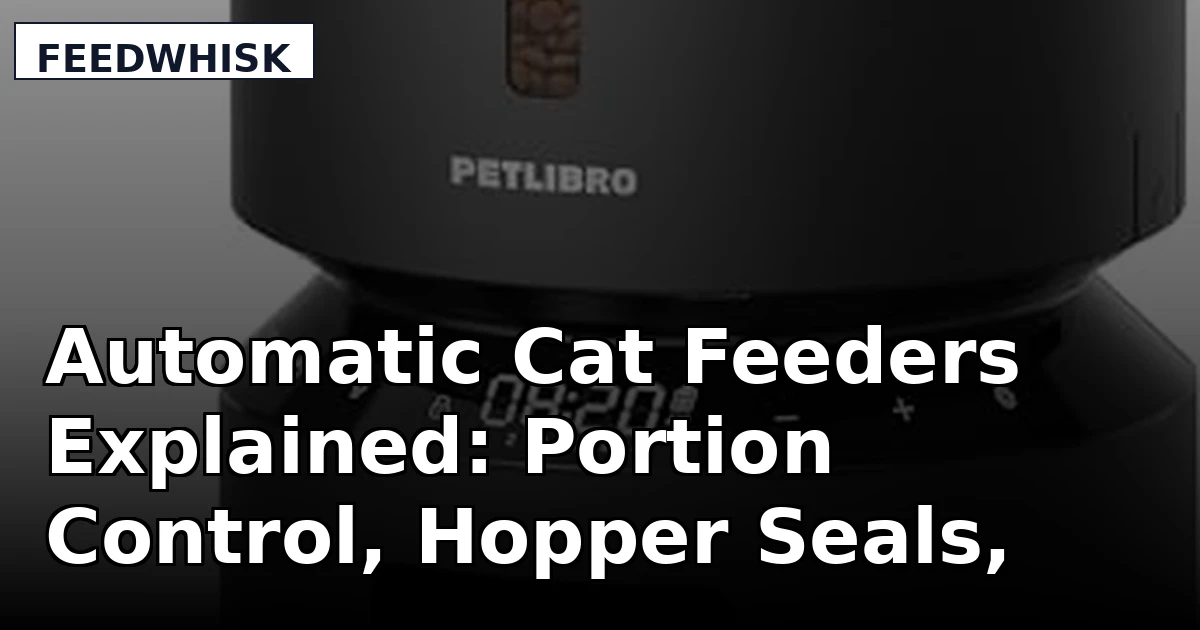
An automatic cat feeder is a portioning machine, not a food bowl with a timer bolted on. That distinction matters the moment you start shopping, because nearly every complaint about these devices traces back to one of three parts: the mechanism that meters kibble out of the hopper, the seal that keeps that kibble fresh between meals, and the bowl or bowls the food actually lands in. If one of those three fails your household, the app, the voice recording, and the battery backup will not rescue the situation at 6 a.m.
This guide breaks down four current feeders that handle those three jobs in different ways. One is a single-bowl unit with sealed storage and a programmable schedule. Two are the same dual-bowl, 6-liter design sold under separate listings. One is a feeder-and-water-dispenser combo aimed at people setting up a first feeding station. None of them is a universal answer, and that is the point.
Related: How to Build a Feeding Schedule Your Cat Actually Follows →
Quick answer
For a single cat or a single feeding station, the PETLIBRO 3L feeder is the option here that pairs a sealed 3-liter hopper with timed portion control, a voice meal call, and dual power supply. For two cats eating at the same time, the VOLUAS 6L feeder with dual stainless bowls is built around that exact scenario, and because it appears under two separate listings, comparing both is worth the extra click. For a first setup that covers food and water in one purchase, the FW1 feeder and water dispenser runs on wire or batteries, holds four programed meals a day, and includes a 10-second voice recorder. The deciding factor is almost never the app. It is how many animals eat, how fast they eat, and how much kibble you need to store.
Four useful options
| Model | Best fit | What stands out |
|---|---|---|
| PETLIBRO Automatic Cat Feeder, 3L | One cat or one bowl | 3L hopper with airtight storage, timed portion control, voice meal call, dual power supply |
| VOLUAS Automatic Cat Feeder for Two Cats, 6L | Two cats eating together | 6L capacity with dual stainless steel bowls on one base |
| VOLUAS Automatic Cat Feeder for Two Cats, 6L (second listing) | Comparing the same model across listings | Same dual-bowl 6L design offered under a separate listing |
| Automatic Cat Feeder and Water Dispenser FW1 | First-time buyers wanting food and water together | Wire or battery power, locking lid, desiccant bag, 4 daily meals, 10-second voice recorder |
The sealed-hopper pick: PETLIBRO Automatic Cat Feeder
The airtight claim is the one worth paying attention to, because kibble sitting in an open hopper absorbs whatever the room is doing. Coastal humidity, kitchen steam, and the general dampness of a laundry room all soften dry food over days, and softened kibble is one of the quieter reasons a feeder starts delivering inconsistent portions. A sealed 3-liter bin addresses that directly, and it also keeps out the pantry moths and dust that find their way into anything left uncovered.
The dual power supply is the second feature that earns its place. A feeder that runs on an adapter with battery backup keeps its schedule when the outlet loses power, which is the difference between a missed meal and a non-event. The trade-off is a 3-liter capacity, which suits one cat or a small dog eating a measured amount per day, not a multi-pet household where everyone queues up at the same bowl.
The dual-bowl pick: VOLUAS Automatic Cat Feeder for Two Cats
Two bowls on one base is not the same thing as two feeders, and the difference shows up in behavior. Cats in particular are sensitive about eating shoulder to shoulder, and a bowl wide enough to share often means one cat eats and the other watches. Two distinct stainless bowls give each animal its own landing zone, and stainless is the material worth having because it does not hold onto oils and odors the way scratched plastic does.
The 6-liter hopper is the other half of the argument. In a two-cat home, food disappears roughly twice as fast, and a capacity that needs refilling every third day turns an automatic feeder into a manual chore with extra steps. The trade-off is footprint. Two bowls plus a 6-liter reservoir take up real floor space, so plan the placement before you buy rather than after.
The matching second listing: VOLUAS 6L, alternate version
It is worth being blunt about this one: the name, the capacity, and the bowl setup are identical to the listing above. Two separate Amazon listings for the same specification is common, and it creates a specific shopping hazard. Reviews, availability, and seller can differ between them even when the product does not, so the version you read about is not always the version you add to your cart.
Practically, that means opening both listings side by side before you commit, and confirming which one you are actually buying. If you are comparing this feeder against a single-bowl unit, the specification that matters here is unchanged: 6 liters of storage and two stainless bowls. If you are comparing the two listings against each other, you are comparing sellers and availability, not hardware.
The starter combo: FW1 Feeder and Water Dispenser
The locking lid and the desiccant bag are the two details that tell you this unit was designed by someone who has thought about storage rather than just schedules. A lid that stays shut keeps a curious cat out of the hopper between meals, and a desiccant bag actively pulls moisture out of the enclosed space instead of merely slowing it down. Four programable meals a day covers the standard twice-daily routine with room to split portions further.
The 10-second voice recorder is the feature people either love or ignore, and it works best as a cue rather than a gimmick. A short recording in your own voice, played at dispensing time, gives pets a consistent signal that food is arriving, which is genuinely useful during the first week of a transition. The trade-off is that this is a combo unit: one integrated feeder and dispenser set rather than two separate devices you can position independently. If your cat drinks in one room and eats in another, that matters.
Prices and availability may change. Product images, names, and retailer links must be matched by verified ASIN. Do not state a current price, rating, stock status, or measured result without current evidence.
How portion control and storage actually work
An automatic feeder has four mechanical jobs, and most failures trace to one of them. First, the hopper stores kibble. Second, a metering system, usually a rotating portion wheel or an auger screw, moves a set volume of food toward the opening. Third, a motor drives that mechanism on a timer. Fourth, the food lands in a bowl. When people say a feeder "over-fed" or "jammed," they are describing a problem in the second step, and it is almost always a tolerance issue: kibble that is slightly too large, too small, or too irregular for the wheel or screw to move cleanly.
That is why "clog-free" is a design statement rather than a guarantee. Kibble size varies enormously between brands, and a feeder tuned for a standard 8-millimeter piece can struggle with a large breed formula or a tiny pellet. Before you commit to any feeder, check your food against the manufacturer's recommended kibble dimensions. It is the single most useful piece of pre-purchase research available, and it costs nothing.
Storage is the second half of the equation. Dry food exposed to air picks up moisture and loses crispness, and in humid climates that happens faster than most people expect. A sealed hopper slows it down. A desiccant bag slows it further. Neither replaces the basic habit of buying food in quantities you will finish in a reasonable window, but both make a multi-day hopper realistic instead of optimistic.
Power is the third piece. A feeder on an adapter with battery backup keeps its schedule through an outage. A battery-only unit depends entirely on your diligence about replacing cells. If the whole reason you bought the device was that you would not be home, the backup path is the feature you cannot skip.
Matching the feeder to the animal, not the marketing
The most common mismatch is a grazing cat sharing a home with a speed eater. A cat that nibbles a few pieces at a time is well served by a scheduled feeder that delivers small portions through the day. A dog that inhales everything in front of it will empty a shared bowl before the cat arrives, which is how a two-pet household ends up with one overfed animal and one underfed animal. Dual bowls help only if the animals can be separated at feeding time or trained to their own stations.
Multi-cat homes add a second layer: resource guarding. Two bowls on one base reduce competition for a single dish, but they do not stop one cat from shouldering the other aside. If that is happening in your house, the fix is placement and separation rather than a different feeder, and it is worth addressing before you spend money on capacity you cannot use.
Small dogs change the calculation again. A 3-liter hopper with portion control suits a small dog well, but the bowl height and the kibble size both matter more than the schedule does. Feeders designed for cats and small dogs generally assume a smaller kibble, so check that your dog's food fits the mechanism before assuming any unit will work.
Finally, think about what happens when the smart features fail. A feeder with a phone app and a cloud account should still dispense on its saved schedule if the network drops. If it cannot, you have bought a remote-controlled bowl, not an automatic feeder. The schedule that lives on the device is the one that feeds your pet.
The decision sequence that holds up across every household looks like this:
- Count the animals eating from the feeder and decide whether they eat separately or together.
- Measure your actual daily food volume so you know whether a 3L or 6L hopper is the right size.
- Check your kibble dimensions against the feeder's supported range before buying.
- Confirm the unit has a power path that survives an outage, either an adapter plus batteries or a reliable battery routine.
- Decide where the feeder will live and measure the footprint, especially for dual-bowl units.
Practical guidance before you buy
- Weigh your current portions with a kitchen scale for a week. Knowing your actual daily volume makes hopper size a calculation instead of a guess.
- Store only what the hopper will hold for a few days. Long-term kibble storage belongs in the original bag or an airtight container, not in a hopper you refill monthly.
- Test the dispense mechanism with your real kibble in the first week, watching for crushed pieces, partial drops, or doubles.
- Clean the bowl and the hopper on a schedule you will actually keep. Oils from kibble build up on plastic and stainless alike, and a feeder you dread cleaning becomes a feeder you stop cleaning.
- Set the schedule a week before you need it. Running a new feeder while you are home reveals problems while you can still fix them.
Which option should you choose?
Choose the PETLIBRO Automatic Cat Feeder when one cat or one small dog eats from a single station and you want sealed 3L storage, a programmed schedule, a voice meal call, and dual power supply in one unit. Choose the VOLUAS Automatic Cat Feeder for Two Cats with Dual Stainless Bowls, 6L when two cats eat at the same time and you want separate stainless bowls plus enough capacity that refilling is not a daily task, checking both listings before you commit. Choose the FW1 Automatic Cat Feeder and Water Dispenser when you are setting up a first automated station and prefer one purchase covering food and water, with wire or battery power, a locking lid, a desiccant bag, and a 10-second voice recorder.
Whichever you pick, the honest limitation is the same across all four: the specifications above come from the product listings, not from independent measurement. Portion accuracy, noise at dispensing, and real-world jam resistance vary with the kibble you use and the way the unit is set up, so treat the first two weeks as a trial period and confirm the return window before you commit.
The bottom line
The right automatic feeder is the one whose mechanism, hopper, and bowl layout match your household, and that is a question about your animals rather than about features. A sealed 3L single-bowl unit like the PETLIBRO suits one pet eating measured meals. A dual-bowl 6L design like the VOLUAS, in either of its two listings, suits two cats eating side by side. The FW1 combo covers food and water together for someone starting from scratch. Match the capacity to your actual daily volume, confirm your kibble fits the mechanism, and make sure the unit keeps feeding when the power or the Wi-Fi does not.