Most automatic cat feeder setup guides start with the app. That is the wrong end of the machine. The app is a convenience layer, and it is usually the first thing to fail. The auger, the portion wheel, and the hopper are the product, and they decide whether your cat eats at 6 a.m. or yells at your bedroom door until you get up.
I have set up feeders in more than 60 client households around Pacific Beach and in my own apartment, where a tortoiseshell cat named Mochi treats every bowl as a challenge and a 75-pound lab mix named Tank treats every feeder as a puzzle box. Between the two of them I have learned that almost every "my feeder is broken" complaint is really a setup problem. Wrong kibble. Wrong floor. Wrong portion size. Or a machine that was never tested with the Wi-Fi unplugged.
This is the order I use now. It takes about half an hour, plus a week of transition, and it is the difference between a feeder that works for years and a feeder that gets returned in a month.
Why you should trust me
I have been pet sitting and dog walking in Pacific Beach for eight years, and my client list runs past 60 households. That is a lot of kitchens with a feeder in the corner, and a lot of texts that start with "the feeder didn't go off."
I have returned four automatic feeders. One had an auger that jammed in the second week. Two had portion wheels that over-fed, which I only caught because I weigh servings on a kitchen scale. One was app-connected and stopped feeding entirely when the Wi-Fi hiccuped. Those returns taught me more than any spec sheet ever did, and they are why nothing gets recommended here until it has run a full month in my apartment with Mochi and Tank.
Mochi is a tortoiseshell who tips water bowls on purpose, because she has decided that still water is an insult. Tank is a 75-pound lab mix who inhales kibble and has learned to body-slam gravity feeders until they dump. If a feeder survives both of them, it can survive your house.
How I judge a feeder before it earns a spot
Four questions, in this order.
Can the animal break it? Design for the pet, not the marketing photo. A feeder a determined cat can unlatch will be unlatched. A hopper a dog can knock over will be knocked over. Secure lids and a stable base are not premium features, they are the baseline.
Does the portion come out accurate? The portion wheel is the rotating compartment that meters each serving. Dispense accuracy means the delivered portion matches the number you programmed, and the only way to know is to weigh it. Eyeballing a bowl tells you nothing.
How long does a full clean take? If a hopper and bowl take more than a few minutes to break down, you will skip it, and old kibble oils go rancid in a sealed bin. Ease of cleaning is a health feature, not a convenience.
What happens when the app dies? Unplug the router, pull the cord, and see if the unit still feeds on its schedule. If the answer is no, the device is a Wi-Fi gadget that happens to hold kibble.
The auger is the product. The app is a feature. If a feeder fails the first three questions, the app does not save it.
The two units I would set up first
Both of these are dry food feeders with a programmable schedule. One adds a water fountain so the whole job lives in a single app. The other is the plain, cheap, single-job machine I would put in a client's kitchen when the budget is tight and the cat just needs to eat on time.
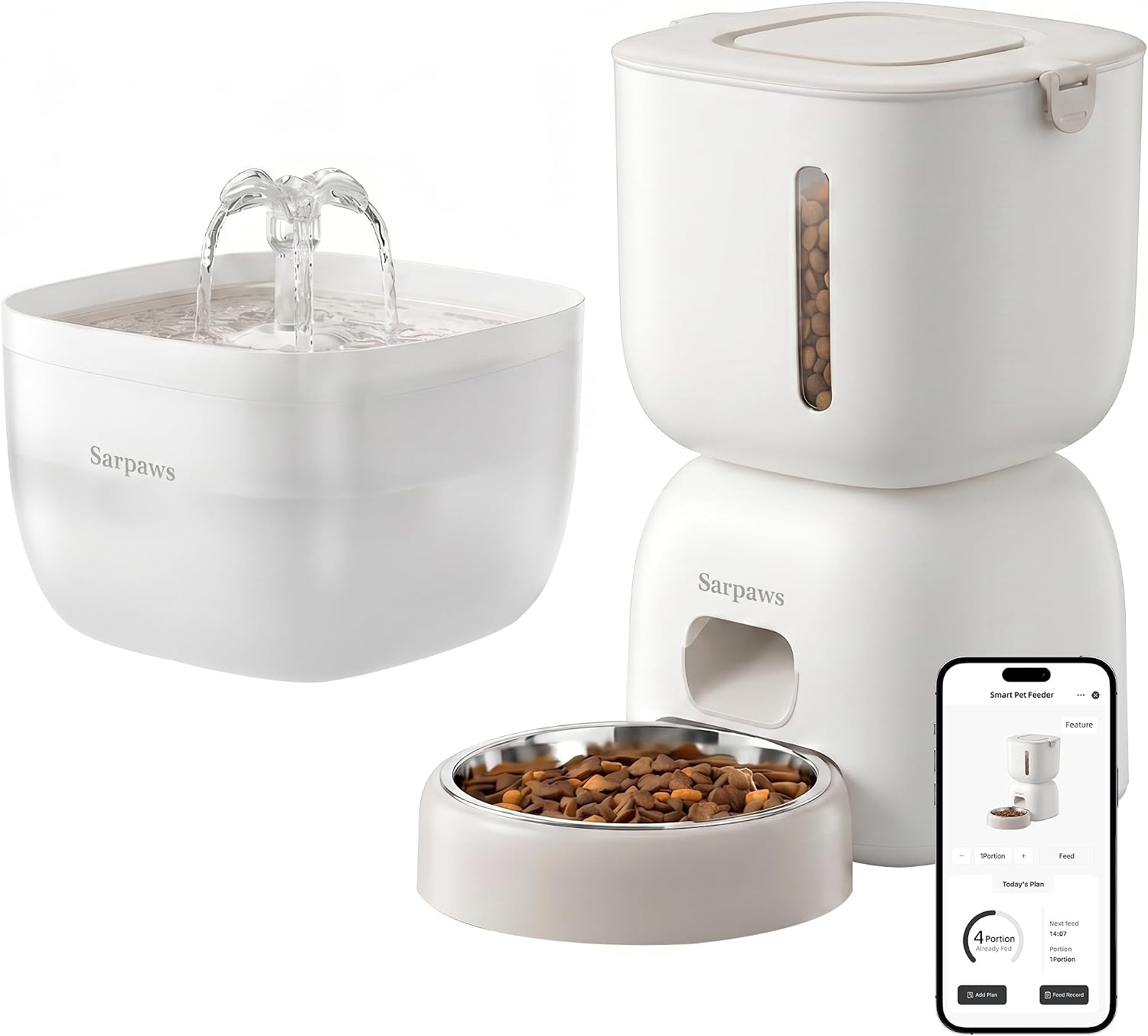
Best all-in-one: SARPAWS WiFi Automatic Cat Feeder and Water Fountain Set
 Visit on Amazon →
The SARPAWS set is what I would hand a client who wants one purchase to cover both jobs. You get a 3L feeder and a 2L waterer in the same box, both reachable from the same app, and the food bowl is 304 stainless steel instead of plastic. That last detail matters more than the spec sheet suggests. Plastic bowls are a common trigger for feline chin acne, and stainless is the swap most vets suggest first.
The feeder records a 10-second voice clip, so you can call your cat to the bowl in your own voice instead of a beep. Dual power means it runs on the cord with a battery backup behind it, and the secure lock is there for the cat that has already figured out how the lid works. The 2L waterer is listed as quiet, which is the fountain spec I care about most, because a noisy pump is the reason people unplug fountains at 2 a.m. and never plug them back in.
What to watch: Two devices means two cleaning jobs. The food bowl needs a rinse every couple of days, and the fountain needs a full teardown, pump included, once a week. If you will not do that, buy a feeder only and leave out a plain water bowl you change twice a day.
Who it is for: Anyone who wants feeding and hydration handled from one place, especially if you travel or work long shifts and want to adjust both from your phone.
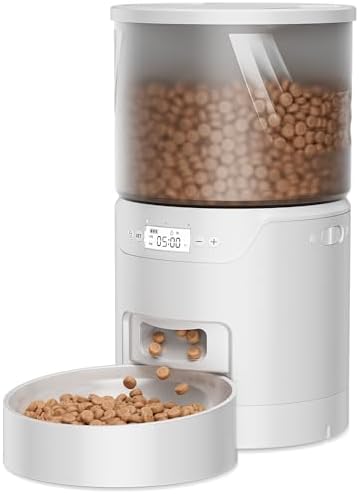
Budget pick: IMIPAW PET Automatic Cat Feeder
 Visit on Amazon →
The IMIPAW is the single-job machine. It holds 3L of kibble, programs up to 6 meals, and meters portions across a 1 to 20 range, which is more granularity than most cats will ever need. It is built for indoor cats on a timed schedule, and it is designed to be easy to clean and easy to set up, which is the pair of features that actually determines whether a feeder gets used.
The desiccant bag is the detail I would point at first. A hopper holds kibble for weeks, and kibble that sits in humid air goes soft and stale. San Diego humidity is mild compared to a Florida kitchen, but I have still opened client hoppers that smelled like a pantry that gave up. A desiccant bag is a cheap fix for a real problem.
What to watch: There is no fountain in this box, so you are still handling water separately. And no spec sheet tells you how a feeder handles your specific kibble. Buy one bag of the food you actually use, run a full hopper through it, and watch for jams before you build a schedule around it.
Who it is for: A single indoor cat, a tight budget, and an owner who wants timed meals without paying for an app ecosystem.
The actual setup workflow
This works on either unit, and on most timed feeders. Do it in order.
Step one: Wash everything before the first fill. Hoppers and bowls ship with manufacturing dust and warehouse grit. Warm water, mild soap, full dry. A damp hopper is how you grow mold in week one.
Step two: Pick the floor, not the corner. Put the feeder on a hard, level surface, not carpet, because carpet lets a determined cat drag the unit. Keep it away from the water bowl, since many cats prefer to drink away from where they eat. Run the cord where no dog can chew it, and leave a hand's width of clearance behind the unit so the dispense chute does not back up against a wall.
Step three: Match the kibble to the auger. Small, uniform, dry pieces feed cleanly. Oversized or irregular pieces are what jam a dispense mechanism, and the jam shows up around week two, after the honeymoon phase. If your cat eats a chunky kibble, this is the moment to find out, not at 5 a.m. on a Tuesday.
Step four: Calibrate one portion on a kitchen scale. Program a single portion, dispense it into a bowl sitting on a scale, and repeat three times. If the three weights are close to each other, the wheel is consistent. If the delivered amount does not match what you intended to feed, adjust the portion setting until it does. This is the step almost nobody does, and it is the reason so many cats quietly gain weight on a "measured" diet.
Step five: Build the schedule around the routine your cat already has. Do not invent a new feeding time because it is convenient for you. If your cat eats at 7 and 6, program 7 and 6. Consistency is the entire point of an automatic feeder, and a diabetic cat on a twice-daily schedule is the clearest example of why.
Step six: Record the clip and test the volume. Call your cat the way you actually call her, not in a fake cheerful voice. Play it back at the unit and stand in the next room. If you cannot hear it, neither can she.
Step seven: Test the failsafe before you trust it. Put batteries in, unplug the power cord, and unplug your router. Confirm the feeder still dispenses on schedule. A feeder that only works while the internet is up is a feeder with an outage plan you did not agree to.
Step eight: Run it beside the old bowl for a week. Keep the old bowl in place, slightly emptier each day, while the feeder delivers the same food. Cats are suspicious of change, and a feeder that appears next to a familiar bowl reads as furniture instead of a threat.
Step nine: Set the fountain up away from the food. If you are running the SARPAWS set, keep the waterer a few feet from the feeder, on a hard floor, with the pump fully seated. A fountain that burbles unevenly is usually a pump that is not clicked in, not a broken pump.
Step ten: Lock in a weekly maintenance rhythm. Rinse the bowl, check the hopper for dust and oil buildup, swap or dry the desiccant, and tear down the fountain pump. Five minutes a week keeps the machine from becoming a science project.
What I skip, and why
Gravity feeders are for grazing cats only. A bowl with a reservoir on top refills itself, which is fine for a cat that nibbles, and dangerous for a dog like Tank who will eat until the reservoir is empty and then look for more. Dogs that eat like that need portion control or they need a vet bill. There is no third option.
I also skip the no-name auger feeders. I have taken three apart, and the tolerances in the dispense mechanism are the problem every single time. The housing looks fine. The wheel is where it fails.
"Slow feed" modes that dispense one small meal a day are a diet plan, not a feeder. A slow feeder bowl is cheaper and does the job better.
And any fountain with a hidden pump compartment is a slime trap. If I cannot see the pump, I do not buy the fountain. Ease of cleaning is a health feature.
What this all costs
Both units sit at the affordable end of the category, and you can check current Amazon price on each of them above rather than taking a blog's word for a number that changes weekly. The math that matters is not the sticker. It is what a missed meal costs you.
A feeder that reliably delivers two meals a day replaces a midday pet sitter visit on the days you are stuck at work. Over a year, that is the entire purchase price several times over. A feeder that jams and dumps a full hopper onto the floor costs you a vet visit for a bloated dog and a carpet cleaning, which is why the calibration step and the failsafe test are worth the twenty minutes.
The other thing worth treating as a spec: the return policy. I have returned four feeders, and the ones with easy returns cost me nothing but time. Buy from a seller who takes it back without a fight, keep the box for a month, and run the thing hard during that window. If it survives a month of a bowl-tipping cat and a speed-eating dog, it will survive your kitchen.
That is the whole job. Wash it, place it, calibrate it, unplug the internet and prove it still feeds, then let the machine do what you bought it for.