Most people set up an automatic cat feeder and water fountain in the wrong order. They fill the hopper, plug in the pump, take a photo for the family group chat, and then spend two weeks wondering why the cat is still screaming at 5 a.m. and why the water bowl is already filming over.
I have been pet sitting and dog walking in Pacific Beach for eight years, with a client list north of 60 households. I have also returned four automatic feeders: one with a jammed auger, two with portion wheels that over-fed by roughly 40 percent, and one app-connected unit that stopped feeding the moment the Wi-Fi hiccuped. That last one belonged to a client with a diabetic cat on a strict twice-daily schedule. Missing a meal was not a minor inconvenience for her.
So when I say setup order matters, I mean it in the boring, practical way. Placement first. Portion accuracy second. App third. Cleaning routine before any of it, because a fountain you dread cleaning is a dirty fountain by Friday.
Why you should trust me
Every feeder and fountain I recommend has spent a full month in my apartment before it gets anywhere near a client's home. My test space is not a lab. It has a tortoiseshell cat named Mochi who tips water bowls on purpose, and a 75-pound lab mix named Tank who eats like a shop vac and has learned to body-slam gravity feeders until they dump their contents on the floor.
That combination breaks things fast. Tank tells me whether a hopper latch survives a determined dog. Mochi tells me whether a fountain is stable enough and whether the moving water actually gets her drinking instead of pawing at it.
I also have a specific bias you should know about. I think the app is a feature and the auger is the product. If the dispense mechanism jams or measures badly, the Wi-Fi, the voice recording, and the cute notification all mean nothing. That is the lens this whole guide runs through.
How I picked and how I tested
The two units below are what I would buy right now for a first setup, and I want to be clear about what they are not. They are not the cheapest thing on the shelf and they are not a 12-device smart home project.
During a month-long test, every feeder gets the same treatment. I weigh portions on a kitchen scale instead of trusting the label, I listen at dispense time to see whether the thing wakes up the whole apartment, and I take the dispense mechanism apart afterward to look at the tolerances. Portion wheels that vary wildly between dispenses are the single most common failure I find, and it is almost always visible in the first week.
Fountains get a different test, because the failure mode is different. A fountain does not usually break. It gets gross. So the only metric I really trust is cleaning time: how long from unplug to fully reassembled, with the pump pulled and the impeller rinsed. If that number is over five minutes, the fountain will not get cleaned weekly, and an uncleaned fountain is a bacterial film generator with a nice trickling sound.
One caveat before we go further: I am writing this from a house with a bowl-tipping cat and a speed-eating dog, so the advice leans toward stability and portion control. If your cat free-feeds politely from a gravity feeder and has done so for years, some of this will feel like overkill. That is fine. You already solved your problem.
What to buy before setup day
You can absolutely set up a feeder and a fountain as two separate devices. You can also run them as one. Here is the case for each.
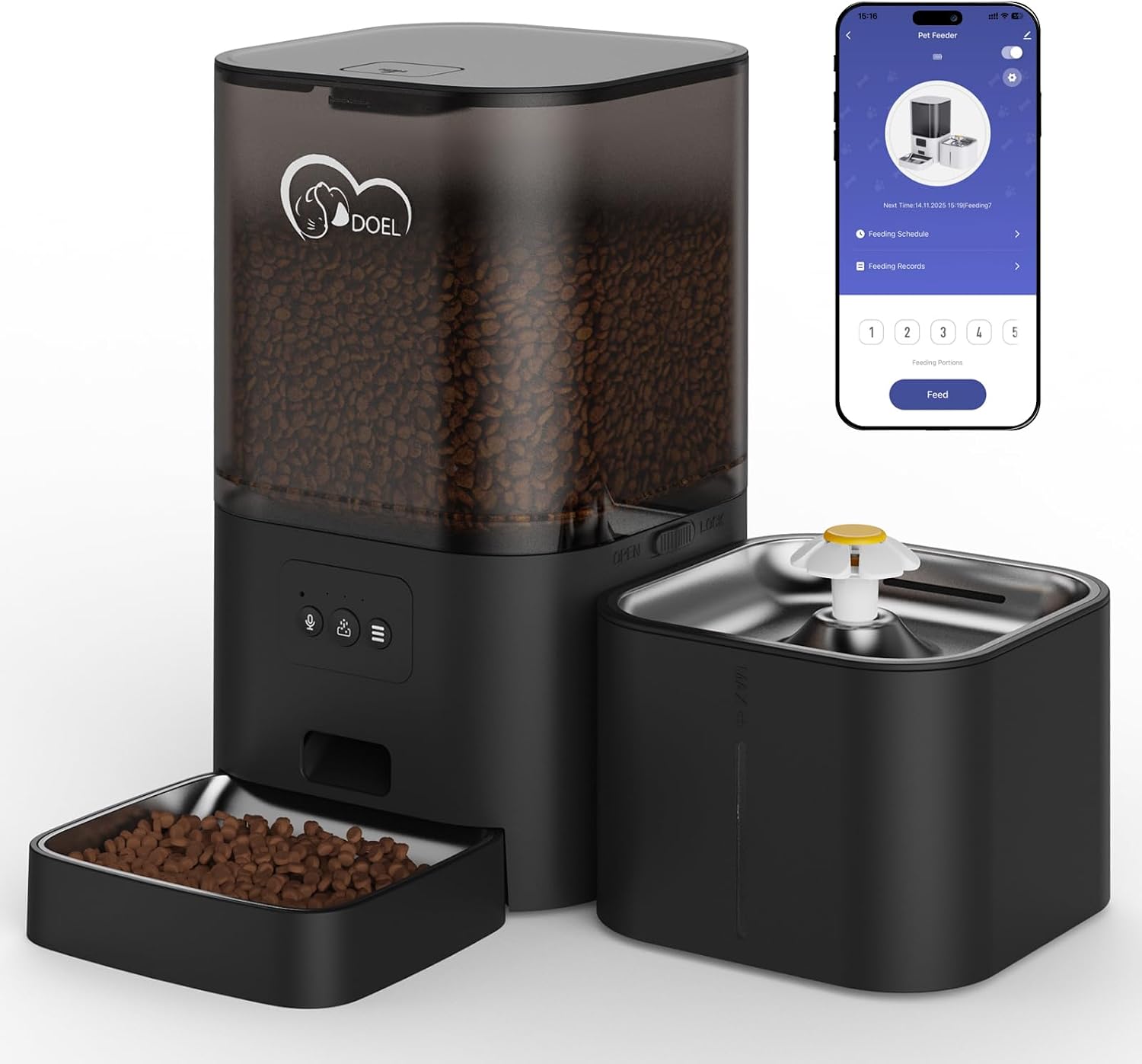
The all-in-one pick: DOEL 2.4GHz WiFi Automatic Cat Feeder and Water Fountain, 6L/24 Cups Timed Dry Food Dispenser for 2.5 Weeks, with APP Remote Control, Voice, for Small Medium Dog Puppy Kitten
 Visit on Amazon →
This is the unit I would start with if you want one plug and one footprint for both jobs. It pairs a 6-liter dry food hopper with a fountain, and the listing puts the food capacity at roughly 2.5 weeks on a normal two-meal schedule for one cat. It runs on 2.4GHz WiFi with app control, and it takes a voice recording, which sounds like a gimmick until you are out on a late dog walk and your cat hears your actual voice instead of a beep.
Two things I check on any combo unit, and you should too. First, does the feeder still dispense on its internal schedule when the Wi-Fi drops? Set the meals on the device itself and treat the app as a convenience, not as the brain. Second, is the fountain side serviceable, meaning can you see and reach the pump without a screwdriver and a prayer? If the answer to either question is no, keep shopping.
For a single cat or a small dog in an apartment, the shared footprint is a genuine win. In a multi-cat house, it does not solve guarding, so you still want separate feeding stations.
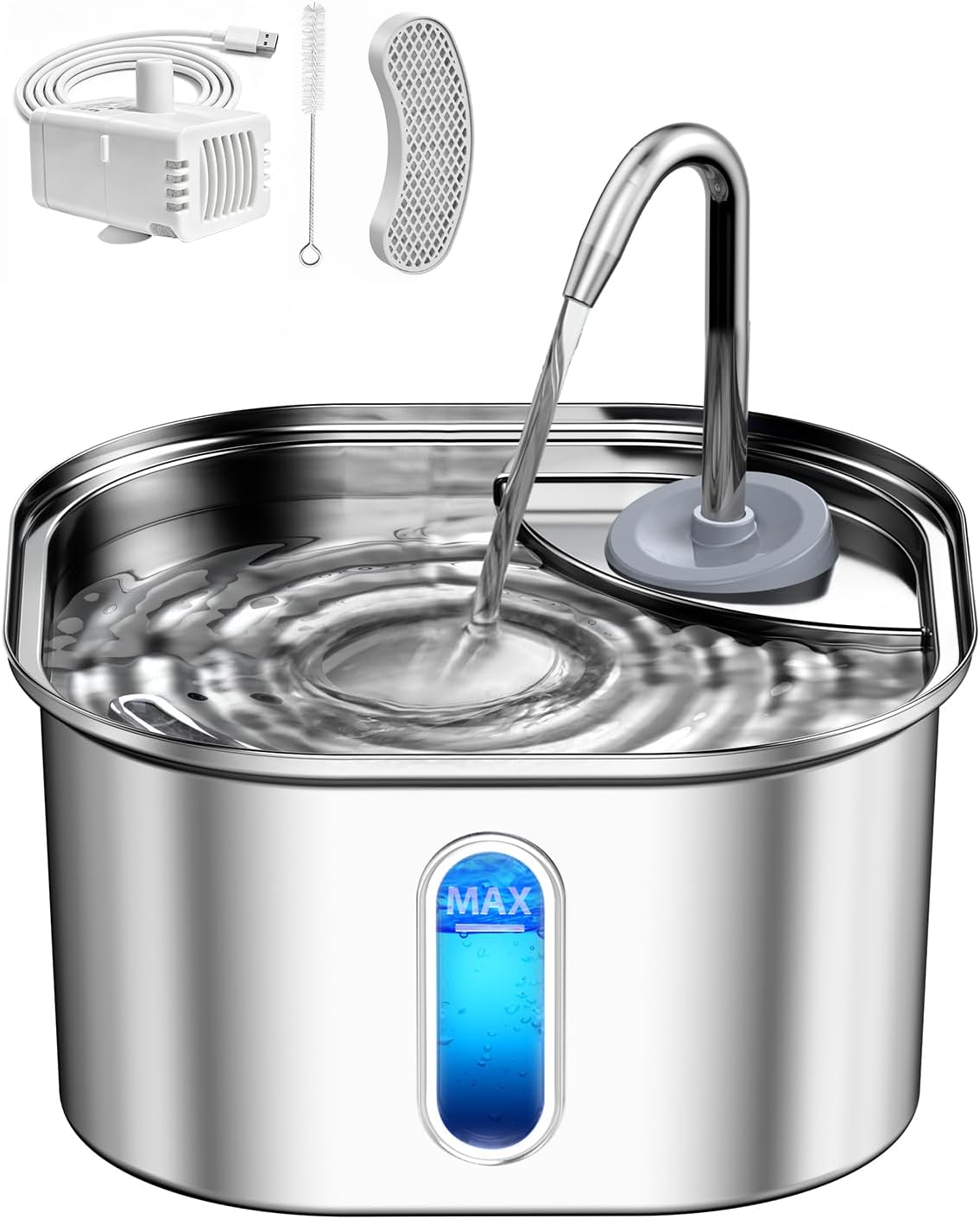
The dedicated fountain pick: Stainless Steel Cat Water Fountain for Cats Indoor 3.2L 108oz BPA-Free S304
 Visit on Amazon →
Stainless steel is the material I push people toward, and this is a 3.2-liter (108-ounce) BPA-free S304 unit. That size is the sweet spot for one or two cats: big enough that you are not refilling daily, small enough that you will actually dump it and rinse it on a schedule.
The reason stainless matters is chin acne. Mochi got spots on her chin from a plastic fountain, and the first question the vet asked was what she drank out of. Plastic scratches. Scratches hold bacteria, and no amount of scrubbing reaches into a scratch. Stainless does not scratch the same way and does not hold odors.
The cleaning question is what decides it, though. Pull the pump, check whether the impeller comes apart for rinsing, and time yourself. If a full clean runs longer than five minutes, it will not happen weekly, and a fountain that is not cleaned weekly is worse than a plain bowl you rinse twice a day.
The actual setup workflow
This works whether you bought one combo unit or two separate devices. Do it in this order.
Step one: pick the spot before you unpack anything. The feeder goes on a hard floor, not carpet, because kibble crumbs work their way into carpet and stay there. Both devices want a wall outlet you are not going to need for anything else, and both want their cords routed where a dog cannot chew them and a cat cannot hook a claw under them. Give the fountain a corner or a wall side. Mochi can and will knock over anything with a low center of gravity and a wide open side, and a corner buys you one extra second of reaction time.
Step two: wash everything that touches food or water. This is the step everyone skips and it is the one I insist on. Hoppers, bowls, lids, and fountain basins ship with manufacturing dust and residue. Warm water, mild dish soap, full rinse, full dry before anything goes in. You only have to do it once.
Step three: calibrate the portion on a kitchen scale before the first real meal. Put an empty bowl on the scale, tare it, and run one dispense. Write down the grams. Run five more and write those down too. Now you know two things: whether the machine matches its own setting, and how much the number bounces around between dispenses. A tight spread means a decent portion wheel. A wild spread means the feeder is guessing, and that is your warning sign long before the wheel actually jams. Adjust the portion setting until the average lands where your vet or your feeding plan says it should.
Step four: prime the pump and set the water level. Before the fountain goes on the floor, drop the pump into a sink of water and run it. You are checking that it moves water and that you know how to take it apart, because you will be doing that weekly. Then assemble and fill above the minimum line. A pump that runs dry burns out, and a burned-out pump is the most common reason people give up on a fountain entirely.
Step five: run a week on the device schedule, not the app. Set the meal times on the unit itself. Connect the app afterward if you want the notifications, the remote feeding, or the voice clip. Then leave it alone for a full week and see whether the schedule holds without you touching anything. If you have a pet on medication or a diabetic cat, this week is the whole point of owning the machine. Also decide now what happens in a power outage, because it will happen, and the answer should be a plan and not a surprise.
Step six: build the weekly clean into a day you already remember. Trash night, laundry day, Sunday morning coffee. It does not matter which, it matters that the trigger already exists in your week. Full dump, rinse, pump out, impeller rinsed, basin scrubbed. Once a month, take the whole thing apart. That routine is what keeps the fountain a health tool instead of a science project.
Caveats that will bite you
Kibble size matters more than any spec on the box. A feeder with tight auger tolerances will jam on large kibble, and a feeder with loose tolerances will over-feed on small kibble. Whatever you buy, run it with the food you actually feed, not the food in the marketing photo.
Cats that tip bowls do not stop tipping because the bowl is expensive. If you have a Mochi, put the fountain somewhere a spill just wets tile, and check that the base is wide enough that a shoulder check does not send it over.
Hidden pump compartments are the number one thing I refuse to buy. If the pump sits behind a panel that needs tools and patience, the fountain is designed for the showroom, not for your kitchen sink on a Sunday night.
And the app is never the product. Every single feeder I returned failed at the mechanism, not the software. One of them failed at the software too, but the mechanism was already the problem.
What I did not buy, and why
Gravity feeders. They are fine for a grazing cat and genuinely dangerous for a dog that eats like Tank, because the food just keeps refilling and the dog just keeps eating. If you have a speed eater, you want portion control or you want a vet bill, and portion control is cheaper.
The no-name auger feeders. I have taken three apart and the auger tolerances are the problem every single time. They work for a week, then they jam or they over-feed, and by then you have already trusted them with a meal.
Plastic fountains. Not because plastic is poison, but because it scratches, and scratched plastic holds bacteria right where your cat's chin rests. Stainless and ceramic are the two materials that have held up in my apartment.
What this all costs
Two devices, one routine, and a kitchen scale you probably already own. Compared with a month of drop-in visits from someone like me, the hardware pays for itself quickly, and it keeps working on the days you get stuck at the office or stuck in traffic on the 5.
The honest math is not about the purchase price. It is about the twenty minutes of weighing portions in week one and the five-minute clean every week after. Skip either one and you have bought an expensive bowl.
The short version
Place it, wash it, weigh the first dispenses, set the schedule on the device, then clean it on a day you already remember. The DOEL combo handles the food and water in one footprint if you want a single setup. The stainless fountain is the one to add if you want hydration to be its own clean, simple job, and it is the one I would hand a client whose cat has a history of chin issues.
That is the whole job. Your pets do not care what the app looks like. They care that the food shows up on time and the water is clean.