Most automatic feeders don't die of a bad motor. They die of bad placement, bad kibble, and a portion chart nobody ever checked against a kitchen scale. I've watched a diabetic cat miss a meal because an auger jammed at 6 a.m., and I've watched a 75 pound lab mix body-slam a gravity feeder until a week of kibble hit the carpet. Setting up an automatic cat feeder and fountain is not complicated, but the order of operations matters, and most people do it backwards.
Get the placement right, verify the portion, then let the machine take over. That's the whole method, and it fits in an afternoon.
Why you should trust me
I'm Luis. I've been pet sitting and walking dogs in Pacific Beach for eight years, and I keep a client list of more than 60 households. That list is a graveyard of feeding disasters: the cat who unlatches every lid, the beagle who chewed through a feeder at 3 a.m., the "slow feeder" that lasted exactly one meal.
At home I have Mochi, a tortoiseshell who tips water bowls on purpose because still water offends her, and Tank, a 75 pound lab mix who eats like a shop vac and has learned to body-slam gravity feeders until they dump. In 14 months I returned four automatic feeders: a jammed auger, two portion wheels that over-fed by 40%, and one app-connected unit that stopped feeding when the Wi-Fi hiccuped. Those returns taught me more than any spec sheet ever did.
My rule now is simple. Nothing goes into a client's home until it has run in my apartment for a month with Mochi and Tank. No portion claim without a scale check across 30 days. No fountain recommendation unless I can clean the pump in under five minutes. And no "quiet" claim I haven't heard at dispense time with my own ears.
How I picked and how I tested
The gear in this guide isn't about which unit has the longest feature list. It's about what survives a house with a bowl-tipping cat and a dog who treats feeding time like a contact sport.
The checklist I run on every feeder and fountain that comes through my door:
- Does it still feed when the network drops, or does it need the cloud to push kibble?
- Does the portion wheel hold accuracy, weighed on a kitchen scale, across a month of meals?
- Can a determined cat open it, tip it, or reach the dispense opening with a paw?
- How long does a full clean take, including the pump, the impeller, and every corner a finger can't reach?
- What does the return policy look like, because return policies are part of the spec.
I apply the same checks to budget units and premium ones, because the failure modes are usually the same. The auger tolerances are the weak point on cheap feeders, and the pump housing is the weak point on fountains. Everything else is packaging.
The gear I would start with
Two very different pieces of equipment, because "feed the animals" in my world includes the ones with feathers in the yard.
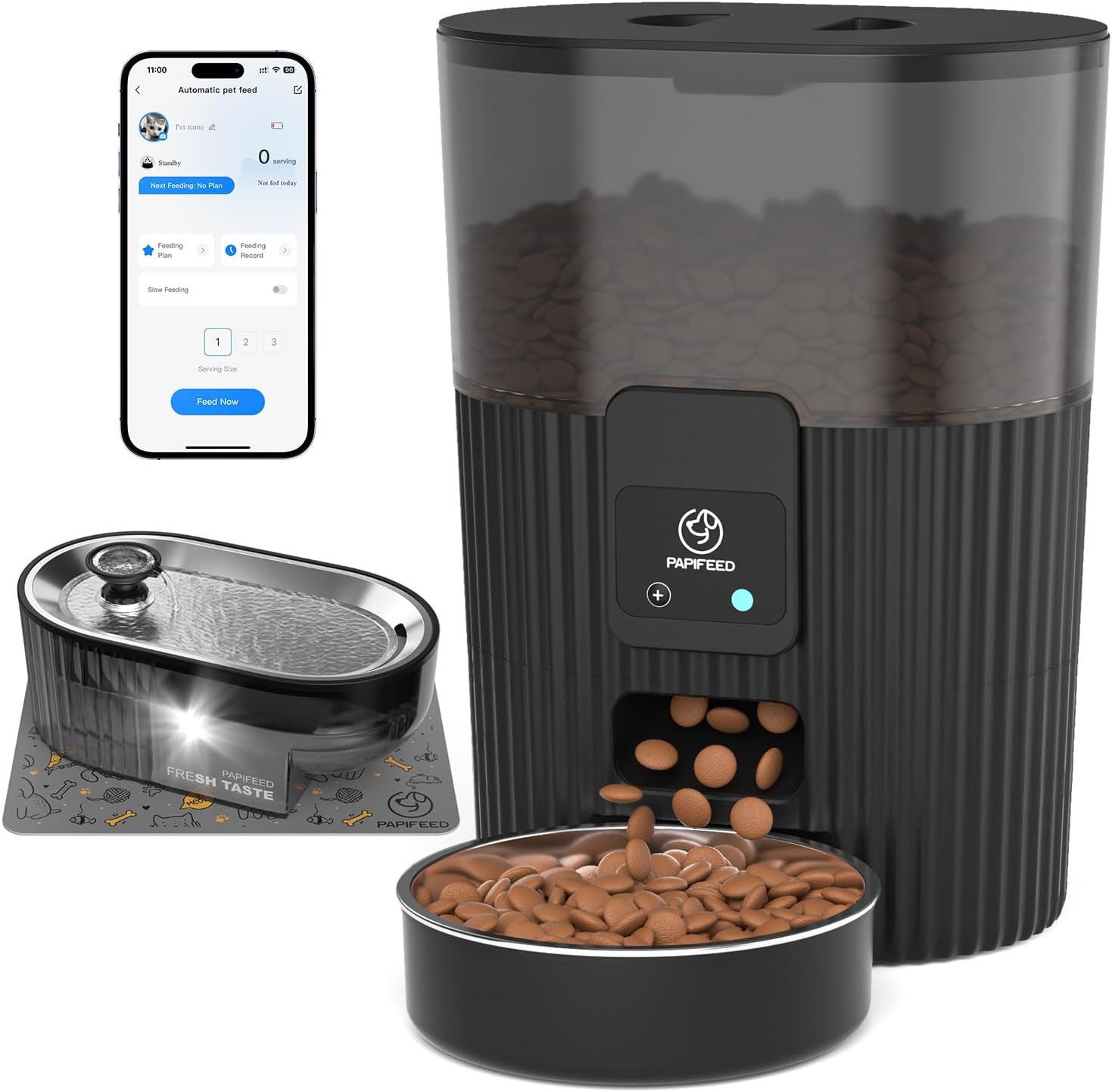
Best all in one: PAPIFEED Automatic Cat Feeder and Water Fountain Stainless Steel
 Visit on Amazon →
This is the unit I'd hand a first-time feeder owner, mostly because it solves two problems with one cord. It's a timed feeder with app control and up to 10 meals a day, paired with a circulating drinking fountain with an LED and a stainless steel contact surface. The stainless steel matters more than people think: Mochi got chin spots from a plastic bowl, and the fix from my vet was to move her to metal and glass. If your cat has had acne or a sensitive chin, that detail alone justifies the switch.
The app handles scheduling and lets you adjust portions without kneeling on the floor at 5 a.m. The fountain side keeps water moving, which is the entire reason Mochi stopped treating her bowl like a personal enemy. Moving water reads as fresh water to a cat, and a cat who drinks more is a cat you're not paying the vet to rehydrate.
Flaws but not dealbreakers: All-in-one units share a footprint and a power cord, and cats generally prefer food and water in separate spots. If your cat is a fussy drinker, plan on running the fountain across the room from the food bowl, which means the two halves of a set don't always live together. Also, an app is a feature, the dispense mechanism is the product. Set the schedule at the unit itself if the hardware allows it, so a router reboot at 6 a.m. doesn't cost your cat breakfast.
Anyone who wants one purchase, one plug, and a stainless bowl should start here.
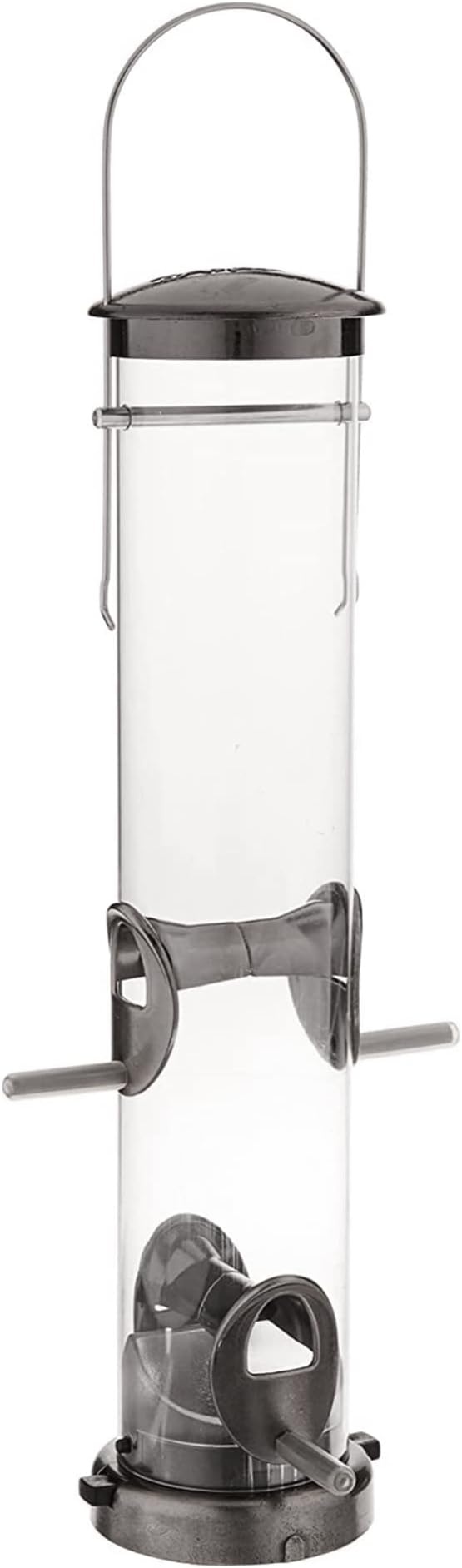
The yard feeder: Aspects 392 Quick-Clean Seed Tube Feeder, Medium
 Visit on Amazon →
This one is not for your cat or your dog. It's a brushed nickel tube feeder for wild birds, and it belongs in the yard, not next to the pet bowls. I keep one because half my clients travel and ask me to keep the backyard alive while they're gone, and because a bird feeder in the wrong spot creates real problems: seed hulls in a water fountain, spilled seed on the ground, and rodents following the spill toward the pet feeding station.
The quick-clean base is the feature that matters. Tube feeders collect damp seed and hulls at the bottom, and a base you can open and dump without disassembling the entire tube is the difference between cleaning it weekly and never cleaning it. The medium size is a good middle ground for a small yard. Big enough to matter, small enough that you'll actually empty it before the seed goes stale.
Flaws but not dealbreakers: Metal tube feeders get hot in direct San Diego sun, and wet seed clumps and molds. Hang it in partial shade and dump it after rain. Also, a feeder this size holds enough seed that if you fill it and leave for two weeks, you'll come home to a science experiment.
Anyone who feeds birds and pets in the same yard should own one, and should hang it well away from the fountain.
The actual setup workflow
Now the part you came for. This order works on any feeder and any fountain, app or no app.
Step one: Choose the spot before you unbox anything. Hard floor, against a wall, out of the kitchen traffic lane. Keep the feeder away from the water fountain by at least a few feet if you can manage it. Kibble plus splashing water equals mold, and mold equals a vet visit. If your cat tips bowls, the fountain goes somewhere you can see it, not tucked behind a chair.
Step two: Set the fountain up first. Rinse every part, including the pump housing, before the first fill. Place it on a towel or a silicone mat. Fill with filtered water if your tap water runs hard, because mineral scale is what kills pumps early. A fountain that's a pain to clean is a dirty fountain by Friday, so figure out the disassembly now, while the parts are still dry and you're not in a hurry.
Step three: Fill the hopper, then verify the portion with a scale. Program your first meal, put a bowl on a kitchen scale under the dispense opening, and run it. Weigh the result. Do this for the first three meals. If the wheel over-feeds or under-feeds, adjust the setting before your pet ever eats from it. This single step is why I returned two feeders.
Step four: Program the schedule around the animal, not your convenience. For a healthy adult cat, two to four meals a day is typical. For a dog like Tank, portion control is the entire point, and a gravity feeder is not an option. If your cat is diabetic, the schedule is medical, not casual, and the feeder needs to hold it without an app or a network.
Step five: Test with the network off. Feed once with the router unplugged or the app closed. If the unit only feeds when it's online, you need to know that before you're on a plane, not after.
Step six: Secure it against the animal. Non-slip mat underneath. If your dog body-slams things, put the feeder in a corner or anchor it. If your cat has learned to pop the lid, a strip of painter's tape on the seam tells you whether the latch is the problem or the cat is.
Step seven: Transition, don't switch. For three to five days, run the automatic feeder alongside the old bowl. Put a normal portion in the old bowl and a slightly smaller portion in the feeder. By day five, most animals have decided the machine is just the new food source.
Step eight: Lock in the maintenance rhythm. Fountain: full clean weekly, including the impeller, and top off the reservoir daily. Feeder hopper: wipe and dry every week or two, and never top off old kibble with new. Bird feeder: dump and rinse weekly, more often in humidity.
Where setups go wrong
The jam is almost never the motor. It's kibble that's too large for the wheel, too small for the auger, or coated in something that makes it clump. If your feeder jams twice in a month, change the food before you change the feeder.
App-connected units fail in a specific way: the schedule lives in the cloud and the device waits for instructions. Set whatever schedule the hardware can hold locally, and treat the app as a convenience layer, not the mechanism.
Fountains fail because of the pump. A hidden pump compartment you can't see into is a slime trap, and slime means a cat who stops drinking. If you can't get the pump out and clean it in a few minutes, the fountain will be dirty by Friday and you'll stop cleaning it. That's not a convenience problem, it's a health problem.
Multi-cat homes need a different answer than a single dispenser. If one cat is on a diet and another isn't, a shared feeder just feeds whoever gets there first. That's a separate problem, and it needs a feeder with a lid, not a better app.
What I skipped and why
Gravity feeders. They're fine for a grazing cat and dangerous for a dog who eats like Tank, because the reservoir keeps refilling the bowl and the dog keeps eating. If you want slow feeding, a slow feed bowl is cheaper and actually works. A feeder that dispenses one meal a day is a diet plan with a motor, not a slow feeder.
Cheap no-name dispensers. I've taken three apart. The auger tolerances are the problem every time, and no app update fixes a wheel that dumps 40% extra.
Any fountain I can't fully disassemble. If the pump hides behind a molded plastic shell, it doesn't make this list, no matter how good it looks on a counter.
What it costs over a year
I'm not going to quote you a price, because prices move and I'd rather you check the listing yourself. What I will say is that the math that matters isn't the sticker, it's the cost per day across the life of the unit, plus the cost of the alternative. A jammed feeder means a missed meal. A dirty fountain means a cat who drinks less and a vet bill later. A bird feeder that never gets cleaned means sick birds in your yard.
Check current Amazon price on both, compare that number to one emergency vet visit, and the decision usually makes itself.
Common questions
How long does setup take? About 30 minutes for placement, programming, and the first scale check, plus three to five days of transition where both the old bowl and the new feeder are in play.
What happens when the Wi-Fi goes out? It depends on the unit. Test it yourself: unplug the router, wait for the next scheduled meal, and see whether the feeder fires. If it doesn't, set a local schedule if the hardware supports one, or pick a feeder that doesn't depend on the network.
Can I put the feeder and the fountain side by side? You can, but cats often drink less when water sits next to food. Give the fountain its own spot, and give the feeder a hard floor away from splashes.
Do I need the bird feeder if I have pets? No, but if you have a yard and a pet, keep the seed away from the pet feeding station. Hulls and spilled seed attract rodents, and rodents are how a clean feeding setup turns into a problem.
That's the method: place it, weigh it, secure it, clean it, and test what happens when the network dies. Do those five things and the machine does the rest, which was the entire point of buying it.