An automatic cat feeder with camera is not a gadget you buy because it is clever. You buy it because you are stuck in traffic on the 5 at 6:40 p.m. and your cat has already started the stare-down routine at the empty bowl. I have been pet sitting and dog walking in Pacific Beach for eight years, with a client list north of 60 households, and the single most common reason a feeding setup fails is not the hardware. It is the setup.
Most people unbox a feeder, dump in kibble, punch in a time, and walk away. Then the auger jams on day nine, the cat drinks from a fountain that has been quietly growing a biofilm since Tuesday, and the whole thing gets blamed on the product. I have returned four feeders in 14 months, so I know exactly what a bad setup looks like from the other side.
This is the process I run now, in order, before a feeder or a fountain goes into my apartment with Mochi (a tortoiseshell who treats still water as a personal insult) and Tank (a 75-pound lab mix who eats like a shop vac and has learned to body-slam gravity feeders). It takes about 40 minutes. Do it once and the machine does the rest.
Why you should trust me
I am not a reviewer with a lab bench. I am the guy clients hand a key to when they fly to Denver for a week. That means my reputation rides on whether a cat gets fed at 7 a.m. and 7 p.m. while nobody is home.
Four feeders have gone back from my apartment: one with a jammed auger, two with portion wheels that over-fed by roughly 40 percent against a kitchen scale, and one app-connected unit that stopped feeding entirely when the Wi-Fi hiccuped. Those returns taught me more than any spec sheet, because a return is a real animal missing a real meal. My rules are boring and they have not changed: the dispense mechanism is the product, the app is a feature, and anything a determined pet can break will be broken.
How I picked and how I tested
I run every unit in my own kitchen for a full month before I will suggest it to a client. That month covers three things: how accurate the portion is when I weigh it on a kitchen scale instead of eyeballing the bowl, how long a full clean takes including the pump, and what happens to the feeding schedule when the internet drops.
The numbers I trust are simple. If a programmed portion is off by more than a few grams across 30 days, the feeder is a diet problem waiting to happen. If I cannot get the pump out and back in under five minutes, the fountain will be dirty by Friday, because I am honest about how often I actually clean things. And if the device stops feeding when the app loses connection, it is not a feeder. It is a phone accessory.
I also weigh the pet, not just the food. A cat that gains weight on a "measured" portion is telling you the portion wheel is lying.
The gear I set up first
You do not need much. You need one device that dispenses food on a schedule, and you need a clean water source you will actually maintain. Everything else is optional.
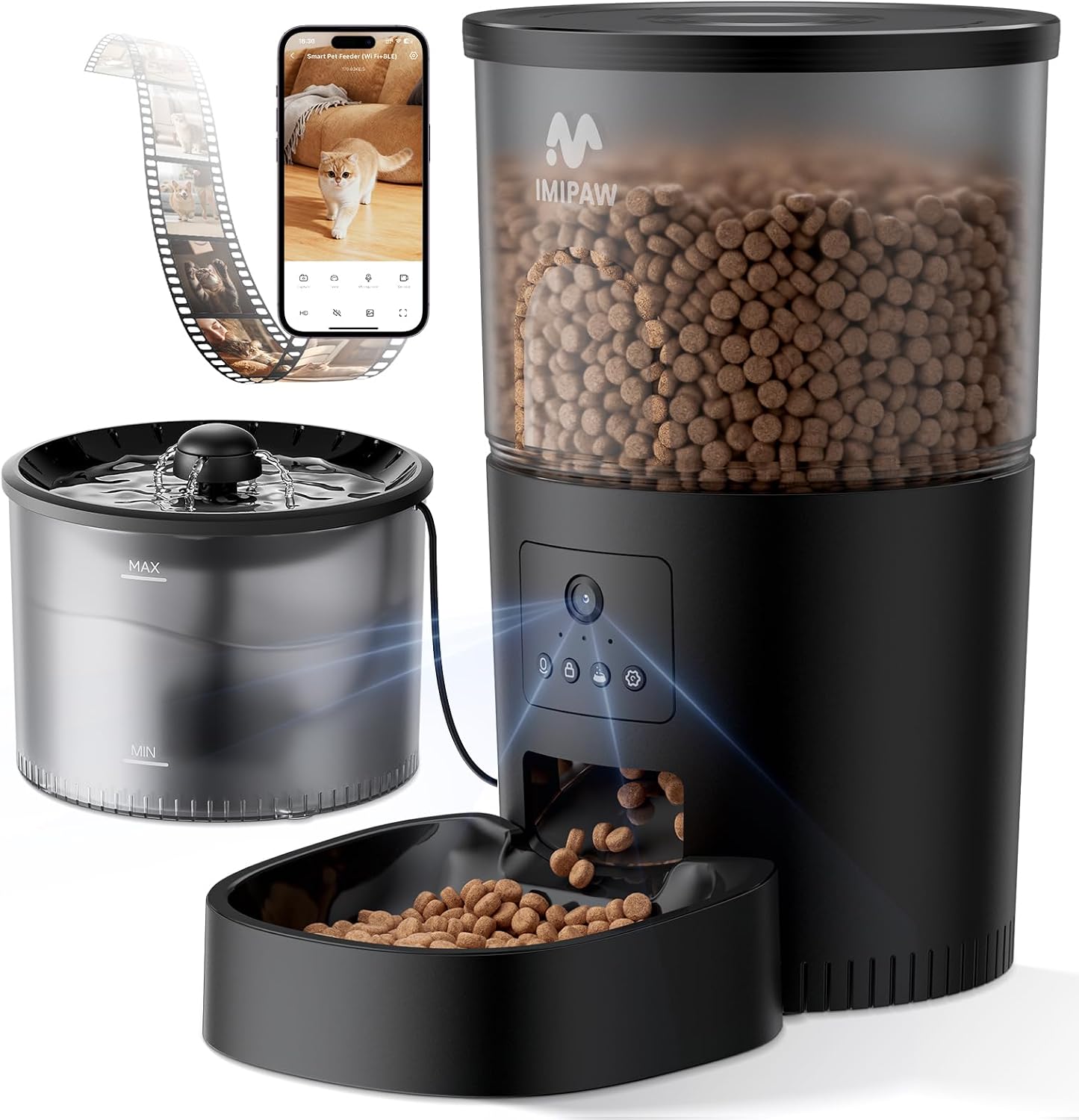
Our pick: IMIPAW Automatic Cat Feeder with Camera and Water Fountain, HD AI Pet Recognition, APP Remote Control, Timed Food Dispenser, Two-Way Audio, Night Vision Function, 3L Fountains for Drinking with Filter
 Visit on Amazon →
This is the all-in-one version of the setup: a timed food dispenser paired with a 3L drinking fountain, plus a camera with night vision, two-way audio, and app control with AI pet recognition. If you have one cat and one counter, this replaces two separate devices and one power strip. Check current Amazon price.
The camera is the part that changes how you use a feeder. With a plain timed unit, you learn that your cat ate by looking at an empty bowl, which tells you nothing in a two-cat house. With a camera and pet recognition, you can confirm which animal actually showed up. For anyone managing a cat on a strict schedule, that is the difference between data and guessing.
The fountain side is where I would focus my first week of testing. Run it, then take it apart. Pull the pump, look at the impeller, and time yourself. If the pump is buried behind three plastic clips, that 3L reservoir will be the cleanest it ever is on day one. The other thing to verify on day one: unplug your router for 20 minutes and confirm the feeder still dispenses on schedule. A feeder that needs Wi-Fi to feed is a feeder that fails the week you travel.
Flaws but not dealbreakers: A camera and an app mean an account and a login, and that is friction you do not have with a $30 gravity feeder. The trade is visibility, which is worth it if you are away from home during feeding windows.
Anyone who works long days, travels, or manages a cat on a fixed schedule will get the most out of this.
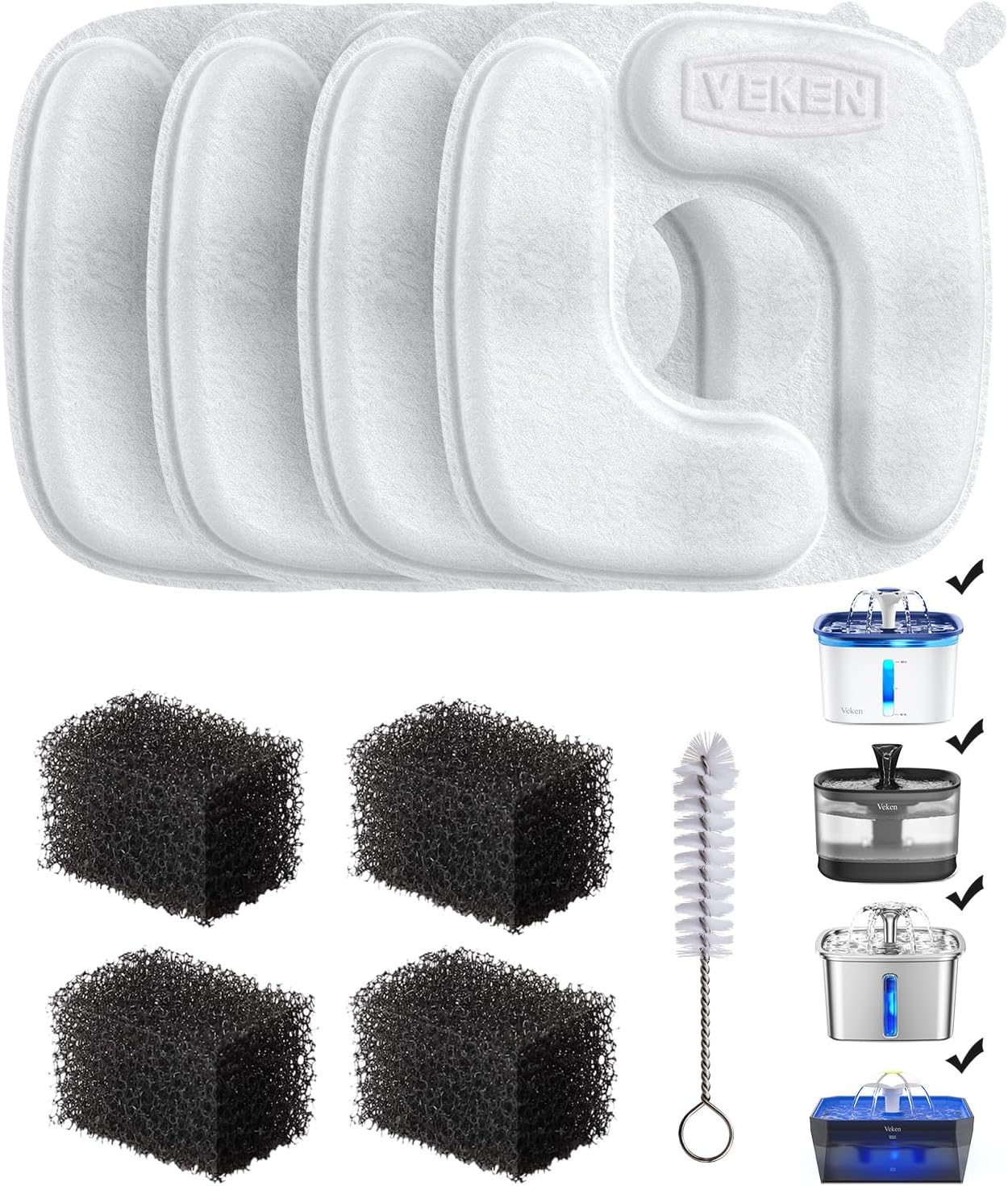
The upkeep pick: Veken Cat Water Fountain Filters, 4 Pack Replacement Filters
 Visit on Amazon →
Filters are the least exciting purchase in this entire article and the one that decides whether your fountain is a health tool or a decorative object. A four-pack gives you a rotation, which matters because the single biggest cause of a fountain that "suddenly stopped working" is a clogged filter starving the pump. Check current Amazon price.
Here is the honest math. A filter that has been in a fountain for a month has been trapping hair, dust, and kibble crumbs, and once it is saturated, water flow drops, the pump works harder, and your cat loses interest. Buy the four-pack, write the swap date on the calendar the same day you set up the fountain, and change it on schedule instead of when the water starts looking cloudy.
Flaws but not dealbreakers: These are replacement filters, so they only make sense if your fountain takes this style. Match them to the fountain you own before ordering, and keep a spare set in a drawer so you never put off a swap because a package has not arrived.
Anyone running a filtered fountain for a cat, or for a dog that drinks like Tank, should keep a rotation on hand.
The actual setup workflow
This works on any timed feeder and any pump-driven fountain. Order matters, and skipping steps is how people end up with a jam in week two.
Step one: Read the portion spec before you pour anything. Find the minimum and maximum dispense size in the manual. If the manual says one "portion" without telling you the grams, that is a red flag, not a rounding error. You are going to program grams, not scoops.
Step two: Calibrate the portion wheel with a kitchen scale. Put a bowl on the scale, tare it, and run one portion. Write down the weight. Run three more and write those down too. If the numbers drift, you have found the problem before your cat has. Do this before the first scheduled meal, and repeat it once a week for the first month.
Step three: Set the schedule around your cat, not your convenience. Cats are crepuscular, which means they eat hardest at dawn and dusk. Two meals, roughly 12 hours apart, matches that pattern better than one big morning dump. If your vet has your cat on a specific schedule, the feeder follows the vet, not the other way around.
Step four: Test the Wi-Fi failure. Unplug the router for 20 minutes during a scheduled meal. If food lands in the bowl, the unit has an internal schedule and you can trust it. If nothing happens, you now know the feeder depends on the cloud, and you need a backup plan before you travel.
Step five: Place it where the cat will actually use it. A feeder in a busy hallway gets skipped. A fountain next to a litter box gets ignored. Put the water away from the food if your cat is a finicky drinker, and put both on a hard floor if you have a bowl tipper. Mochi has flipped every light plastic bowl I have ever filled, and running water is the only thing that stopped her.
Step six: Set up the fountain and prime the pump. Fill the reservoir, then let the pump run before you trust it. Listen for the change in pitch that means it is pulling air instead of water. If it is loud, the water level is low or the pump needs a prime, and neither one is a product defect.
Step seven: Establish a cleaning day and stick to it. Full teardown once a week: reservoir, bowl, pump housing, impeller. If you cannot do the whole thing in under five minutes, you will stop doing it, and that is a design problem worth returning over. Hidden pump compartments are slime traps. If you cannot see the pump, think hard before you buy.
Step eight: Write the filter swap on the calendar. Every three to four weeks, or whenever flow drops, whichever comes first. Pair it with the cleaning day so it is one habit, not two.
Where most people go wrong
The mistakes are predictable, and I have made most of them.
Feeding a dog from a gravity feeder is the big one. A gravity feeder is a self-refilling bowl, and for a grazer it is fine. For a dog that inhales kibble like Tank, it is a free buffet with a vet bill attached. Dogs that eat fast need portion control, not unlimited access, and a timed feeder with weighed portions is the tool.
Trusting the marketing phrase "anti-jam auger" without testing is another. Cheap no-name feeders jam in week two because the auger tolerances are loose, and I have taken three apart to confirm it. Run the calibration in step two and you will catch a bad wheel before your cat does.
The last one is treating the app as the product. The auger is the product. The portion wheel is the product. If the dispense mechanism is unreliable, no amount of camera resolution or night vision saves the setup.
What this all costs
The all-in-one feeder and fountain is the larger line item, and replacement filters are the small recurring one, with a four-pack covering you for several months of swaps. Do not buy a current price from me, because prices move: check the live listing on each product page and compare against a month of your own time. If you were paying a sitter for two drop-in visits a day, a feeder and fountain pay for themselves in about a week, and they keep paying after that.
The question I get every week
Do I need a camera on a cat feeder? No, but it changes how you use one. A camera lets you confirm the cat actually ate instead of inferring it from an empty bowl, and in a multi-cat home that is the whole ballgame. If you have one cat, one bowl, and a normal routine, a plain timed feeder is enough. If you are managing a schedule, a diet, or more than one animal, the camera earns its place.
The bottom line
Set the portions by weight, not by scoop. Prove the feeder still feeds when the internet dies. Clean the fountain on a schedule you will actually keep, and keep filters in the drawer so you never skip a swap. Do those four things and an automatic setup stops being a gamble and starts being the reason your cat eats at 7 a.m. whether you are home or not.
That is the job. Set it up once, properly, and let it run.