A machine that drops kibble at 6 a.m. is not a feeding plan. An automatic cat feeder and fountain solves two problems at once: meals that arrive on schedule whether or not you are home, and water that keeps moving so a cat actually drinks it. Neither one works the day you plug it in.
I have set up feeders and fountains in plenty of my clients' homes around Pacific Beach, and the failure is almost never the hardware. It is the introduction. A cat that watches a strange box drop food into a bowl she has never eaten from will walk away from it. A dog will treat the same box as a puzzle to be defeated.
The work you do in the first ten days decides whether the thing on your kitchen floor is a feeding system or an expensive decoration. This is the workflow I use, and it takes about half an hour of actual labor spread across two weeks.
Why you should trust me
I have been a pet sitter and dog walker in Pacific Beach for eight years, with a client list that has run past 60 households. I have watched a diabetic cat miss a meal because a feeder jammed, and I have watched a beagle chew through a feeder at 3 a.m.
At home I run the same equipment through a torture chamber. Mochi is a tortoiseshell who tips water bowls on purpose. She watched me fill a bowl one too many times and decided that still water is an insult. Tank is a 75-pound lab mix who inhales kibble like a shop vac and has learned to body-slam gravity feeders until they dump.
In 14 months I returned four automatic feeders: one with a jammed auger, two with portion wheels that over-fed by 40 percent, and one app-connected unit that stopped feeding when the Wi-Fi hiccuped. Those returns taught me more than any spec sheet ever did. Nothing gets recommended to a client now until it has run a full month in my apartment with those two animals.
How I picked and how I tested
My current round is a 30-day torture test on six 2026 feeders and four fountains. I track four numbers: jam rate, portion accuracy on a kitchen scale, cleaning time per unit, and how many days each one survives Tank.
The rules I hold myself to:
- No feeder gets recommended without a full month in my house with Mochi and Tank.
- No fountain gets recommended unless I can clean the pump in under five minutes.
- No portion claim without a kitchen scale check across 30 days.
- No quiet claim without a decibel reading at dispense time.
The two units below cover two different jobs in this how-to. One handles food and water in a single footprint. One is feeder-only with a much bigger hopper, for a household that already has the water side sorted.
What to buy before you start
Buy the machine that matches your animal, not the machine with the best photos. A tipped bowl is a cat asking for running water. A dog that eats in nine seconds needs portion control, not a reservoir that refills itself.
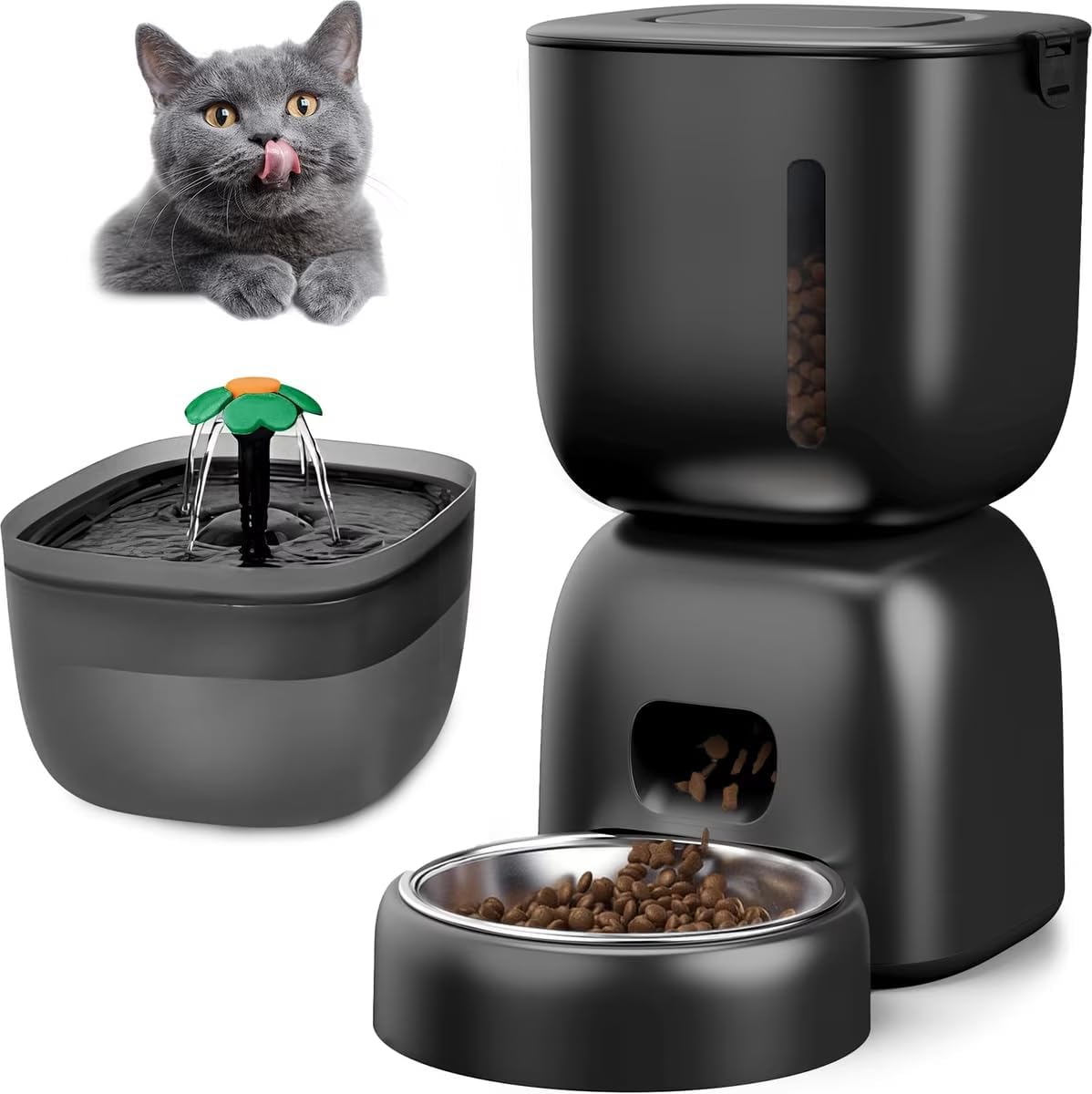
All-in-one pick: Casfuy 2-in-1 Automatic Cat Feeder & Water Fountain Set, Black, 3-L & 2-L
 Visit on Amazon →
This is the set I would hand a first-time buyer who wants one machine instead of two. It pairs a 3-liter food hopper with a 2-liter fountain, so both jobs live in one corner of the kitchen. Two separate devices mean two cords, two cleaning schedules, and two places for a cat to decide she does not approve. One box means one.
The trade-off to plan for is the fountain size. A 2-liter reservoir is not a travel-sized tank. In a multi-cat home, or a house with a dog that drinks the way Tank does, you will be topping it up more often than you would a dedicated large fountain. That is a routine cost, not a defect, but it belongs in your decision before you buy.
The second trade-off is that a set ties the two halves together. If the feeder side gives you trouble, you are dealing with the whole package instead of swapping one component. That is exactly why I test the dispense mechanism first and the fountain second, and why I keep a kitchen scale next to the setup.
Who it fits: a single-cat apartment, a small kitchen with limited floor space, or anyone who wants food and water handled in one purchase. If you have three cats, read the next section instead.
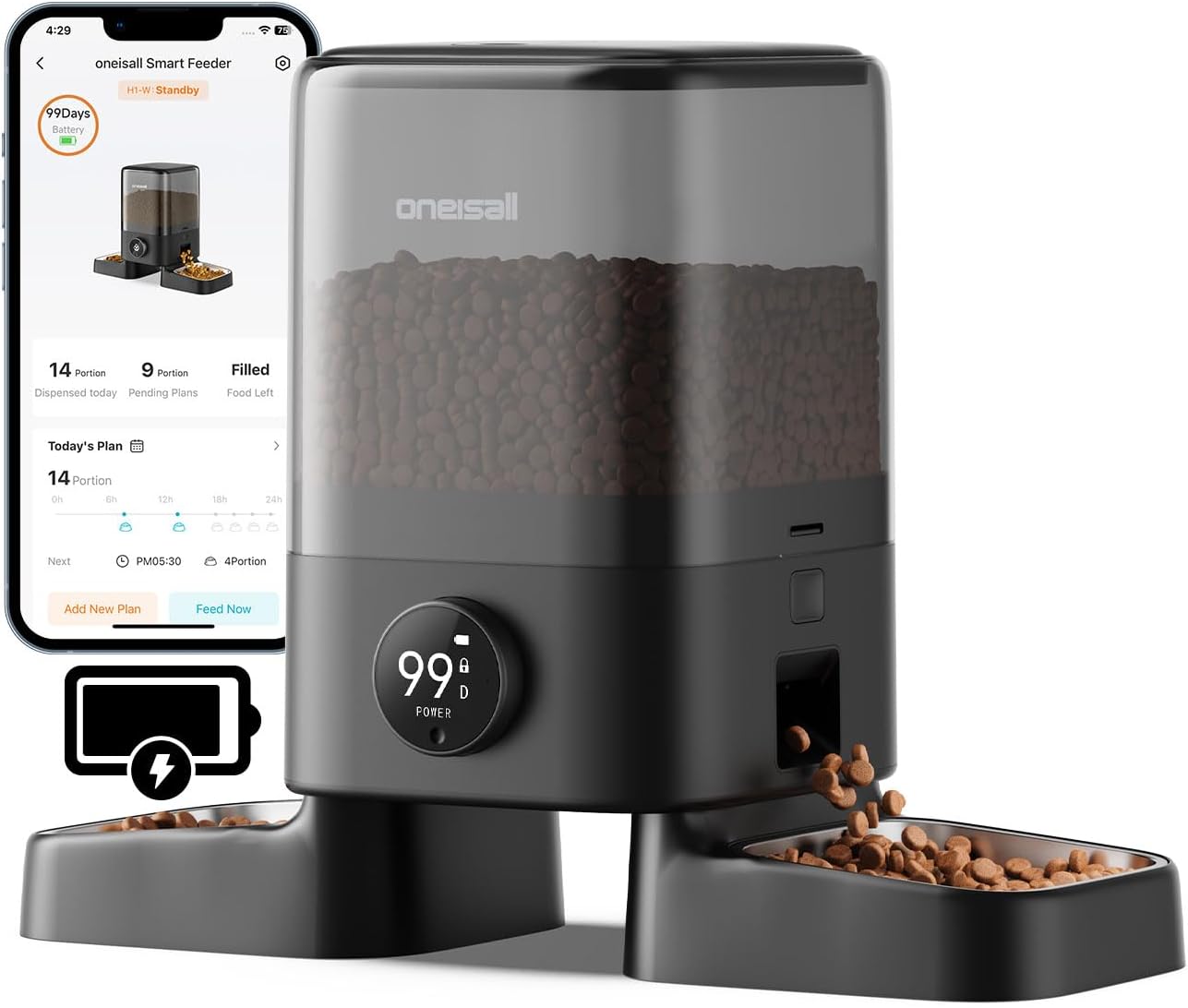
Feeder-only pick: oneisall 2.4G Cordless Automatic Cat Feeder, 20 Cups/5L
 Visit on Amazon →
This one is feeder-only, which sounds like less until you look at the hopper. Twenty cups and five liters of capacity, and it is cordless, so you are not negotiating with an outlet when you decide where it lives. In my apartment that matters, because the only free outlet is behind a bookshelf where Tank can reach the cord.
Capacity is the reason I would point a multi-cat household or a big-dog household here. Five liters is a lot of kibble, which means fewer refills and a longer window if you travel. Cordless also means you can slide it around during the transition without unplugging anything, which makes the two-week introduction below noticeably easier.
The trade-off: no fountain in the box. You are supplying water separately, whether that is a bowl or a fountain you already own. And because it is cordless, power management becomes part of your weekly check instead of a cord you never think about again.
Who it fits: a home with more than one eater, a dog household that needs portion control instead of a gravity feeder, or anyone who wants the feeding side solved without replacing their water setup.
The setup workflow
Here is the actual how-to. This works with any automatic feeder and fountain, not just the two above.
Step one: choose the location before you unbox anything. Level, hard floor if you have a body-slammer. Out of direct sun, because both kibble and water suffer in a hot window. Away from the litter box. Away from the splash radius of any water bowl. Cordless units give you freedom here, so use it instead of defaulting to the nearest outlet.
Step two: wash everything that touches food or water. Warm water, mild soap, full rinse, air dry. New plastic carries manufacturing dust, and your cat's nose notices what your eyes do not.
Step three: calibrate the portion before your pet ever sees the machine. Set the smallest portion the unit offers, run three test dispenses into a bowl, and weigh each one on a kitchen scale. If the three weights are close, you have a keeper. If they drift, you found the problem on day one instead of day nine. This is the step most people skip, and it is the one that catches the over-feeding portion wheels I have returned twice.
Step four: program the schedule around meals your pet already eats. Do not invent new times just because the machine can. Match the times you feed now, then shift by 15 minutes a day if you need to move them. A feeder is not a reason to change a cat's routine. It is a way to protect that routine on the days you are not home.
Step five: run it for a day while you are in the house. Let it dispense into a bowl on your normal schedule with you nearby. You want to hear the dispense noise, catch the first jam, and confirm the portion with your own eyes before the machine is responsible for an actual meal.
Step six: introduce the hardware as furniture, not as a feeder. Set the unit in its spot, unpowered or with the chute closed, next to the bowl your pet already uses. Give it two days. Let them sniff it, circle it, and ignore it. This is the step that prevents the strange-box rejection.
Step seven: transition the food, not the machine. Keep the old bowl and put a normal portion in it, right beside the feeder. Then split the meal: part in the bowl, part from the feeder. Over roughly a week, shift the ratio toward the feeder. If your cat skips a meal, hold that ratio for another day rather than pushing forward.
Step eight: place the fountain, then wait a week before removing the old bowl. Running water usually wins, but not on day one. Run both for a week, clean the fountain once inside that window so your pet watches you handle it, and only then retire the still bowl.
What to watch in the first two weeks
Most problems show up in the first ten days, which is exactly why you run the machine while you are still home.
- A jam in the first ten days. That is auger tolerance, and it is the reason cheap no-name feeders fail on the second week. Write down the day it jammed. That date is your return-window decision point.
- Portion drift. Weigh a dispense again on day 14. A unit that was accurate on day one and is off by day 14 is not a unit I would leave in a client's home.
- A cat that ignores the fountain. Check placement and cleanliness before you blame the design. Most refusal I see is a fountain sitting next to a wall in a traffic corner, or one that has not been cleaned since setup.
- A dog that breaks in. Move the unit to a hard floor, reposition it out of body-slam range, or accept that the cordless unit needs to live on a surface the dog cannot reach.
- Multi-cat homes. One feeder per cat, or a microchip feeder. A shared hopper means the fastest eater gets the most food, and that is a vet bill waiting to happen.
Cleaning and upkeep, which is the real deciding factor
A fountain that is a pain to clean is a dirty fountain by Friday, and a dirty fountain is a health problem, not a convenience problem. Ease of cleaning is a feature. Treat it like one.
Any fountain with a hidden pump compartment is a slime trap. If I cannot see the pump, I do not buy the fountain. Plan on a full clean once a week: pump out, impeller scrubbed, bowl and reservoir washed, everything air dried before it goes back together. If that takes more than five minutes, you will stop doing it, and then the fountain is worse than the bowl it replaced.
For the feeder side, a sealed hopper keeps San Diego humidity, dust, and pantry moths out of the kibble. Kibble dust collects in the auger channel and is the quiet cause of a lot of jams, so wipe the chute when you refill. If your cat has chin acne, remember that plastic is often the culprit. Mochi got spots from a plastic bowl before I switched her, and it cleared up after.
What this costs you
I am not going to quote you a price. Listings move, and a number I write today is wrong next month, so check the current Amazon price on the listing before you commit. What I can give you is the time math, which does not change.
Setup runs 30 to 40 minutes of actual work, spread across two weeks of patience. Weekly cleaning runs 10 to 15 minutes for a feeder and fountain pair. Calibration is three weighed dispenses at the start and one more at the two-week mark.
The other cost is the one nobody puts on a spec sheet: your return policy. I have returned four feeders. The ones with an easy return window cost me nothing but time. The one I bought from a seller with a two-week window and a restocking fee cost me an afternoon and a bad mood. Check the policy before you unbox, because a feeder that jams on day six should be somebody else's problem.
The part people skip
The machine is the easy half. The two days of furniture, the week of split meals, and the week of running water and still water side by side are what make the purchase work. Do that, weigh your portions, clean the pump, and an automatic cat feeder and fountain stops being a gadget you hope your pet tolerates. It becomes the reason your cat eats at the same time every day whether you are in the apartment or three hours away on a client's couch.