An automatic cat feeder and fountain is not a convenience gadget. It is a small appliance you are handing a piece of your pet's daily care to, and it either holds up on the day you are stuck in traffic or it does not. I have watched both outcomes up close. I have watched a diabetic cat miss a meal because a feeder jammed at 6 a.m. I have also watched two cats drink more water in a week than they had in a month, just because someone finally put moving water in front of them.
I am Luis, a pet sitter and dog walker in Pacific Beach, and I have been doing this for eight years across a client list that runs past 60 households. I have returned four automatic feeders, kept one, and I run every unit I recommend through my own apartment first, where a tortoiseshell cat named Mochi tips water bowls on purpose and a 75-pound lab mix named Tank body-slams gravity feeders until they dump.
The setup is where most people lose. Not the buying. The setup. Get the first hour right and the machine disappears into your routine. Get it wrong and you are the person driving home at lunch to check on a feeder that fed twice.
Why you should trust me
Eight years of sitting and walking means eight years of standing in other people's kitchens at 6 a.m. watching a machine either do its job or fail in front of me. I have taken apart three cheap no-name feeders to find out why they jam, and the answer is always the same: the auger tolerances are sloppy, and sloppy tolerances plus kibble dust equals a stall.
My own returns taught me more than any spec sheet. A jammed auger. Two portion wheels that over-fed by 40 percent, which I know because I weighed the food instead of trusting the label. And one app-connected unit that stopped feeding entirely when the Wi-Fi hiccuped, which is the single most predictable failure in this category.
My rules are not negotiable. No feeder gets recommended without a full month in my house with Mochi and Tank. No fountain gets recommended unless I can clean the pump in under five minutes, because a fountain you dread cleaning is a dirty fountain by Friday. No portion claim survives without a kitchen scale check. And no "quiet" claim survives without actually standing next to the thing at dispense time.
How I picked and how I tested
I judge every feeder and fountain on four questions, in this order.
Can the animal break it? Mochi tips. Tank slams. If a hopper lid pops off under a paw or a nose, the unit is done, no matter how good the app is.
Is the portion accurate on a scale, not on a label? Dispense accuracy is the entire product. I weigh meals in grams across a full month, because a feeder that is 10 percent heavy is a diet plan that slowly stops working.
How long does a full clean take? For fountains especially. If the pump is buried in a compartment I cannot see into, I do not buy the fountain. Hidden pump compartments are slime traps with a warranty.
What happens when the app dies? Power blips, the router reboots, your phone updates. A feeder that forgets its schedule in that moment is not a feeder. It is a phone accessory.
That filter is the reason the two units below are the ones I would put in a client's house for this job. Both are built around a mechanism first and a feature list second.
The indoor gear you'll need before you start
This is the indoor half of the job: a feeder that meters meals and a fountain that keeps water moving. You want both decisions made before you program anything, because the schedule and the placement depend on what you bought.
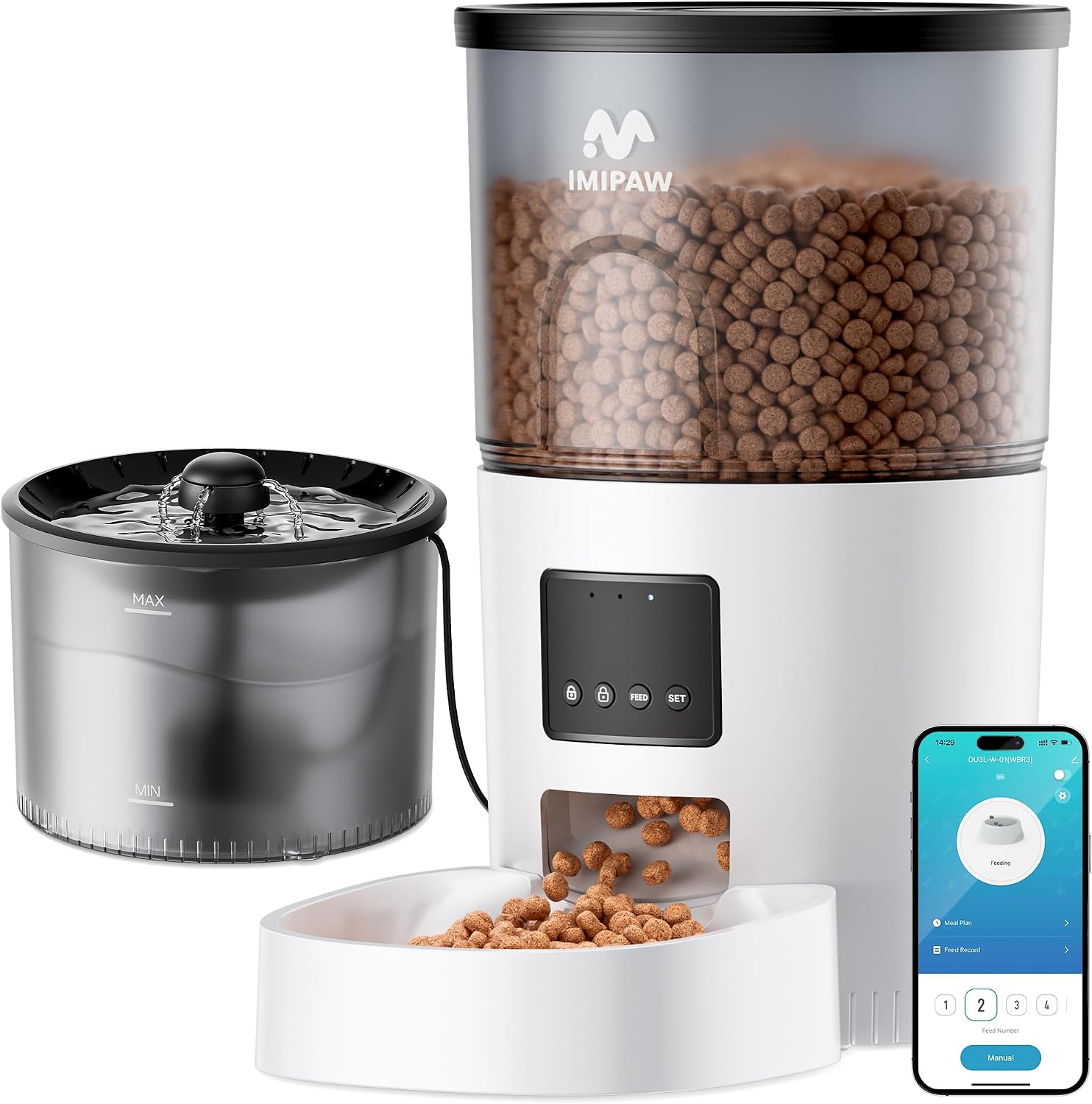
Our pick for most cat homes: IMIPAW 5G WiFi Automatic Cat Feeder and Water Dispenser, Timed Dry Food Dispenser APP Remote Control, Programmable Portions, with Desiccant, Cat Fountains for Drinking with Filter, Small Pets (Combo)
 Visit on Amazon →
This is the combo I would start with for a cat-only home, because it collapses two routines into one. It is a timed dry food dispenser with programmable portions and app control, paired with a drinking fountain that pushes water through a filter. It also ships with desiccant for the hopper, and that detail matters more than it sounds. Coastal San Diego air is wet, and kibble sitting in an open bin goes soft and stale in a couple of weeks. A desiccant pack in a sealed hopper is cheap insurance against a cat who suddenly refuses food that smells off.
The fountain half is what gets a bowl-tipping cat drinking again. Mochi taught me this the way she teaches everything, by knocking over a freshly filled bowl while making eye contact. Moving, filtered water is the whole point of a fountain, and it is the reason a cat who ignores a still bowl will drink from a stream. Place the fountain away from the feeder, not next to it. A lot of cats prefer their water separated from their food, and you get more drinking out of the same unit by splitting them across the room.
Check current Amazon price before you commit, and check it against buying a feeder and a fountain separately, because a combo is only a deal if you actually want both halves.
Flaws but not dealbreakers: A combo means two devices living in one app, and if the app annoys you, it annoys you twice. The fountain filter is a recurring cost you will re-buy, and the pump still needs a weekly rinse no matter how good the filter is. This is dry food only, so if your cat eats wet food, you are buying this for the fountain half and the feeder becomes a backup.
Anyone with one or two cats, a normal work schedule, and a kitchen outlet near where the bowls already live will get the most out of this.
If you also feed the backyard birds
Half my clients keep a feeder on the patio, and the request I get most often is not about the birds at all. It is about the squirrels. Which makes it a mechanism problem, and mechanism problems are the ones I actually enjoy.
Squirrel-proof is not a marketing word the way "anti-jam" is. It describes a real design idea: the feeder reacts to weight. Something light lands and the ports stay open. Something heavy lands and the ports close, so the squirrel gets a perch and no seed. That is a mechanical trigger doing the work, the same way a portion wheel does the work in an automatic cat feeder. The electronics are optional. The trigger is not.
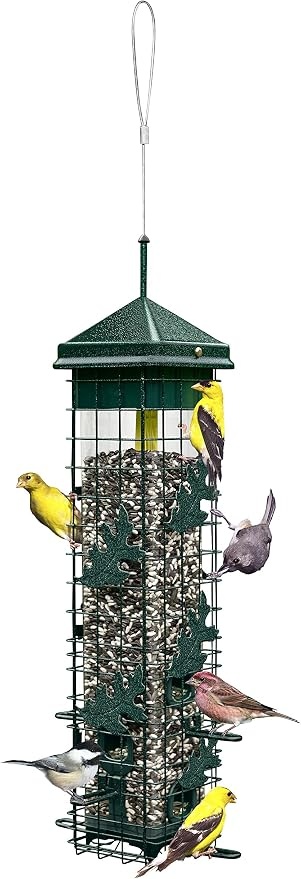
The backyard pick: Squirrel Solution200 Squirrel-proof Bird Feeder w/6 Feeding Ports, 3.4-pound Seed Capacity, Free Seed Funnel
 Visit on Amazon →
Six feeding ports and a 3.4-pound seed capacity, built around a squirrel-proof design, and it comes with a seed funnel. If you have ever tried to pour a bag of sunflower seed into a feeder opening the size of a coffee cup, you already know why the funnel is the most useful thing in the box. You lose less seed to the ground, and you lose less time refilling.
The capacity number is the one to think about before you hang it. A 3.4-pound hopper is a reasonable size for a quiet yard, and it is a twice-a-week refill in a busy one. Match the feeder to how much traffic your yard actually gets, not to how much traffic you hope it gets.
Check current Amazon price, then hang it where a squirrel cannot simply reach it from a fence rail or a branch. Squirrel-proof describes the ports. It does not describe your fence.
Flaws but not dealbreakers: Squirrel-proof is not raccoon-proof, and nothing short of a steel drum is bear-proof. The seed funnel is a nice inclusion, not a reason to buy, so do not let it tip the decision on its own. And clean the ports out seasonally, because old seed paste blocks the openings just as effectively as a squirrel does.
Anyone with a patio, a seed habit, and a squirrel problem will get their money's worth out of this one.
The actual setup workflow
Now the part you came for. This works on any timed feeder and any pump-driven fountain, whether they came as a combo or as two separate boxes.
Step one: pick the spot for the outlet, not the view. You need a plug, a stable surface, and no direct sun. Put the feeder where the bowl already lives so your cat's routine does not change, then put the fountain at least a few feet away in a different room if you can manage it. Cats drink more when water is not sitting next to food.
Step two: weigh the first portion before your cat ever eats from it. Run three test dispenses into a bowl on a kitchen scale. If the delivered grams drift from what you programmed, adjust the setting and run three more. Do this before the hopper is full and before the schedule is live. A portion wheel that over-feeds is the most common defect in this category, and it is invisible until you put food on a scale.
Step three: set the schedule around your cat, not around you. Two meals at the same times every day beats three meals at random times. If your cat is diabetic or on a prescription diet, the timing is medical, not convenience, so build the schedule with your vet and treat any missed meal as a phone call.
Step four: pair the app before you fill the hopper. Do the network setup on an empty machine while you are standing in the same room. If the app cannot find the feeder, the problem is almost always a router band mismatch, so check which band your phone and your router are using before you decide the unit is defective.
Step five: run one full trial day with the cat watching. Be home, be in the next room, and let the schedule fire on its own. You are listening for the dispense, watching whether your cat comes running, and checking the bowl afterward. One trial day catches more problems than a week of reading the manual.
Step six: fill the hopper, then seal it and add the desiccant. Kibble goes stale in humid air, and stale kibble is the number one reason a cat walks away from a full feeder. Keep the lid locked and swap the desiccant on the schedule the manufacturer gives you, not when you remember.
Step seven: rinse the fountain filter and prime the pump before the first drink. New carbon filters shed dust, and a pump that runs dry is a pump that burns out. Fill the basin, let it circulate, then dump that first basin and refill it before your cat gets near it.
Step eight: clean the pump weekly, tear down monthly. Pull the pump every week and rinse the impeller. Once a month, take the whole fountain apart and scrub the basin and the pump housing with a bottle brush. If the pump is hidden inside a compartment you cannot see into, you will skip this, and skipping it is how fountains get slimy.
Step nine: write down your outage plan. Know what your feeder does when the power blips and whether it keeps its schedule or resets to nothing. If it resets, keep a measured backup portion in a sealed container and a neighbor who can pour it. This is the step everyone skips until the first power outage.
Step ten: transition slowly and re-weigh after any food change. Mix old routine and new routine over about a week so nobody gets an upset stomach. Then, any time you switch kibble brands or sizes, re-run the scale test from step two. Kibble shape and density change how a portion wheel meters, and a new food can turn an accurate feeder into a heavy one.
One caveat worth saying plainly: none of this tells you how much food your cat actually ate in a two-cat house. A feeder dispenses. It does not audit. If you need to know who ate what, you need a microchip-reading feeder or separate rooms, and that is a different setup.
The competition and why it lost
The feeders I keep hearing about are good machines, and most of them are simply not what this guide is about. WOPET is the budget answer: plastic, loud, basic app, but it dispenses consistently. PetSafe Smart Feed is the boring veteran that just works, which is the whole job. Petlibro Air is the one I would grab for a single cat in a humid climate, because the sealed hopper does real work. SureFeed Microchip Feeder is the only one I trust in a multi-cat house, because the lid is the entire product.
On the fountain side, the Catit Flower Fountain is the entry point I still recommend to first-timers. PETKIT Eversweet is the one for people who travel, because the low-water alert is genuinely useful. Stainless steel fountains like the Drinkwell line are the better choice if your cat gets chin acne from plastic. Ceramic is what you buy for a cat who tips, and it is heavy enough that you will only drop it once.
None of them are in this guide because this guide is about getting a feeder and fountain running correctly, and about the backyard feeder that solves a squirrel problem. If you want the buying comparison, that is a separate decision, and you should make it with the four questions above in front of you.
What this all costs
The honest answer is that both units here sit in the mid-range, and you should check current Amazon price on each rather than take a number from an article, because these move. What I can tell you is where the real money goes.
The real cost is the second purchase. A feeder that jams, over-feeds, or quits when the Wi-Fi drops costs you the return shipping, the time, and sometimes a vet visit. I have returned four. The units with easy return policies cost me nothing but time, and that is why I tell clients to buy from somewhere with a return window they can actually use, then run the scale test in the first week while the window is still open.
The recurring cost is consumables. Fountain filters get replaced. Desiccant gets swapped. Bird seed gets eaten by things that are not birds. None of that is expensive, and all of it is predictable, which is more than you can say for a jammed auger at 6 a.m.
Spread across two years, a feeder you set up correctly on day one is cheaper than a cheaper feeder you replace twice. The setup is the part that decides which one you bought.
Do the ten steps once. Weigh the portions, pair the app on an empty hopper, clean the pump before it needs it. Then the machine goes quiet, your cat eats on time, and you stop thinking about it. That is the whole job.