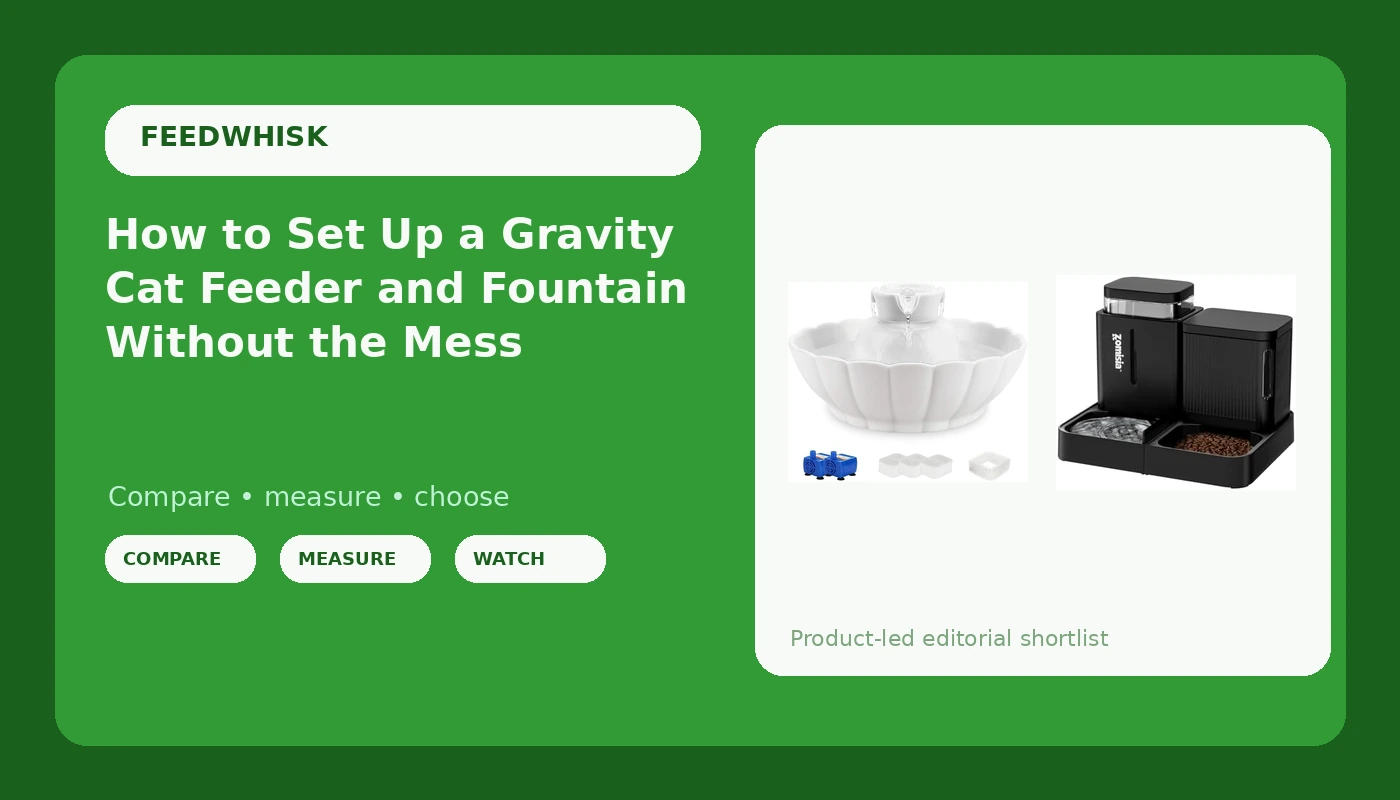
A cat feeder and fountain setup looks like unbox, fill, walk away. It is not. Most of the problems I get called about, the clumped kibble, the pink film in a pump, the cat that stopped drinking, come from the first two hours of setup, not from a bad product.
I have set up feeding stations in more than 60 client households around Pacific Beach, and I run every feeder and fountain in my own apartment for a full month before it goes on a recommendation list. That month is not a formality. It is where I learn whether a cat can tip the thing, whether the kibble survives San Diego humidity, and whether I will actually take the pump apart on a Sunday.
This guide is about the two pieces that matter most in a cat household: the food side and the water side. The ZOMISIA gravity feeder and the iPettie ceramic fountain are the two I would start with, and the setup order below is the one I use in client homes.
Why you should trust me
I am Luis, a pet sitter and dog walker in Pacific Beach. Eight years, 60-plus households, and a graveyard of feeding disasters behind me: the cat that unlatches every lid, the beagle that chewed through a feeder at 3 a.m., the slow feeder bowl that lasted exactly one meal.
I have returned four automatic feeders. One had a jammed auger, two had portion wheels that over-fed by 40 percent, and one app-connected unit stopped feeding the day the Wi-Fi hiccuped. Those returns taught me more than any spec sheet, which is why nothing gets recommended here until it has survived a month in my apartment with Mochi, my tortoiseshell who tips water bowls on purpose, and Tank, my 75-pound lab mix who body-slams gravity feeders until they dump.
That is also why this guide draws a hard line. Gravity feeding is for cats. If you have a dog that eats like Tank, no amount of clever setup will fix a feeder with no portion control, and you should read a portion-control guide instead.
How I picked and how I tested
Four questions decide everything I keep.
Can Mochi tip it, and can Tank break it? Design for the animal, not the marketing photo. How accurate is the portion, weighed on a kitchen scale rather than eyeballed? For a gravity feeder that question changes shape, because the answer is that there is no portioning at all, and the real test becomes whether your cat self-regulates. How long does a full clean take, and will I actually do it weekly? And what happens when the power or the Wi-Fi dies, does the device still feed or water?
For fountains I add one hard rule: if I cannot reach the pump and get it apart in under five minutes, I do not buy the fountain. A hidden pump compartment is hidden for a reason.
For the two units in this guide, the tests look different from an app feeder review. On the food side I am checking whether the reservoir stays sealed, whether kibble stays loose instead of caking, and whether the whole thing stays upright when a cat leans on it. On the water side I am checking weight and stability, whether the pump comes apart without tools, and whether the ceramic holds any smell after a week of use.
The two pieces to set up first
One unit for food, one for water, and they solve different problems. A gravity feeder solves the "my cat wants six small meals a day and I am at work" problem. A ceramic fountain solves the "my cat will not drink still water and tips the bowl to prove it" problem. Get those two right and most of the daily friction disappears.
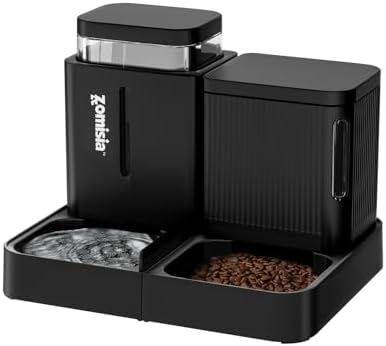
For the cat that grazes: ZOMISIA Automatic Cat Feeder, Gravity Cat Food Dispenser, 0.8Gal x 2, Black
 Visit on Amazon →
This is the simplest food delivery device in the house, and that is the entire argument for it. There is no auger to jam, no portion wheel to drift, no account to create, and no Wi-Fi to lose. Kibble sits in the reservoir, gravity moves it down into the tray, and the cat eats when the cat is hungry. The listing describes 0.8-gallon capacity times two, in black, which is the version that disappears against a kitchen wall instead of announcing itself.
For a cat that nibbles eight times a day, that is exactly the right shape of product. I have taken apart three cheap auger feeders and found the same tolerance problem inside every one, so a feeder with no auger at all sidesteps the failure mode I see most.
Flaws but not dealbreakers: There is no portion control, so this is a cat-only device in my house. A speed eater like Tank would empty it in one sitting and then look for more. Gravity also means the kibble is exposed to your kitchen air the entire time it takes to eat through the reservoir, so humidity, dust, and staleness are real concerns. My habit is to load a smaller batch and refill more often rather than fill it to the top and forget it for two weeks. And because the design is passive, a bored cat can learn to paw at the opening, which is a habit you want to interrupt early by keeping the tray reasonably full.
Anyone with a self-regulating cat and a work schedule that does not allow midday meals will get the most out of this one.
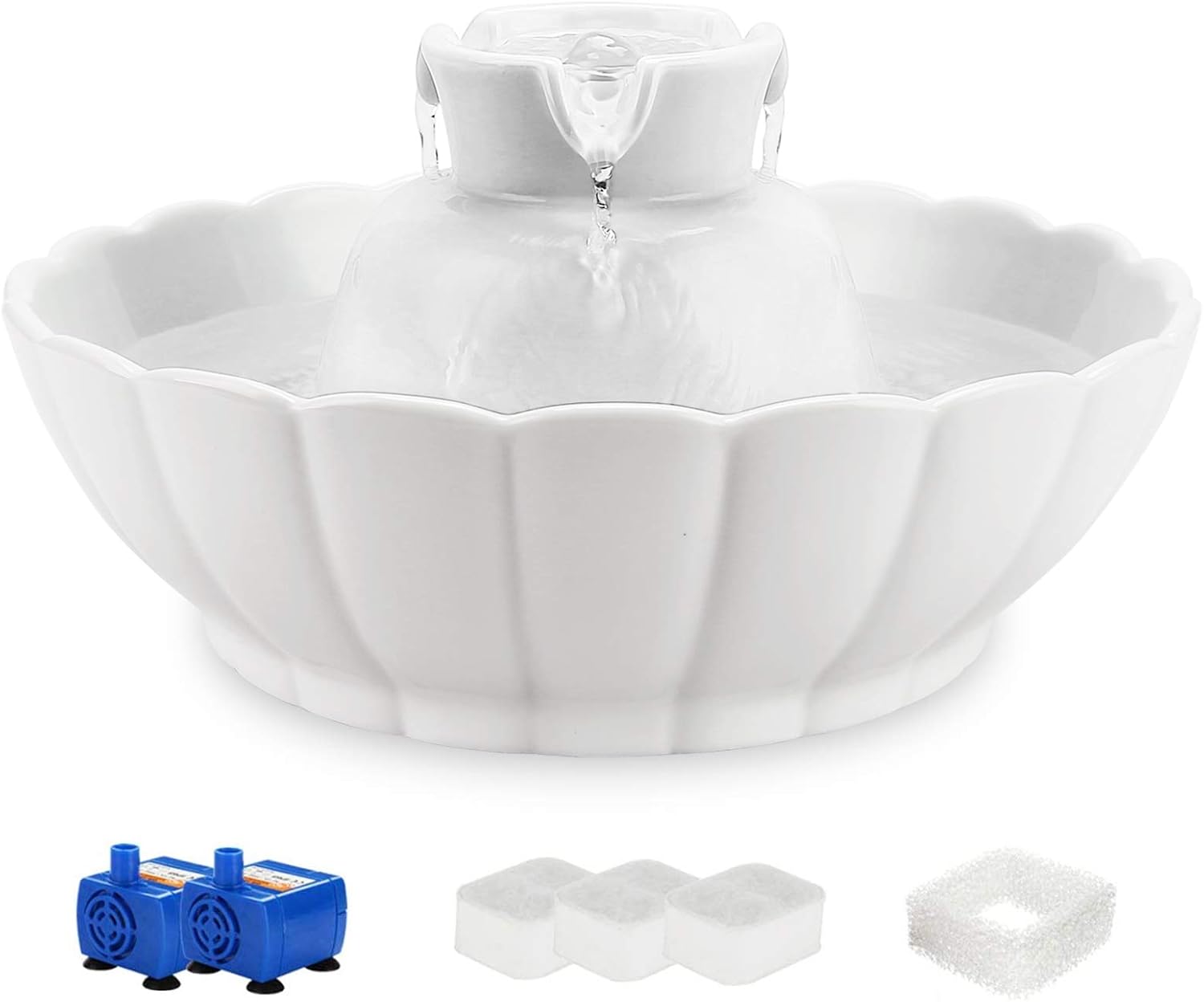
For the cat that tips bowls: iPettie Tritone Ceramic Cat Water Fountain, Heavy-Duty Waterer for Pets
 Visit on Amazon →
Mochi tips bowls. She watched me fill one too many times and decided that still water is an insult. The thing that finally stopped her was weight, and ceramic is the only material in my kitchen that she cannot shove across the floor. The Tritone is built around that idea: a heavy-duty ceramic body with moving water on top, which is also the setup that gets a stubborn cat drinking instead of batting at the bowl.
Ceramic matters for a second reason. I moved Mochi off plastic after she developed chin spots, and ceramic is where she has stayed. It does not pick up the film and odor that plastic does, and it rinses clean with hot water and a soft sponge.
Flaws but not dealbreakers: Ceramic is heavy in both directions. It is heavy enough to stay put, and heavy enough that you have to lift the whole basin to the sink for a real clean, which means one wrong drop on tile and the fountain is gone. I clean mine on a drying mat, with both hands, never over the floor. The second tradeoff is commitment. A ceramic fountain with a pump only stays healthy if you take the pump apart weekly. If you know you will not do that, a cheap plastic fountain you actually clean beats a ceramic one you do not. Finally, weight helps on hard floors and does less on thick carpet, so keep it on tile or a hard mat if your cat is a shover.
Anyone whose cat ignores standing water, or who has replaced one too many tipped bowls, should start here.
The setup order that actually matters
The mistake almost everyone makes is doing these steps in the wrong order, filling first and placing second. Do it this way instead.
Step one: pick two separate spots. Most cats drink more when the water is away from the food. Put the feeder in one place and the fountain in another, not side by side. For the feeder, choose a hard, level floor against a wall, out of direct sun, and away from the dishwasher, oven, or anywhere steam collects. For the fountain, choose a spot where you can reach the plug without dragging the unit, and not in the hallway you stumble through at 6 a.m.
Step two: wash everything before the first fill. Ceramic picks up manufacturing dust, and cats have noses that will reject a soap film you cannot smell. Warm water, a drop of mild dish soap, a hard rinse, then a second rinse. Do the same for the feeder reservoir and tray, then let both air dry completely.
Step three: fill the fountain and run it before you place it. Fill to the line your unit marks, plug it in, and let it run a few minutes. Check that the flow is steady, listen for a rattle or a grind, and confirm the pump is fully submerged. Running a pump dry is the fastest way to kill it, so top the water level before you walk away, not after.
Step four: load the feeder dry. Dry kibble only into the reservoir. Seal the lid fully, and keep the scoop out of the bin or use a clean, dry cup, because a damp scoop is how you grow mold in a food bin. Never top off old kibble with new. Dump the reservoir, wipe it, and refill.
Step five: leave the old bowl in place for three to five days. Cats are suspicious of new objects, and a cold switch is how you end up with a cat that eats nothing for two days. Set the new station beside the old setup, let the cat investigate on its own schedule, and pull the old bowl only after a week of normal eating and drinking.
Step six: set a 60-second daily check. Eye the kibble for clumping, look at the water level, and listen to the pump. That is the whole ritual. It takes less time than filling a bowl, and it is the check that catches a problem before your cat does.
Step seven: schedule the weekly teardown. Unplug the fountain, take it apart, and scrub the basin and the pump impeller with a bottle brush, then rinse and refill. On the feeder, dump the reservoir, wipe it dry, and refill. Both together should take about fifteen minutes. If it is taking longer than that, the fountain is the problem, not you.
Step eight: watch the cat, not the device. If the water level stops dropping, if the litter box changes, or if the cat starts sitting by the feeder and walking away, the hardware is not the point anymore. That is a vet conversation.
What goes wrong, and how to avoid it
Gravity feeding a dog. No. A gravity feeder has zero portion control, and a dog that eats fast will clear it and then bloat. Keep this setup cat-only.
Multiple cats and one station. Free feeding breaks down when one cat camps the feeder. Two cats need two stations in two rooms, or the shy cat eats nothing.
Humidity and stale kibble. In a coastal climate, kibble left in an open reservoir goes soft and eventually rancid. Smaller batches, more refills.
Slime in the pump. A fountain is a wet, warm, moving environment, which is exactly what biofilm wants. Weekly teardown is not optional, and any fountain where you cannot see and reach the pump is a fountain I would skip.
Power loss. The gravity feeder does not care. The fountain stops. Keep a plain bowl of still water in a bathroom as an emergency backup, and accept that a bowl-tipping cat may tip it once in a while.
Ceramic on tile. One drop ends it. Clean over a mat, not over the floor, and never carry a full basin one-handed.
What this costs to run
Both pieces are one-time purchases, so the honest cost conversation is about what comes after. You pay for kibble, for whatever replacement filters your fountain's manual calls for, for the electricity the pump draws, and for your own time. Fifteen minutes of weekly cleaning is roughly thirteen hours a year, which is less than the time you spend refilling a bowl every morning and rinsing it every night.
Check current Amazon price for the feeder and the fountain before you decide, because both move around, and compare that against the cost of a feeder you return in three weeks. The units I kept are the ones that survived a month, not the ones with the best box copy.
Set the station up in the right order, keep the water moving and the kibble dry, and clean the pump on a schedule you will actually keep. That is the whole job, and it is a fifteen-minute job once a week. Do it and your cat stops treating still water as an insult.