Most people who go looking for a gravity feeder and waterer setup are trying to fix one of two problems: a cat who grazes all day and yells at 5 a.m. for a refill, or a work schedule that keeps them out of the house for ten hours. I have set up both versions in client homes around Pacific Beach for eight years, and I have watched the same three mistakes turn a two piece station into a slime farm inside a week.
Gravity is the oldest feeding technology there is. No auger, no portion wheel, no app, no power cord. A reservoir holds the food or the water, and physics moves it down into the bowl as your pet eats or drinks. Nothing to jam. Nothing to update. Nothing to reconnect after the Wi-Fi hiccups. That is the whole appeal, and it is a real one.
The tradeoff is control. A gravity feeder cannot portion, cannot schedule, and cannot tell you how much your pet actually ate. It free feeds, full stop. For a grazing cat that is fine. For a dog that inhales kibble, it is a vet bill with a bowl attached.
So this is the guide I wish more clients had read before they bought one: where to put the station, how to fill it without an airlock, how to keep it clean enough that you will actually keep cleaning it, and how to tell when gravity is simply the wrong tool for your animal.
Why you should trust me
I am Luis, a pet sitter and dog walker in San Diego with a client list of more than 60 households. Over 14 months I returned four automatic feeders: a jammed auger, two portion wheels that over fed by 40 percent, and one app connected unit that stopped feeding the day the Wi-Fi dropped. Those returns taught me more about feeding hardware than any spec sheet, which is why every unit now runs a full month in my apartment before I will recommend it to a client.
My test subjects are a tortoiseshell cat named Mochi, who deliberately tips still water bowls because she has decided standing water is an insult, and a 75 pound lab mix named Tank, who has learned to body slam gravity feeders until they dump their contents on the floor. They are the reason I care about base weight, bowl depth, and reservoir seals.
My rules are simple. A feeder a determined pet can break will be broken. A fountain I cannot clean in under five minutes is a dirty fountain by Friday. And no portion claim counts until I have weighed it on a kitchen scale.
What a gravity station does well, and what it cannot do
A gravity feeder and waterer setup is at its best in a quiet, single pet household with a grazer. Cats who nibble eight small meals a day do well on it. So do rabbits, guinea pigs, and small dogs who self regulate. It is also the cheapest way to leave water available all day without running a pump, and it survives a power outage, which no app connected feeder can say.
It falls apart in four situations. First, speed eaters, who will empty the reservoir and then look for more. Second, multi pet homes where one animal guards the bowl and the other never gets near it. Third, any pet on a measured diet, a prescription diet, or a weight loss plan, because gravity cannot measure anything. Fourth, humid kitchens with ants or pantry moths, where an open reservoir of kibble becomes a habitat.
One more caveat that surprises people: a gravity waterer holds standing water. The reservoir keeps the bowl topped off, but the water in the bowl is still. If your cat tips bowls because she wants movement, gravity will not satisfy her. That is a fountain conversation, not a feeder conversation.
The gear I would start with
You need two pieces: a water side and a food side. You can buy them separately or as a matched set, and the matched set is usually the better call because the two halves are sized to sit next to each other without one towering over the other.
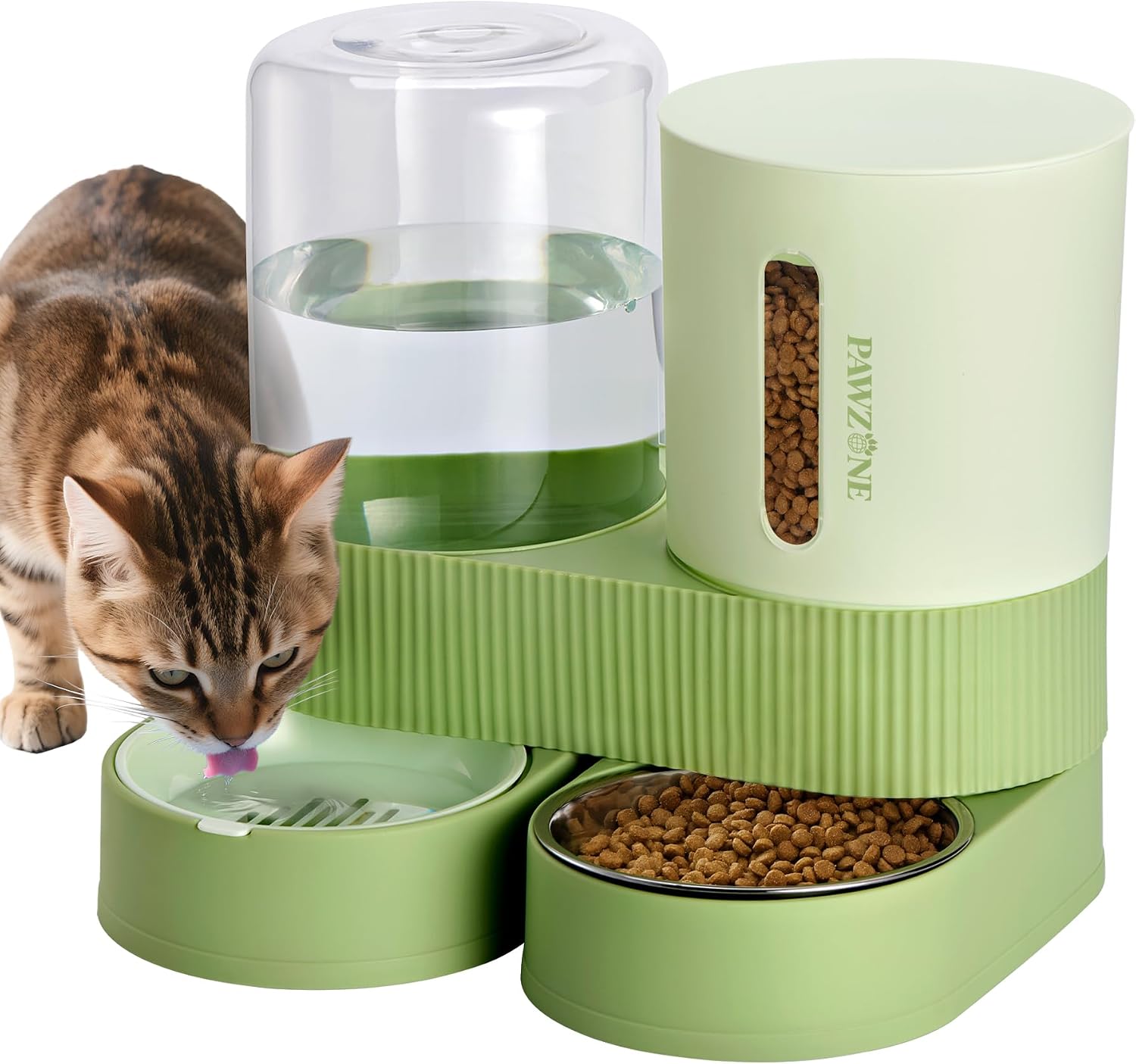
Our pick: Automatic Cat Feeder Stainless Steel Water Dispenser Gravity Food Feeder and Waterer Set with Pet Food Bowl for Small Medium Kitten Puppy Pets Large Capacity(Green)
 Visit on Amazon →
This is the set I point clients toward when they want gravity and nothing else. You get both halves in one box, which matters more than it sounds, because the most common failure I see with mismatched gravity gear is a food reservoir that is taller and lighter than the water reservoir next to it, and a cat who knocks over the food side to get at the water side.
The stainless steel water bowl is the part I care about most. Plastic bowls are the usual suspect when a cat shows up with chin acne, and stainless is the easy fix. The food side uses a reservoir that feeds down into a bowl, and the set is sized for kittens, puppies, and small to medium adult pets, so it is not the station for a 75 pound lab who body slams things.
What it is not: a portioned feeder. There is no timer, no wheel, no schedule. You fill it, it feeds down, you refill it. If that is what you want, this is a clean, low parts count way to get it, and the green colorway at least looks intentional in a kitchen corner.
Flaws but not dealbreakers: Gravity means the food bowl is open, and an open bowl is fair game for any dog with a nose. And like every gravity reservoir, the food side is not sealed, so buy smaller bags of kibble and keep the rest clipped shut.
Check current Amazon price before you commit, since these sets move around.
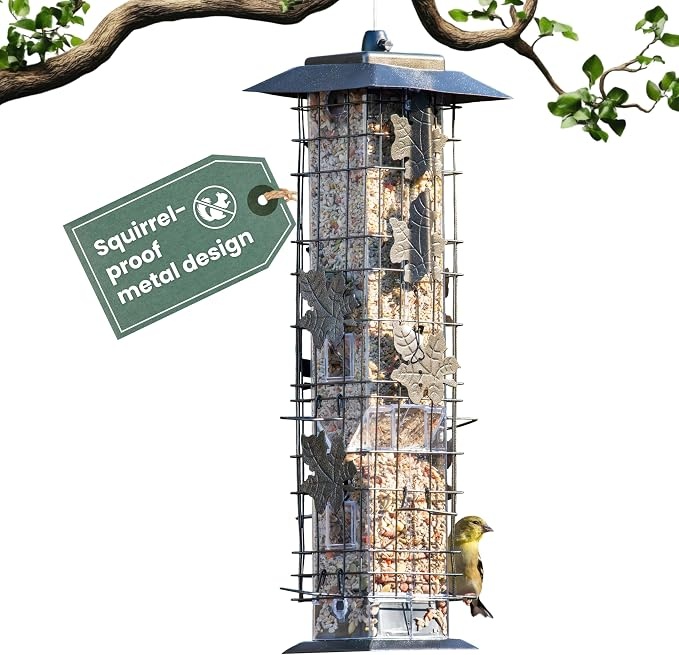
Outdoor add-on: Perky-Pet Squirrel-Be-Gone Bird Feeder, 2 lb Seed Capacity
 Visit on Amazon →
This one is not for your cat or your dog. It is for the birds, and it belongs in this guide because households that build a feeding station inside almost always end up wanting one outside too, and the two should never share a wall. This Perky-Pet model is a hanging feeder with a 2 lb seed capacity and a squirrel deterrent design built into the name, which means it is aimed at the same problem gravity pet feeders have: a determined animal who wants the food and does not care about your plans.
Two rules if you hang one. Keep it well away from where your pets eat, because spilled seed draws rodents, raccoons, and the neighborhood cats, and a raccoon at your pet's food bowl at 2 a.m. is a whole different article. And do not let seed sit in it through a wet San Diego winter, because moldy seed is worse than no seed.
Flaws but not dealbreakers: Squirrel resistant is not squirrel proof, and a feeder that is easy for you to refill is usually easy for a squirrel to figure out. Hang it from a shepherd's hook or a line, not from a branch the squirrel can reach across.
Check current Amazon price on this one too, since bird feeders are seasonal stock.
How to set up a gravity feeder and waterer, step by step
Step one: pick a spot your pet cannot guard or tip. A kitchen corner against a wall beats the middle of a hallway every time. Keep it away from the litter box, out of direct sun, and away from anything with a cord. In a multi pet home, put two stations in two different rooms rather than one station everyone fights over.
Step two: wash everything before the first fill. Warm water, a drop of mild dish soap, rinse until there are no suds, and let it air dry. Manufacturing residue and warehouse dust are real, and your cat will smell both.
Step three: set up the water side first. Fill the reservoir, seat the base, invert it, and press the bowl down so water releases and the vacuum forms. If water trickles and then stops, the seal is not seated. If the bowl floods and keeps flooding, you have lost the vacuum and there is a leak path somewhere in the gasket.
Step four: fill the food reservoir with dry kibble only. Gravity needs free flowing dry food. Wet food, freeze dried chunks, and mix-ins bridge in the chute and stop the flow, and then you have a pet staring at a full reservoir and an empty bowl.
Step five: let both halves settle for an hour before you trust them. Watch the water level and the kibble level. A reservoir that drains on its own in an hour has a bad seal. A bowl that never refills has an airlock.
Step six: put a tray or a mat underneath. Water rings ruin wood floors, and a tray also gives you one thing to carry to the sink instead of two.
Step seven: transition, do not swap. Keep the old bowls out for three to five days and put the new station beside them. Cats in particular are suspicious of a new object in their territory, and Mochi has refused a bowl for two days purely out of spite.
Step eight: audit for the first week. Measure what you pour into the reservoir so you know what is disappearing. If a pet empties it in a day, gravity is the wrong tool and you need portions, not a bigger reservoir.
Step nine: anchor it if your pet is a bulldozer. If your dog body slams the feeder, wedge it into a corner, use a heavy base or a lipped mat, or move it into a room the dog cannot get into. Designing around the animal beats replacing the gear.
How to keep it clean without hating it
Rinse the water bowl daily with hot water. Once a week, take the whole water side apart, scrub the reservoir and the bowl with a bottle brush and mild soap, and rinse thoroughly. A slick film on the inside of the bowl is biofilm, and it shows up faster than people expect in a warm kitchen.
Skip the dishwasher unless the manufacturer says otherwise, because heat warps gaskets and a warped gasket is a flooding waterer.
For the food side, empty the reservoir completely, wipe it out, and let it dry before refilling. Kibble oils go rancid against plastic, and stale kibble is the number one reason a cat walks away from a gravity feeder after two weeks. Once a month, do a full vinegar soak on the water side, then rinse until you cannot smell it.
If you also run a fountain, the same rule applies: if you cannot see the pump, you cannot clean the pump, and a hidden pump compartment is a slime trap.
What goes wrong, and how to fix it
Water stops flowing. Almost always an airlock or a gasket that is not seated. Take the reservoir off, reseat the seal, invert, and press again.
The bowl floods. Same seal, different symptom. Check for a cracked base or a gasket folded over on itself.
Kibble arches in the chute. Tap the side of the reservoir. If it happens daily, your kibble is the wrong shape or the chute is too narrow, and no amount of tapping fixes that.
Kibble goes stale. A gravity reservoir is not sealed, so buy smaller bags and rotate the contents. In a humid climate this matters more than the brand.
Ants and gnats. Rinse the bowl daily, keep the station off the floor if you can, and stop leaving crumbs in the tray.
Your cat tips it anyway. Weighted base, lipped mat, corner placement. And if she is tipping the water specifically, she is asking for moving water. Get her a fountain.
Your dog drains it. Separate rooms or a portioned feeder. There is no gravity fix for a speed eater.
What it costs to run, in time
The gear is the cheap part, and you can check current Amazon price on both items above. The real cost is maintenance: about two minutes a day for a rinse and a level check, and ten to fifteen minutes a week for a full clean. That is roughly 15 hours a year per station.
Compare that to the alternative, which is a portioned feeder you have to program, charge, and troubleshoot, and the gravity setup wins on simplicity every time. Compare it to a pet who stops drinking because the bowl went empty while you were at work, and the math is not close at all.
The short version
Gravity is the right answer for grazing cats, small pets, and anyone who wants water available without a pump or a power cord. It is the wrong answer for speed eaters, measured diets, and multi pet homes with a food guarder. Set it in a corner, wash it before the first fill, rinse the bowl daily, take the water side apart weekly, and rotate the kibble so it never goes stale.
Do that, and a two piece gravity station will outlast three app connected feeders that cost four times as much. That is not nostalgia. That is just fewer parts to break.