Most people set up an automatic cat feeder and water dispenser in ten minutes, walk out the door, and come home to a cat that is overfed, underfed, or drinking out of the toilet because the fountain pump clogged on day four. I have watched all three happen in other people's homes, which is exactly why I stopped trusting the quick-start card.
A feeder is not an appliance you plug in and forget. It is a machine that has to survive your animal. Mochi, my tortoiseshell, has flipped every open water bowl in my apartment, and Tank, my 75-pound lab mix, has body-slammed two gravity feeders until they dumped a week of kibble on the floor. That is the real test, and it happens after you leave.
The setup below takes about 40 minutes the first time. Do it once, do it properly, and the routine runs itself for months.
Why you should trust me
I have been a pet sitter and dog walker in Pacific Beach for eight years, with a client list that has topped 60 households. In that time I have returned four automatic feeders: one with a jammed auger, two with portion wheels that over-fed by roughly 40%, and one app-connected unit that quit feeding when the Wi-Fi hiccuped during a storm. Those returns taught me more than any spec sheet.
Every unit I recommend now runs in my own apartment for a full month first, with a cat who tips things and a dog who eats like a shop vac. If it survives both of them, it goes on the list.
How I picked and how I tested
The two items below are not a ranking of every feeder on the market. They are the hardware I would hand a client who wants a feeding routine that holds up when nobody is home: a metered feeder with a sealed water station, and a puzzle toy that slows down a fast eater without electronics.
My checklist is short and boring. Can the animal tip it or chew it open? Does the dispense mechanism move kibble without an auger that binds? Can I clean the water side in under five minutes, because a fountain that is annoying to clean is a dirty fountain by Friday? And what happens when the power or the network drops, does the device still feed on schedule?
Portion accuracy is the part owners skip. I weigh meals on a kitchen scale for the first week, not to grade the machine but to learn what a portion actually looks like in the bowl. Most overfeeding I see in client homes is not a broken feeder. It is a feeder set to the wrong number.
The hardware you need before you start
You cannot build a routine around gear that fights you. Start with the food and water, then add the enrichment.
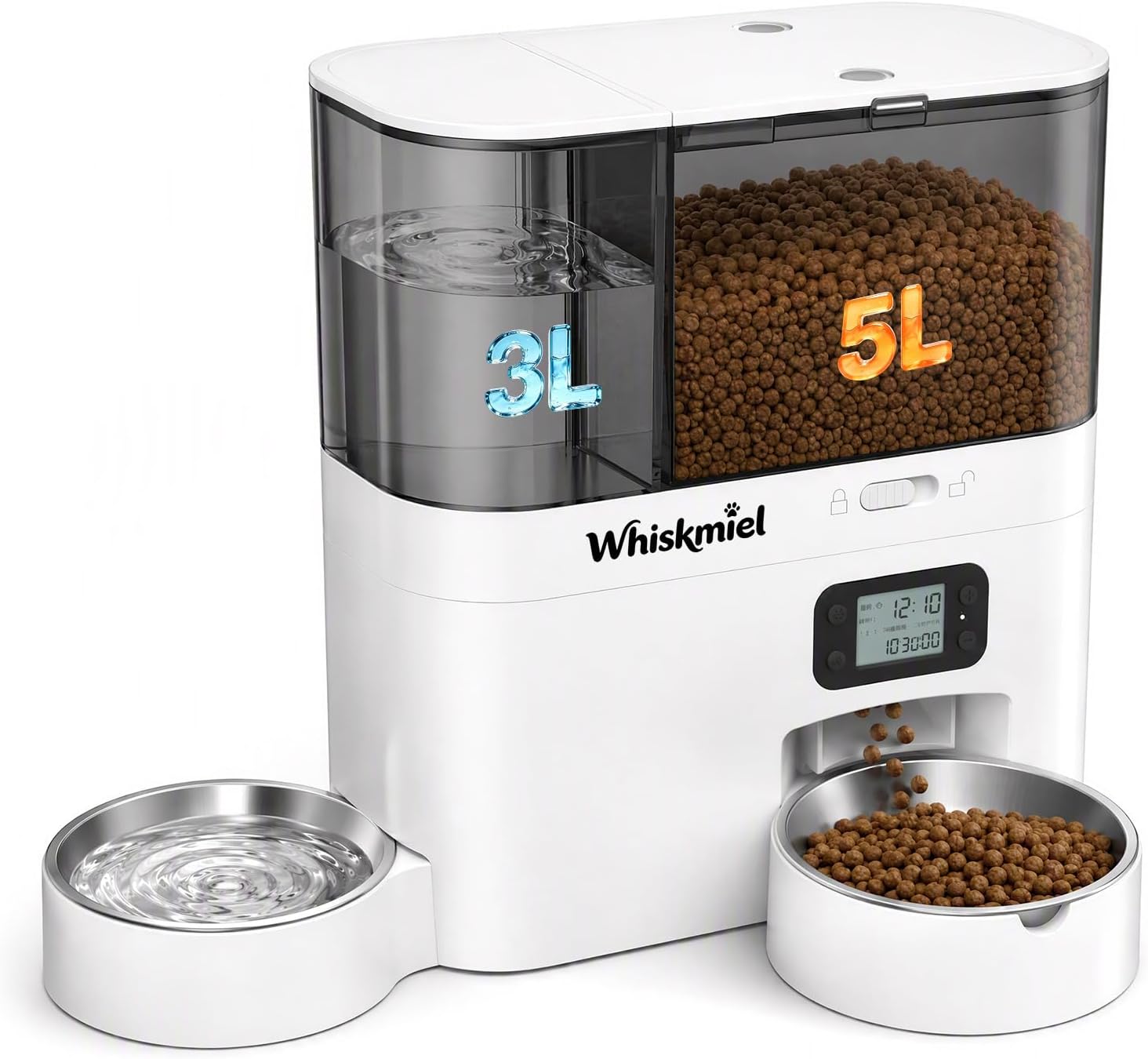
Our pick: 5L Automatic Cat Feeder & 3L Water Dispenser, Button Control
 Visit on Amazon →
This is the combination unit I hand to most clients: a 5L dry food hopper paired with a 3L water reservoir, run entirely from buttons on the device. That last detail matters more than it sounds. There is no account to create, no app to update, and no router to blame. You press a button, you set a schedule, you walk away.
The two-bin design is the practical part. One machine covers food and water, which means one cord, one footprint, and one thing to clean instead of two. For a cat home, or a small dog home, that simplicity is worth more than any dashboard.
The hopper is the piece to inspect when you unbox it. Kibble stored in an open bin in a San Diego apartment picks up humidity and goes stale, and stale kibble is how you get a cat that walks away from a full bowl. Check that the lid seats fully before you fill it, and keep the whole unit out of direct sun.
On the water side, the reservoir holds enough that a single cat will not drain it in a day, but the pump is the part that decides whether this works long term. Read the manual for the cleaning interval and follow it. I cannot say this strongly enough: the pump is the product. A pretty water dish with a slimy impeller is a vet visit waiting to happen.
Flaws but not dealbreakers: Button control means no remote alerts and no feeding history on your phone. If you travel for weeks at a time and want a notification when the hopper runs low, this is not that machine. For a weekend trip, or for someone who wants zero app friction, the trade is worth it.
Households with one or two cats, or a small dog, that want food and water handled by one unit should start here.
The gear that makes the routine work
Automation handles the calories. It does not handle the animal's brain.
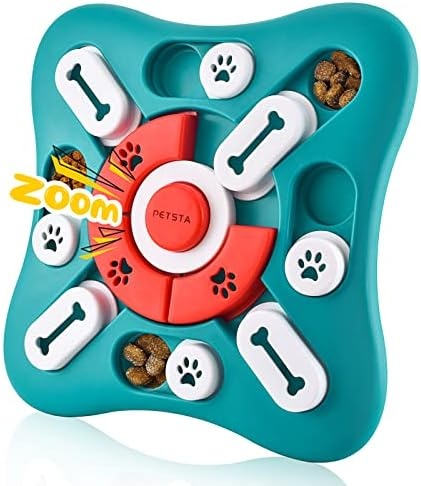
Enrichment pick: PETSTA Dog Puzzle Toys, Treat Dispensing Dog Enrichment Toys for IQ Training and Brain Stimulation, Interactive Mentally Stimulating Toys as Gifts for Puppies, Cats, Dogs
 Visit on Amazon →
A feeder that drops kibble at 7 a.m. solves the timing problem and creates a new one: the animal eats in 90 seconds and then stares at the wall. Tank inhales his bowl in under a minute. If I feed him and leave, he finds something else to do, and "something else" is usually a baseboard or a trash can.
This puzzle toy is the counterweight. It dispenses treats through the animal's own work, so the meal takes minutes instead of seconds, and the mental effort tires a dog out faster than a walk around the block. It works for puppies, adult dogs, and cats, which is why it earns a spot in a routine built around a feeder.
Two things to plan for. First, this is a treat toy, not a meal replacement, so keep the calories accounted for or you will quietly undo the portion control you just set up on the feeder. Second, introduce it supervised. A frustrated dog will chew a puzzle apart, and a puzzle that gets destroyed on day one is not enrichment, it is a chew toy with extra steps.
Flaws but not dealbreakers: It is not a slow feeder bowl, and it will not fix a dog that bolts food. It slows the eating and occupies the brain. The actual bowl still does the portioning.
Anyone with a fast eater, a bored indoor cat, or a puppy that needs a job should add this to the setup.
The actual setup workflow
Now the part that decides whether any of this works. About 40 minutes, once.
Step one: Pick the location before you unpack anything. The feeder goes on a hard floor, against a wall, out of the kitchen traffic path. Not next to the water heater, not under a window where the sun cooks the hopper, and not somewhere you have to step over it at 6 a.m. A feeder that gets bumped gets moved, and a moved feeder leaks kibble at the seams.
Step two: Level it and test stability with your own hand. Press down on the top of the hopper and try to slide it. If it rocks or slides on tile, put a silicone mat underneath. This is the cheapest insurance against a tipped unit.
Step three: Fill the hopper and seal the lid. Fill it dry, wipe the rim, and press the lid until it seats. Moisture is the enemy of a hopper, and a lid that is 90% closed is 100% open as far as humidity is concerned.
Step four: Fill the water reservoir and run the pump for a full cycle. Watch the water move. Listen to it. If the pump rattles or the flow is a trickle instead of a stream, stop and read the manual before you set a schedule. You want to learn the sound of a healthy pump on day one, because that is the sound you will be checking for from across the room later.
Step five: Set the schedule and the portion, then verify with a scale. Program the meals, then let one portion drop into a bowl on a kitchen scale. Write the number down. Do this for three days in a row. If the delivered amount drifts, you found the problem at home instead of at 10 p.m. on a Saturday while you are out of town.
Step six: Run a power-cut drill. Unplug the unit for 60 seconds and plug it back in. Does it remember the schedule, or does it reset to a default? Some feeders hold their settings; some do not. Knowing which one you own takes a minute and prevents a missed meal.
Step seven: Place the puzzle toy away from the feeder. If the treat toy sits next to the food bowl, the animal will ignore the food and work the puzzle for treats all day. Put it in another room or at least across the floor, and use it at a different time of day.
Step eight: Do a full clean before your first trip. Take the hopper out, take the reservoir off, and clean everything the way the manual says. Time yourself. If the clean takes twelve minutes on a calm Sunday, it will not happen on a Wednesday night, and a water station that does not get cleaned is one that grows biofilm.
If you have a multi-cat home, add a ninth step: watch the first three meals in person. Two cats and one feeder is a recipe for a shy cat that never eats. That is a separate problem with a separate solution, and no amount of programming fixes it.
Why the alternatives lose
Gravity feeders are the most common thing I remove from client homes. They are fine for a grazing cat and genuinely dangerous for a dog like Tank, because the reservoir refills the bowl as fast as the animal empties it. There is no portion control at all, and the whole point of automating a feeding routine is control.
App-first feeders are the second category I get asked about. The app is a feature. The auger is the product. If the dispense mechanism binds, no notification on your phone will feed your cat, and I have returned a unit for exactly that reason. A machine that needs a network connection to do its one job is a machine with two points of failure.
Open water bowls lose for a different reason. Still water gets ignored by a lot of cats, and Mochi is proof: she tipped bowls for months until she got moving water, and the tipping stopped. If your cat is knocking over the bowl, that is not mischief. It is a request.
What this all costs
I am not going to quote you prices, because they move and because the number that matters here is not the sticker. It is the time.
The setup above is about 40 minutes the first time. The weekly maintenance is five to ten minutes: rinse the water side, check the hopper seal, wipe the dispense chute. The payoff is a routine that runs while you are at work, at dinner, or on a plane, and a pet that eats the same amount at the same time every day.
That consistency is the actual product. It is what a client with a diabetic cat taught me, and it is the reason I test every unit for a month before it goes into someone else's home. Buy the machine that keeps the schedule, then build the routine around it. Check current Amazon price, set both up once, and let them do the boring part for you.