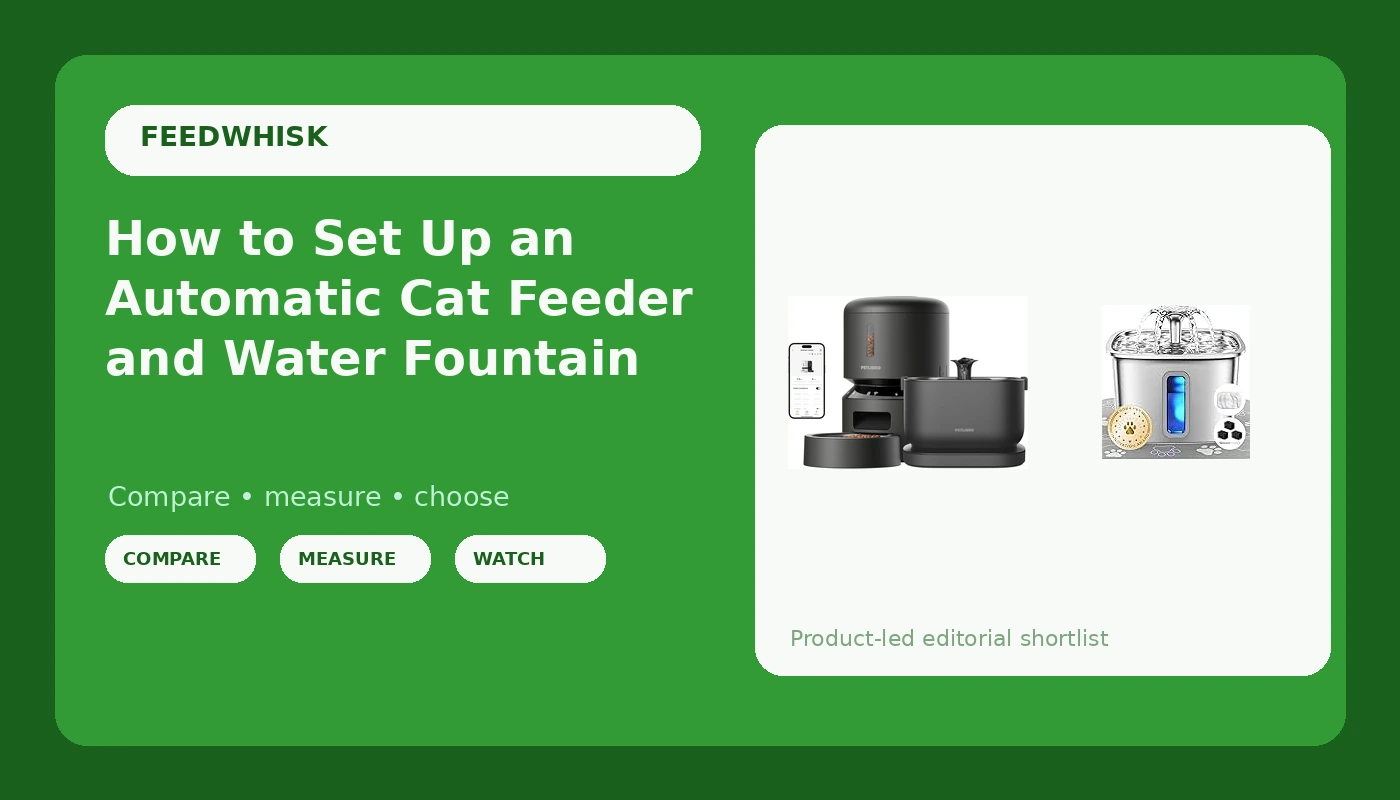
A still bowl of water and a bowl of kibble is the simplest setup in pet care, and it is also the setup that falls apart the first week you work a double shift. An automatic cat feeder and fountain solves two separate problems: food timing and water freshness. The mistake almost everyone makes is buying both at once, plugging them in, and walking away before confirming that the food actually comes out in the right amount and the water actually stays clean.
I have been a pet sitter and dog walker in Pacific Beach for eight years, with a client list north of 60 households and a graveyard of feeding disasters to show for it. I have watched a diabetic cat miss a meal because an auger jammed. I have watched a beagle chew through a feeder at three in the morning. That is the lens I use now.
The setup order below is the one I walk clients through. It takes an afternoon, and it is the difference between a feeder that works for a year and one you return inside a month.
Why you should trust me
Eight years of sitting, 60+ households, and four returned automatic feeders of my own. One jammed its auger in the second week. Two over-fed badly on the portion wheel. One was app-connected and stopped feeding entirely when the Wi-Fi hiccupped while I was three miles away from the house.
The returns taught me more than any spec sheet did, which is why every unit gets a full month in my own apartment before it gets recommended to a client's home.
My test animals are the two pets who are best at breaking things. Mochi is a tortoiseshell who tips any water bowl she can reach, because she has watched me fill one too many times and decided that still water is an insult. Tank is a 75-pound lab mix who inhales kibble like a shop vac and has learned to body-slam gravity feeders until they dump.
My bias is simple. The app is a feature, the auger is the product. If the dispense mechanism jams, the Wi-Fi is worthless.
How I picked and how I tested
Every unit that gets recommended here goes through the same routine. A full month in my apartment with Mochi and Tank. A kitchen scale under the bowl for portion checks, because "about a cup" from a portion wheel is a marketing claim until you weigh it. A cleaning timer, because a fountain that takes 20 minutes to break down is a fountain that gets cleaned twice a year instead of twice a week.
Three questions decide whether a unit stays:
- Can Mochi tip it, or Tank break it?
- Does the portion come out accurate when it is weighed rather than eyeballed?
- What happens when the app dies? Does the device still feed on schedule?
That third question is the one most buyers skip, and it is the one that matters most. A feeder that needs a live internet connection to drop a meal has a single point of failure, and that failure lands on the day you are stuck at work.
The two units below are the gear this routine is built around. One covers food and water in a single system. The other covers water only, for a household that already has feeding handled.
The gear this routine is built around
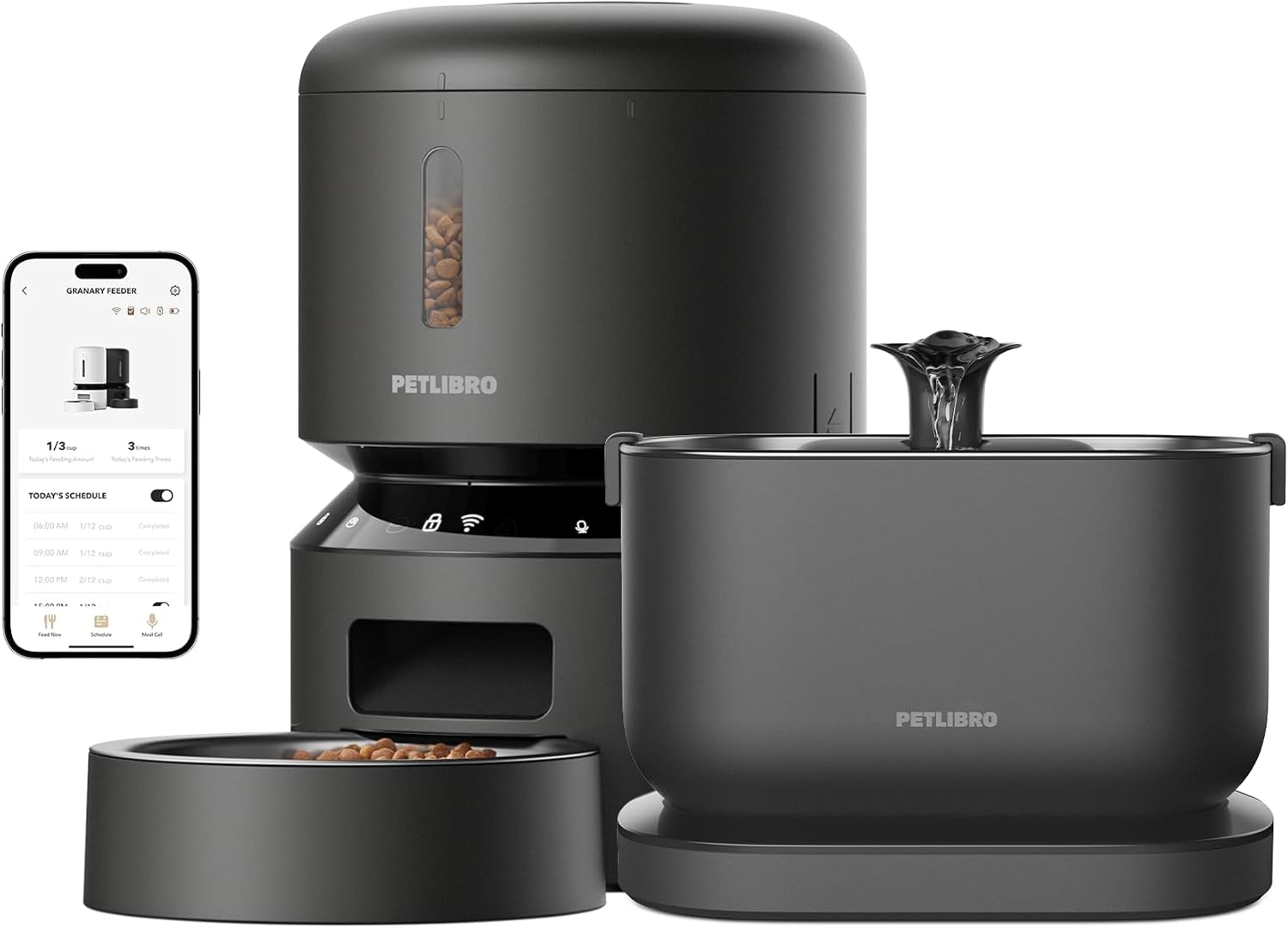
The full system pick: PETLIBRO 5L Wi-Fi Automatic Cat & Dog Feeder Low-Food Sensor, Freshness Preservation with APP + 2.5L Cordless Smart Cat Water Fountain with Battery Operated, Stainless Steel Tray, BPA-Free, Easy-Clean
 Visit on Amazon →
This is the pairing I would buy for a household that wants one app and one power story. The feeder half holds 5 liters of kibble in a sealed hopper, which matters more in a coastal apartment than people expect. San Diego humidity gets into an unsealed bin and softens the bottom inch of kibble, and a cat will refuse soft kibble long before you figure out that the bin is the problem. The low-food sensor is the feature I care about most, because the real failure mode of every feeder I have owned is not a jam, it is an empty hopper discovered on a Sunday night.
The fountain half is cordless and battery operated with a stainless steel tray, and that combination solves the two things that kill fountains in my clients' homes. Cordless means no cable for a cat to chew and no requirement that the fountain sit within reach of an outlet. Stainless steel means the drinking surface is not plastic, which is the change that cleared up Mochi's chin spots after months on plastic bowls.
The tradeoff is that you are buying two devices in one box, so a failure in either half sends the whole thing back. The app also does more work here than I like. I want the feeding schedule to live on the device, not in the cloud, and I want to confirm that before trusting it with twice-daily meals for a diabetic cat.
Flaws but not dealbreakers: A 5-liter hopper is more food storage than a single cat needs, and kibble that sits too long goes stale. If you have one small cat, fill it halfway and top it up weekly instead of filling it to the lid.
For a multi-pet household, or an owner who travels and wants the routine covered by one purchase, this is where I would start.
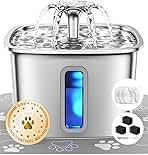
The stainless fountain pick: Veken Innovation Award Winner Stainless Steel Cat Water Fountain, 108oz, C1
 Visit on Amazon →
If feeding is already handled and your only problem is a cat who tips bowls or ignores still water, this is the simpler answer. 108 ounces is a little over three liters, enough that you are not refilling it every morning, and the stainless steel top gives you the same chin-friendly drinking surface as the PETLIBRO fountain without the app or the battery.
Stainless also wins on cleaning. Plastic fountains grow a biofilm in the pump housing and the spout that you can smell before you can see it, and rinsing does not fix it. A stainless tray goes in the sink and comes out clean.
Flaws but not dealbreakers: A corded fountain needs an outlet near the water, which limits where you can put it. And a fountain is only as good as its pump access. If you cannot see and reach the impeller without a screwdriver and a flashlight, you will not clean it often enough.
This is the fountain I point clients to when they want running water, a stainless drinking surface, and nothing to configure.
The actual setup workflow
None of this is hard, and all of it needs to happen before your pet's first automatic meal.
Step one: Place the feeder on hard floor, and the fountain away from the food. Carpet lets a determined dog slide a feeder across the room, so put it on tile or hardwood, in a corner or against a wall where it cannot be pushed. Keep the water a few feet from the food. Cats are notoriously willing to drink less when the water sits right next to the bowl, and a fountain placed beside the kibble often gets ignored for exactly that reason.
Step two: Calibrate the portion with a kitchen scale. Set the feeder to dispense a single portion, catch it in a bowl on the scale, and weigh it. Do that several times. If the delivered weight is consistently off from what you programmed, adjust the portion size until the scale agrees with your target, then write that number on a sticky note inside the hopper lid. Portion accuracy is the entire product, and it is the one thing you can verify at home in ten minutes.
Step three: Prove the device feeds without the app. Program a schedule, then cut the Wi-Fi at the router for one feeding cycle and see what happens. If the meal still drops, you have a feeder you can trust. If it does not, you need a fallback plan, because routers fail and so does your internet provider.
Step four: Build the schedule around the animal, not your convenience. Feeding times should be consistent to the minute, especially in households with a cat on medication or a dog prone to bloat. Pick two times you can actually keep on weekends too. A feeder that dispenses at 6 a.m. on Tuesday and 9 a.m. on Saturday is teaching your pet that the schedule is negotiable.
Step five: Fill the hopper correctly, and empty it weekly. Kibble goes stale, and topping off stale kibble with fresh kibble is how you end up with a pet that refuses the feeder entirely. Empty the hopper completely once a week, wipe it dry, and refill. In a humid climate, that weekly empty matters as much as the seal does.
Step six: Prime the fountain and watch the flow for a full minute. Fill it, seat the tray, and let it run before you walk away. You are checking two things: that water is actually moving over the drinking surface, and that the pump is not slurping air. A fountain that dribbles gets ignored, and a fountain that gurgles gets tipped.
Step seven: Set a cleaning cadence you will keep. Weekly for the bowl, tray, and reservoir. Every few days for the pump and impeller in warm weather, because that is where slime starts. If a full teardown takes longer than five minutes, you will stop doing it, so time yourself the first time and be honest about it.
Step eight: Transition the pet slowly. Do not remove the old bowls on day one. Leave them out for a week while the feeder and fountain run beside them, so the pet learns that the new objects are where food and water come from. Pull the old water bowl last, once you have seen your cat drink from the fountain more than once.
Step nine: Write down the outage plan. Know how long the feeder runs on batteries, whether the fountain keeps circulating without wall power, and what you will do if both die while you are at work. For most households the answer is a battery-operated fountain and a neighbor with a key.
What doesn't work, and why
Gravity feeders are for grazing cats and nobody else. A reservoir on top of a bowl refills itself by gravity with no portion control at all, which is fine for a cat that nibbles and dangerous for a dog that eats like Tank. There is no version of this design that meters a meal, and it is sold to dog owners constantly.
Plastic fountains with hidden pump compartments are a slime trap. If the pump is buried behind a molded housing you have to disassemble to reach, cleaning stops happening by week three. If I cannot see the impeller, I do not buy the fountain.
App-only scheduling is a single point of failure. Any feeder whose feeding times live exclusively in the cloud is one router reboot away from a missed meal. The device should hold the schedule; the app should be for monitoring and changes.
"Slow feed mode" that dispenses once a day is a diet plan, not a feeder. If your dog inhales food, a slow feeder bowl is cheaper and it actually works.
What this all costs
The math here is not about the sticker, it is about the per-day number. Divide the one-time cost of the gear across the years you will realistically use it and the result is usually a few cents a day, which is less than one ruined bag of kibble dumped on the floor by a dog who body-slammed a gravity feeder.
Check current Amazon price on both units before you decide, and weigh that against what you are replacing. The full system costs several times what the standalone stainless fountain does, and if you only have a hydration problem, the fountain alone solves it. If you are trying to fix feeding times, hydration, and travel coverage at once, the combined setup is the better per-day value because you are not buying two separate apps and two separate power arrangements.
The number that actually matters is not the purchase price. It is the cost of a missed meal for a pet on medication, and no fountain or feeder price compares to that.
Questions clients ask me
How long does it take to switch a cat from a bowl to a fountain? Leave the old still bowl in place next to the fountain and let the cat choose. Most cats start drinking from running water within a few days once they realize the bowl is not going anywhere. Pull the still bowl only after you have watched the cat drink from the fountain more than once.
Do I need the app at all? No. Set the schedule on the device, confirm it feeds with the Wi-Fi off, and treat the app as a convenience for changing times and watching alerts. If the app is the only way to set a meal, that is a warning sign.
What if my pet breaks the feeder? Then you learned the lesson the expensive way. Design for the animal you actually have, not the one in the marketing photo, and buy from a seller with an easy return policy. Return policies are part of the spec. I have returned four feeders, and the ones with painless returns cost me nothing but time.