Most people set up a new automatic cat feeder and fountain the way they set up a new router: unbox it, plug it in, hope. Then the kibble bridges in the chute on day six, the cat refuses to drink from moving water, and both units end up in the closet next to the bread maker.
I've spent eight years pet sitting and walking dogs in Pacific Beach with a client list north of 60 households, and I've watched that exact sequence play out in kitchens all over San Diego. The failure is almost never the device. It's the setup order and the transition week nobody plans for.
Getting an automatic cat feeder and fountain right comes down to four things: placement, a weighed portion check, a slow transition, and a cleaning schedule you'll actually keep. Everything below is how I run it in my own apartment with a bowl-tipping tortoiseshell named Mochi and a 75-pound lab mix named Tank.
Why you should trust me
Eight years of sitting and walking, 60-plus households, and a graveyard of feeding disasters to show for it: the cat that unlatches every lid, the beagle that chewed through a feeder at 3 a.m., the "slow feeder" that lasted exactly one meal.
I've returned four automatic feeders in 14 months. One had a jammed auger. Two had portion wheels that over-fed by 40 percent against my kitchen scale. One app-connected unit stopped feeding when the Wi-Fi hiccuped. Those returns taught me more than any spec sheet ever has, and they're why no unit gets recommended to a client until it has run a full month in my apartment first.
Mochi is my water tester. She watches me fill a bowl, decides still water is an insult, and tips it. Tank is my durability tester. He inhales kibble like a shop vac and has learned to body-slam gravity feeders until they dump.
How I picked and how I tested
Every feeder and fountain gets the same month-long routine in my place before it earns a spot in a client's home. I weigh each dispensed portion on a kitchen scale and compare it to the programmed amount. I log jam rates. I time a full teardown and clean with a stopwatch. I take decibel readings at dispense time, because "whisper quiet" is a marketing phrase until you've measured it at 6 a.m.
Fountains get a different gate: if I can't strip the pump, the impeller, and the filter housing and have it back together in under five minutes, it fails. A fountain that is a pain to clean is a dirty fountain by Friday, and dirty water is a health problem, not a convenience problem.
The numbers I actually trust: portion accuracy within a few grams of the program, a pump I can reach without tools, and a device that keeps feeding when the network drops. Those three cover most of what goes wrong.
What matters more than the spec sheet
Before you buy anything, run the same four questions I run:
- Can my pet tip it or break it? A feeder a determined pet can destroy will be destroyed. Design for the animal, not the marketing photo.
- Is the portion accurate by weight? Weigh it. Never trust a portion wheel you haven't checked on a scale.
- What happens when the app or the Wi-Fi dies? The app is a feature, the dispense mechanism is the product. If it jams, the Wi-Fi is worthless.
- How long does a full clean take? If the pump is hidden, it's hidden for a reason, and that reason is slime.
Two devices that carry the routine
You don't need a smart home to run this. You need one reliable way to deliver food and one reliable way to deliver water. Here are the two I'd start with, one that does both jobs in a single footprint and one that solves the bowl-tipping problem outright.
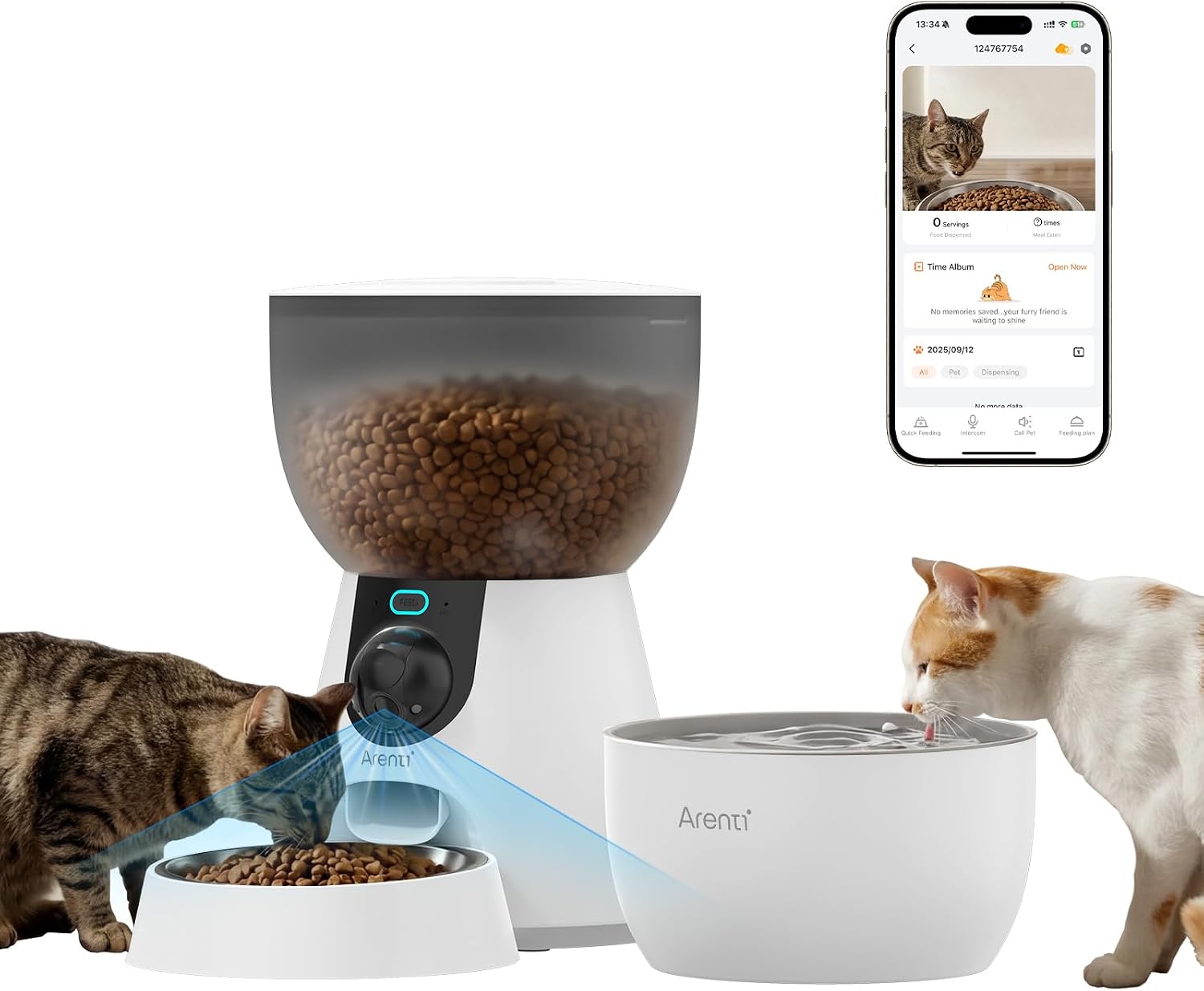
The all-in-one pick: ARENTI 4L/17 Cups Automatic Cat Feeder and Water Fountain with Camera
 Visit on Amazon →
This is a combined feeder and fountain in one body, with 4 liters of capacity, listed as 17 cups, plus a camera on board. The capacity is the number that matters most for a routine: 17 cups is measured in weeks of dry food for a single cat, not days, which means you refill on your schedule instead of your cat's. One unit also means one cord, one footprint, and one place to look when you're checking in from work.
The camera is what makes the combo genuinely useful for travel and for multi-pet homes, because the hard question in a two-cat house is never whether food came out, it's who ate it. Being able to glance at the unit and see the bowl tells you more than any feeding log.
What I'd verify before ordering: how the hopper seals against humidity and pantry moths, how the dispense mechanism is built and how big a kibble it accepts, whether the feeder holds its schedule when the network drops, and how many pieces come apart for cleaning. Check current Amazon price.
Flaws but not dealbreakers: Two appliances in one body means one failure can take out both jobs. A camera also adds placement and privacy decisions you don't get with a plain fountain. If redundancy matters more to you than footprint, buy the two functions separately.
Anyone who travels, works long shifts, or wants a single unit to monitor should start here.
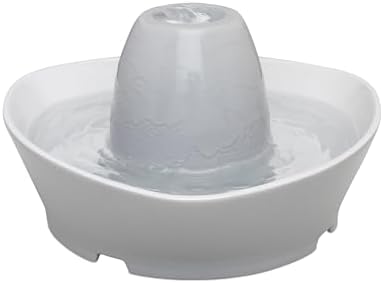
The ceramic fountain pick: PetSafe Ceramic Pet Fountain, for Cats and Small Dogs, 60 Oz Water Capacity, Whisper-Quiet Water Flow, Great for Shy or Timid Pets, Fresh, Filtered Water
 Visit on Amazon →
This is the fountain I point people to when their cat tips bowls. It holds 60 ounces, it's ceramic, and it's built for cats and small dogs, with a quiet flow and filtered water that suits shy or timid pets who bolt at noise.
Ceramic is the material I trust most with a tipping cat. The weight is the anti-tip feature, and there's no scratched plastic to hold onto the bacteria that contributes to chin acne. Mochi got spots from plastic until I switched her, and I've never had that problem with ceramic. Sixty ounces also means the water level doesn't drop while you're at work, so the pump isn't running half dry by the time you get home.
What I'd verify: that the pump housing comes apart without tools, that replacement filters are easy to find on a schedule, and that you have a safe spot for it. Ceramic is heavy in a good way and unforgiving in a bad way. One wrong drop while you're carrying a wet, soapy bowl across tile is a replacement, not a repair.
Flaws but not dealbreakers: It's heavier to clean than plastic, and the ceramic body makes a full teardown slower than a simple plastic fountain. Also budget for filters. A fountain running on a clogged filter is just a noisy bowl.
Anyone with a bowl-tipping cat, a cat with chin acne, or a nervous pet who needs quiet water should look here first.
The setup, step by step
Step one: pick the spot before you unpack. Cats prefer to drink away from where they eat, so put the fountain in a different area than the food, ideally against a wall with a clear view of the room. Put the feeder on a hard floor, not carpet, and not under a shelf that traps the sound of the dispense motor.
Step two: wash everything before the first use. Every part that touches food or water, including the hopper and the filter housing. Manufacturing dust and shipping film are real, and they're the fastest way to get a cat to refuse a fountain.
Step three: water first, food second. Fill and run the fountain a full day before you introduce the feeder. Keep the old still bowl next to the fountain and let it get stale. Running water wins that comparison on its own.
Step four: program the feeder, then test the portion onto a scale. Not into the bowl, not into your hand. Onto a kitchen scale, three dispenses in a row. If the weight is off, fix the program, not your expectations. This is the step people skip and then blame the device for.
Step five: build the schedule around the pet's existing routine. If your cat eats at 7 a.m. and 6 p.m., the feeder runs at 7 a.m. and 6 p.m. If you have a diabetic cat on insulin, the timing is medical, not convenient, and the schedule does not move because you're out late.
Step six: run the failure drill. Kill the Wi-Fi, unplug it for a minute, and watch what the device does when it comes back. You want to know now, not at 7 a.m. on a Tuesday when you're already late. A feeder that loses its schedule is a feeder you can't trust with a medical routine.
Step seven: transition the food slowly. Same portions, same times, mixed old and new kibble over about a week. Change one variable at a time, or you'll never know what the cat objected to.
Step eight: lock it in. Same times, same portions, same place, every day. The routine is the product. Once it holds, stop touching the settings.
The first week
Expect the cat to ignore the fountain for three days and then drink. That's normal, and the stale bowl next to it is doing the work. On the feeder, watch the first three dispenses land, then spot check once a week. If Tank or a Tank-like dog is in the house, watch how they treat the unit. A dog that body-slams a feeder is telling you the feeder needs to be somewhere it can't be reached or reinforced.
Cleaning and maintenance cadence
Daily: top off water, glance at the hopper for bridging or dust.
Weekly: full fountain teardown. Pump, impeller, and filter housing, scrubbed, not just rinsed. If you can't do it in five minutes, the design is wrong for you and you'll skip it.
Monthly: full disassembly of the feeder, check the dispense mechanism for kibble dust and oil buildup, and weigh one portion again. Portion accuracy drifts, and a scale catches it before your cat's waistline does.
Filters get replaced on a schedule, not when they look bad. Hard water, and San Diego has plenty of it, means the pump and the filter are working harder than the box suggests.
The three failures I see most
The feeder jams. Usually stale kibble dust, oversized kibble, or a chute that needs a monthly wipe. Check your kibble size against the dispense opening before you blame the unit.
The cat ignores the fountain. Usually placement or a bowl that's still sitting there full and fresh. Stop refilling the old bowl.
The portions drift. Weigh monthly. Two of the four feeders I returned over-fed by 40 percent against a scale, and neither one threw an error.
What this all costs
Prices move, so check the listing for both units before you decide. The real math is what the routine saves you: a fountain you clean weekly against a vet bill for a urinary issue, a feeder that portions accurately against a cat that gains a pound a year because nobody weighed the kibble.
Set against a month of pet sitting drop-ins, either device pays for itself quickly.
The bottom line
Set the water up first, weigh the food, run the failure drill, and clean on a schedule. Do those four things and the hardware fades into the background where it belongs. Skip them and you'll be the person returning a second feeder, which I can tell you from experience is a worse feeling than the first one.