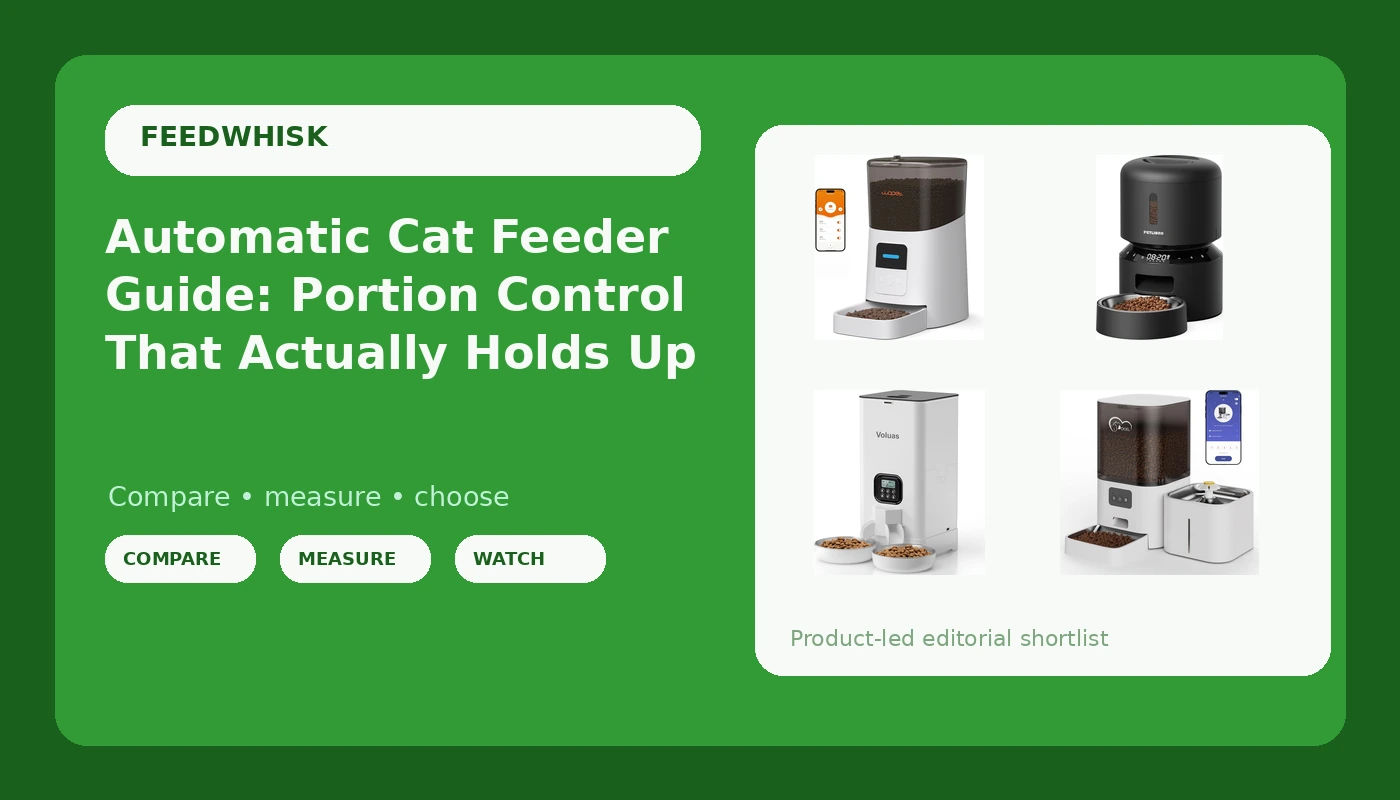
An automatic cat feeder makes one promise that matters: it puts a measured meal in the bowl when you are not there to do it. Everything else in the listing, the Wi-Fi badge, the app, the voice recording, is convenience layered on top of that single mechanical job. The problem for shoppers is that the mechanism is the one part you cannot evaluate from a product page, so most people compare feeders on features and then meet the failure in week two, when the portion wheel drifts or the auger stalls on the last cup of kibble.
I feed other people's pets for a living in San Diego, and the failure modes repeat themselves across brands: jammed augers, portion wheels that over-deliver, app-connected units that stop feeding when the home network hiccups. This explainer walks through four current automatic cat feeders, what each one is actually built to do, and how to match one to the number of pets, meals, and travel days in your household.
Related: How to Clean an Automatic Water Fountain Pump in Under Five Minutes →
Quick answer
Choose the feeder by dispense mechanism, hopper size, and power backup first, and by connectivity last. The PETLIBRO 3L is the model to look at when airtight kibble storage and timed portions are the priority. The WOPET 6L fits households that want Wi-Fi app control, a larger hopper, and a schedule that can run up to 15 meals per day. The VOLUAS is built around two cats eating at the same time from separate stainless bowls. The DOEL combines a 6L timed feeder with a water fountain for homes that want both jobs handled by one unit. If your pet eats fast enough to vomit or bloat, no feeder on this list replaces a vet-guided portion plan.
Four useful options
| Model | Best fit | What stands out |
|---|---|---|
| PETLIBRO Automatic Cat Feeder 3L | Households that want sealed kibble storage and timed portions | 3L airtight hopper, programmable portion control, dual power supply |
| WOPET 6L Automatic Cat Feeder | Remote feeding on a busy or unpredictable schedule | 6L hopper, Wi-Fi app control, low food sensor, voice recorder, up to 15 meals per day |
| VOLUAS Automatic Cat Feeder for Two Cats | Two cats eating at the same time | 6L reservoir with dual stainless steel bowls |
| DOEL 5G and 2.4G WiFi Automatic Cat Feeder and Water Fountain | Homes that want food and water in one footprint | 6L hopper listed as 24 cups and roughly 2.5 weeks of food, plus an included fountain, app control, and voice |
Airtight portion control: PETLIBRO Automatic Cat Feeder, 3L Programmable Pet Food Dispenser with Airtight Storage, Timed Portion Control, Voice Meal Call & Dual Power Supply, Clog-Free Healthy Feeding for Cats & Small Dogs
The trade-off is capacity. At 3L this is the smallest hopper in the group, which is fine for one cat on a normal schedule and less fine for a two-cat home or anyone who travels for two weeks at a stretch. What you get in exchange is the storage design: an airtight hopper keeps kibble from absorbing humidity, which keeps the food from going soft or stale in the bowl, and it keeps the oils in the food where they belong. That is a real quality difference over an open gravity reservoir, even if it never shows up in a marketing photo. If your main worry is kibble freshness between refills rather than maximum capacity, this is the one to start with.
Budget Wi-Fi scheduling: WOPET 6L Automatic Cat Feeder, WiFi Automatic Dog Feeder with APP Control for Remote Feeding, Cat Food Dispenser with Low Food Sensor and Voice Recorder, Up to 15 Meals Per Day
This is the pick for people who want app-driven feeding without moving into the highest price tier. A 6L hopper buys you refill intervals measured in weeks rather than days for a single cat, and 15 meals per day is more schedule slots than most homes will ever use, which leaves room for small frequent meals if your cat does better on those. Two practical notes. First, the app is the feature and the dispenser is the product, so test the unit's basic timed dispensing before you lean on remote feeding. Second, decide up front what your plan is if your Wi-Fi drops while you are away, because remote control is only as reliable as the network in your home.
Two cats, two bowls: VOLUAS Automatic Cat Feeder for Two Cats with Dual Stainless Bowls, 6L
The dual-bowl layout is the whole argument here, and it is a good one if you have watched one cat guard a bowl while the other waits. Stainless steel is also the material I would choose over plastic for daily use: it does not scratch the way plastic does, it does not hold onto oils the way plastic does, and some cats with chin acne do better on it. The trade-off is that this feeder is built for scheduling rather than remote control, so it suits a household that wants to set a routine and leave it alone. If you need to change feeding times from your phone while you are out of town, look at the Wi-Fi units above instead.
Food and water in one unit: DOEL 5G&2.4G WiFi Automatic Cat Feeder and Water Fountain, 6L/24 Cups Timed Dry Food Dispenser for 2.5 Weeks, with APP Remote Control, Voice, for Small Medium Dog Puppy Kitten (White)
Two things make this the right call for some homes and the wrong call for others. The upside is consolidation: one cord, one spot on the floor, one app, and running water available all day, which is often what gets a reluctant cat drinking more. The 2.5-week framing on the hopper also tells you something useful, because that number only holds for a single small pet on a modest schedule. If you have a large dog or two cats, plan on refilling well before then. The downside is that food and water now share a single device, so a problem with one half affects the whole unit. If you already own a fountain you like, buy a feeder on its own and keep the systems separate.
Prices and availability may change. Product images, names, and retailer links are matched to verified listings. No current price, rating, stock status, or measured result is stated here without current evidence.
What actually fails on an automatic feeder
Almost every feeder complaint traces back to the dispense mechanism, not the electronics. There are two common designs. A portion wheel rotates a compartment under the hopper and drops whatever fits in that compartment into the bowl. An auger is a rotating screw that pushes kibble toward the opening. Both can work well, and both fail in predictable ways.
Portion wheels fail by drift: the compartment holds slightly more or less than the programmed amount, and the error compounds over many meals. Augers fail by stalling, usually when the hopper is low or when kibble pieces are small enough to fall out of the screw's grip. That is why kibble size is a real specification and not a detail. Very small kibble, irregular shapes, and mixes with a lot of crumbs all behave differently in a feeder than a uniform, medium-sized kibble does. If your food is unusual, test it before you commit to a schedule you depend on.
The second failure category is environmental. A hopper that does not seal lets humidity in, and humid kibble clogs differently than dry kibble. The third is power. A feeder that loses its schedule every time the power blinks is a feeder you will not trust on a trip. Dual power supply, like the PETLIBRO's, is the feature that addresses this, and it is worth prioritizing over app extras.
Matching capacity and bowls to your household
Capacity math is simpler than it looks. A 6L hopper is roughly 24 cups of dry food, and a 3L hopper is about half that. How long that lasts depends entirely on how many pets are eating and how much each one gets, which is a conversation to have with your vet rather than a number to copy from a listing. The DOEL's 2.5-week framing is a useful anchor: it describes a modest single-pet schedule, so if your household eats more than that, size up or expect more frequent refills.
Bowl count matters as much as hopper size in multi-cat homes. One shared bowl creates competition, and competition creates a cat that eats too fast or a cat that stops eating. Dual bowls, as on the VOLUAS, separate the cats physically even though the food comes from one reservoir. And material matters for hygiene: stainless steel and ceramic clean up better than scratched plastic, which holds onto oils and odor over time.
- Count the mouths and the meals per day before you look at any product page.
- Decide whether you need remote app control or whether a fixed schedule is enough.
- Match hopper size to how often you are willing to refill, not to how often you want to.
- Check the power design, including what happens during an outage or a Wi-Fi drop.
- Decide whether you want food and water in one unit or two separate devices.
- Confirm the return window before you buy, because a feeder that does not fit your kibble is a return, not a repair.
Practical guidance
- Run a new feeder on a dry schedule for a week before you rely on it for a trip or a medical feeding plan.
- Weigh a few dispensed portions on a kitchen scale early on so you know what the programmed setting actually delivers.
- Use a uniform kibble if you can, and avoid mixing in large treats that can bridge the dispense opening.
- Wash the bowl weekly and wipe the hopper between refills; a sealed hopper only helps if the seal is clean.
- Keep the unit on a hard, level surface away from a wall it can be pushed into.
- Keep the packaging and the receipt until the feeder has made it through at least one full hopper.
- For any pet on a timed medication or a diabetic feeding schedule, treat the feeder as a backup and not as the primary plan.
Which option should you choose?
Choose the PETLIBRO Automatic Cat Feeder 3L when airtight kibble storage and dependable timed portions matter more than capacity, and when one or two cats are eating. Choose the WOPET 6L Automatic Cat Feeder when you want Wi-Fi app control, a bigger hopper, and a schedule deep enough for many small meals per day. Choose the VOLUAS Automatic Cat Feeder for Two Cats when two cats need to eat at once from separate stainless bowls and a set routine is all you need. Choose the DOEL 5G and 2.4G WiFi Automatic Cat Feeder and Water Fountain when you want food and running water handled by one unit and your household eats within a 2.5-week hopper window.
One caveat: these are manufacturer specifications and listing descriptions, not measured results. Capacity figures, meal limits, and Wi-Fi band support come from the product listings, and any of them can change between production runs. Check the current listing details and return policy before you buy, especially if your pet has a medical feeding schedule.
The bottom line
An automatic cat feeder is a mechanical device with a network feature attached, so buy it that way. Get the dispense mechanism, the hopper seal, and the power design right first, then decide how much app control you actually need. For sealed storage and timed portions, the PETLIBRO 3L is the cleanest fit. For a large hopper with remote app feeding, the WOPET 6L. For two cats eating at once, the VOLUAS. For food and water in one unit, the DOEL. Whatever you pick, test it for a week before anyone's dinner depends on it.