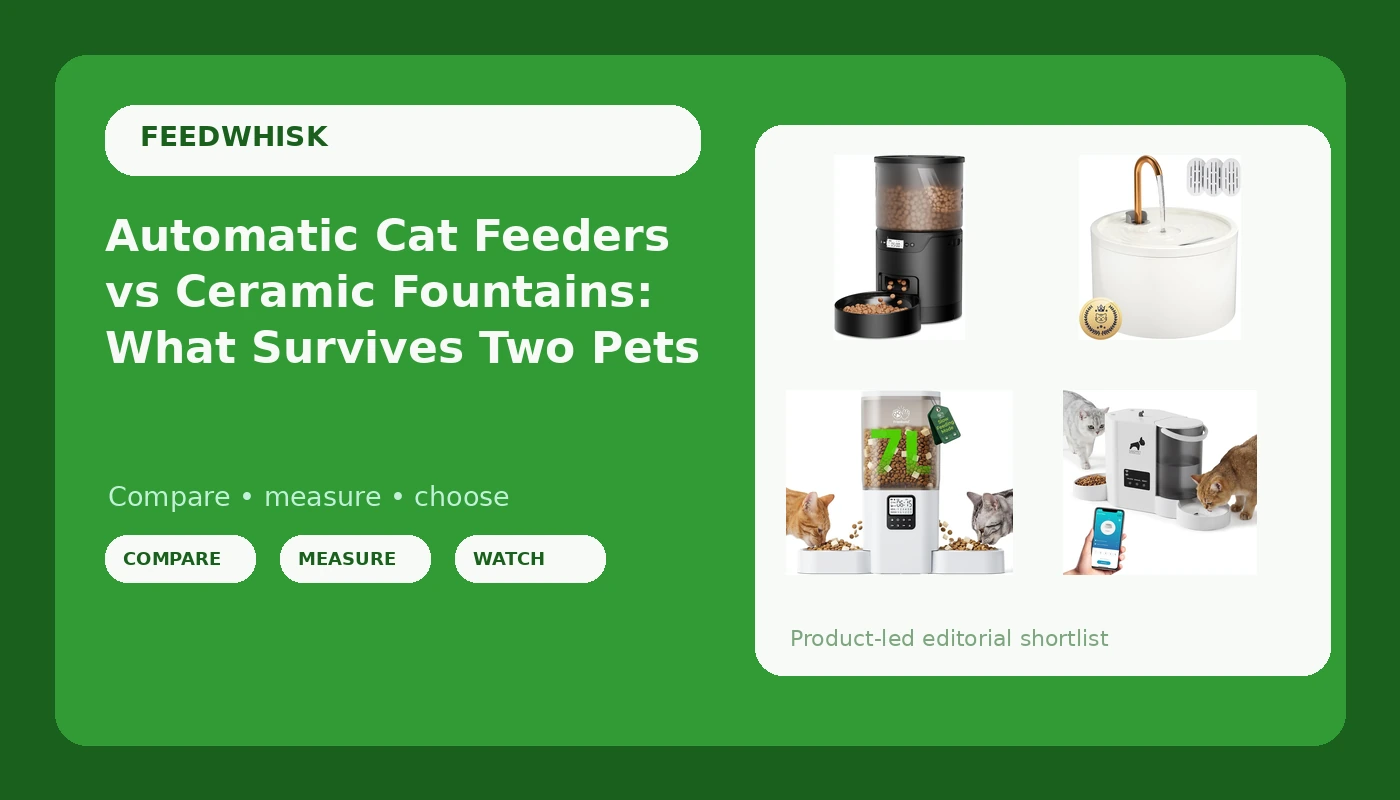
Mochi has tipped over every still water bowl in my apartment, and Tank has body-slammed two gravity feeders until they dumped a week of kibble onto the floor. That is the lens I bring to every automatic cat feeder and fountain that comes through this house. I have been a pet sitter and dog walker in Pacific Beach for eight years, with a client list north of 60 households, and in a 14-month stretch I returned four automatic feeders: one jammed auger, two portion wheels that over-fed by roughly 40 percent, and one app-connected unit that stopped feeding the day the Wi-Fi hiccuped. Those returns taught me more than any spec sheet ever did, which is why nothing here gets a recommendation until it has run a full month with a tortoiseshell cat who hates standing water and a 75-pound lab mix who eats like a shop vac.
The short answer: if you want timed, weighed meals for one cat, the IMIPAW PET Automatic Cat Feeder gives you the finest portion control for the money; if two cats share one machine, the Frienhund dual feeder is the one actually built for it; if you want food and water on one stand with no electronics on the water side, the 2-in-1 gravity combo does exactly that; and if your cat tips bowls, the MISFANS ceramic fountain is the only product here with enough mass to fight back. The long answer is about augers, portion wheels, hopper seals, and cleaning time, so let's get into it.
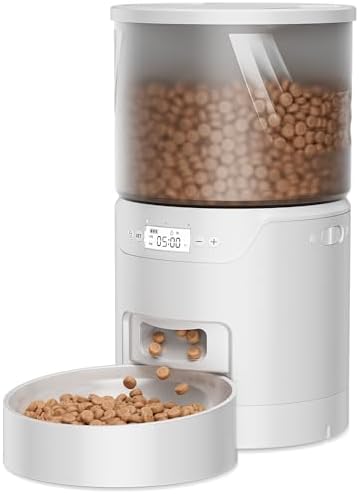
IMIPAW PET Automatic Cat Feeder
Six programmable meals and a 1-20 portion range, so a cat's serving can be dialed in gram by gram; desiccant bag keeps kibble crisp in coastal humidity
Single-pet design, and a 3L hopper means refills every few days in a two-cat house
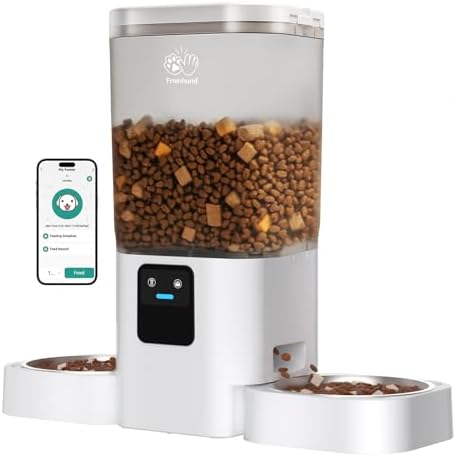
Frienhund Timed Automatic Cat Feeder 2 Cats with Slow Feed
29-cup capacity and dual output feed two cats from one machine; detachable parts make the weekly clean genuinely quick
Big footprint on a small kitchen floor, and the slow feed mode is a dispensing pattern, not a slow feeder bowl
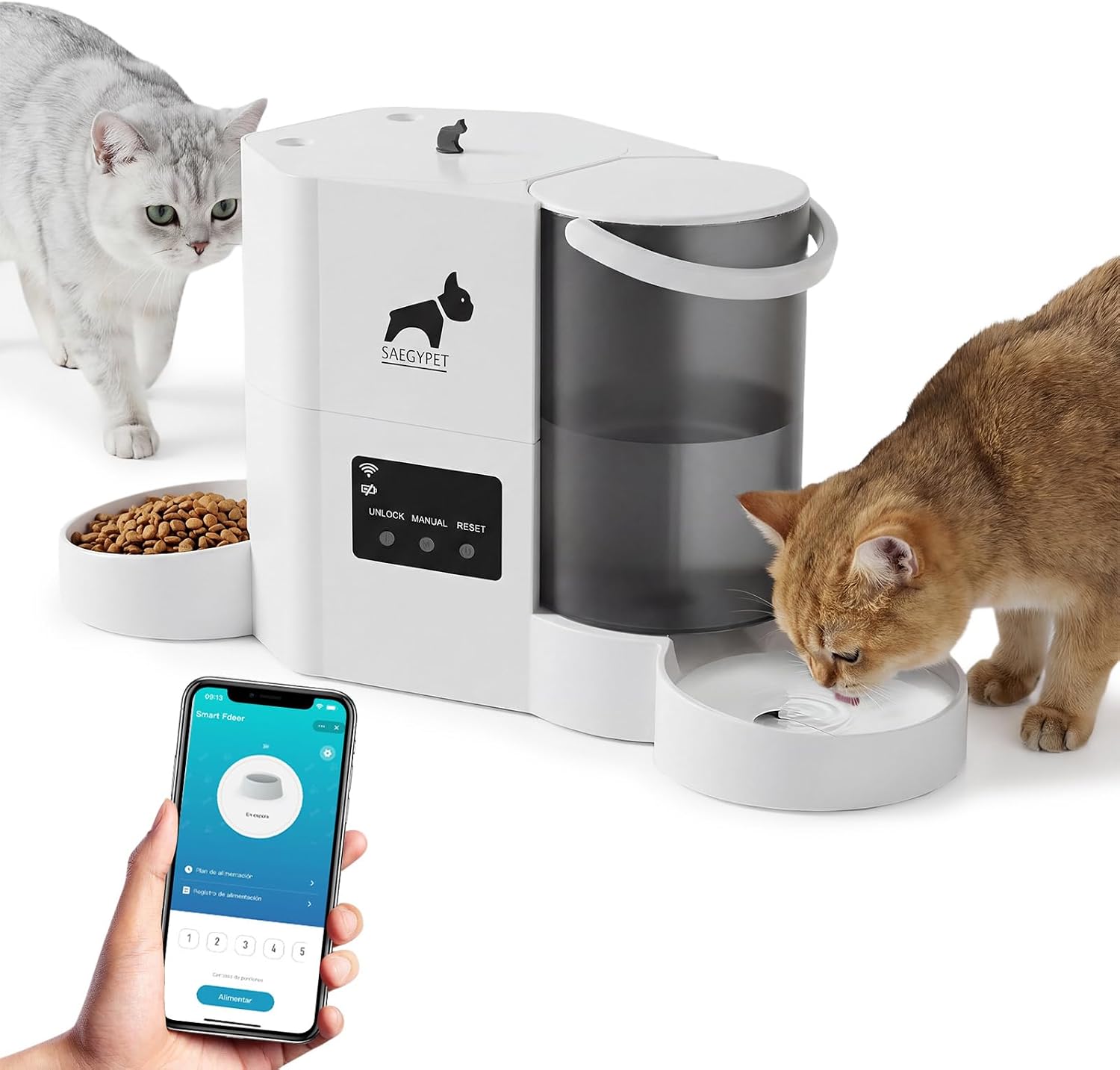
Automatic Cat Feeder 2-in-1 Cat Feeder and Gravity-Fed Water System
One stand covers food and water, the water side has no pump or cord to fail, and setup takes minutes
Gravity feeding means no portion control at all, which is the wrong shape for a dog that inhales kibble
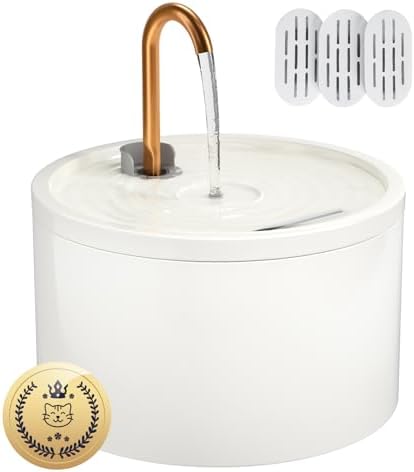
MISFANS Ceramic Cat Water Fountain
All-ceramic body with a pure copper spout; the weight is the anti-tip feature, and ceramic does not hold the biofilm that plastic does
Heavy to lift and rinse, and one wrong drop while cleaning costs you the whole fountain
Prices and availability were captured from Amazon Creators API and may change.
How I test feeders and fountains
Nothing gets recommended to a client's home until it has run a full month in mine, with Mochi and Tank as the crash test dummies. Every portion gets weighed on a kitchen scale, because "one cup" means nothing if the portion wheel dumps 1.4. I log dispense volume, jam events, and how many days a unit survives before Tank finds its weak point. I take decibel readings at dispense time, because "quiet" is a marketing word until you have been woken at 5 a.m. by a plastic auger grinding against a hopper wall. And I time a full teardown clean with a stopwatch, because a fountain I dread cleaning is a fountain that gets cleaned twice a month instead of weekly, and a dirty fountain is a health problem, not a convenience problem.
The four returns came from failures at exactly those checkpoints. A jammed auger is a design failure, not bad luck, and it is almost always a tolerance problem in the dispense mechanism. Two portion wheels that over-fed by 40 percent are the reason the kitchen scale lives on my counter now. The app-connected unit that quit during a Wi-Fi outage is why I ask one question about any smart feeder: when the app dies, does the device still feed? If the answer is no, it is not a feeder, it is a gadget with a bowl attached.
Portion control is the whole product
The IMIPAW PET Automatic Cat Feeder is the cleanest expression of what a timed feeder is supposed to do. Six programmable meals a day covers everything from a twice-daily adult cat to a kitten on four small servings, and the 1-20 portion range is the part that matters most. Fine granularity means you can step a cat down from 1.5 portions to 1.25 without guessing, which is exactly the kind of adjustment a vet asks for when a cat needs to lose a few ounces. Coarse portion settings force you into jumps that are too big, and owners give up on the diet instead of the feeder.
The desiccant bag is a detail I appreciate more than most people will. San Diego humidity is not Florida humidity, but it is enough to turn the top inch of a hopper into stale crumbs over a couple of weeks, and kibble that smells stale is kibble a cat refuses. A desiccant bag does not make a hopper airtight, but it slows the process enough that the last scoop still smells like the first. The 3L hopper is the trade-off: it is a sensible size for one cat, and it is a chore for two.
The Frienhund Timed Automatic Cat Feeder takes the opposite approach, trading precision for capacity. A 29-cup hopper and dual output mean one machine can serve two cats on their own schedules, which is a real problem in multi-cat homes where one cat grazes and the other inhales. The information visualization on the unit is genuinely useful for a pet sitter, because I can glance at it and confirm a meal actually went out rather than trusting a blinking light. Detachable parts matter too: the difference between a five-minute clean and a twenty-minute clean is the difference between a feeder that stays hygienic and one that does not.
One honest caveat on the slow feed label. Spreading a meal across a longer dispense window slows eating a little, but it is not the same as a slow feeder bowl with ridges that force a dog to work for every bite. If your dog eats like Tank, a slow feed mode helps and a real slow feeder bowl helps more. And a 29-cup hopper holds a lot of kibble, which is convenient right up until it is not: the longer food sits, the more it depends on a good seal to stay fresh.
The 2-in-1 gravity combo, and who it is actually for
The Automatic Cat Feeder 2-in-1 Cat Feeder and Gravity-Fed Water System is the simplest product in this comparison, and simple is the point. There is no pump on the water side, no cord running to a reservoir, no app to configure, and no auger to jam. Water refills itself by gravity as the cat drinks, food sits in a reservoir above the bowl, and the whole thing sets up in minutes. For a single grazing cat in a quiet house, that is a low-risk, low-maintenance arrangement, and the failure modes are minimal because there is almost nothing to fail.
The problem is that gravity feeding is portion control's opposite. A reservoir refills the bowl as soon as it empties, which is fine for a cat that nibbles and walks away. Put it in front of a dog that eats like a shop vac and you have created an all-day buffet. I have watched a client's beagle learn to body-slam a gravity feeder until it dumped, and once a dog learns that trick, the feeder is finished. Gravity water is a different story: it is a reasonable option for cats who drink fine from a bowl and a poor one for cats like Mochi, who treat still water as an insult. If your cat tips bowls, gravity does not solve that, mass does.
Why a ceramic fountain changes the equation
The MISFANS Ceramic Cat Water Fountain is the product here I would point a bowl-tipping owner toward first, and the reason is weight. Ceramic is heavy in a way plastic and stainless steel are not, so a cat that leans on the edge, paws at the surface, or flat-out climbs the fountain has a much harder time moving it. Mochi has flipped lightweight fountains with a single shove. She has not flipped anything ceramic.
Ceramic also addresses the chin acne problem I ran into with plastic. Plastic scratches, scratches harbor bacteria, and a cat whose chin rests in that water can develop spots. Ceramic glazes are far less porous and far easier to sanitize. The pure copper spout is a nice touch that resists the mineral buildup plastic spouts collect. The honest downsides are the ones nobody puts on the box: ceramic is heavy to lift for a full rinse, it needs a stable spot because a drop onto tile ends the fountain, and any fountain with a pump still requires you to pull and clean that pump on a schedule. If I cannot get the pump out and clean in under five minutes, I do not recommend the fountain, and that rule applies here too.
The trade-offs that decide it
Capacity and freshness pull against each other. A 29-cup hopper saves refills; a 3L hopper keeps food turning over faster. If you have one cat, smaller and fresher wins. If you have two, convenience usually wins, and the Frienhund's dual output is worth the footprint.
Electronics and reliability pull against each other too. The more a feeder depends on an app, the more it depends on your router, your phone, and a server somewhere. The IMIPAW and the Frienhund are programmable units first, which is the right priority. The 2-in-1 combo skips electronics on the water side entirely, and that is a feature, not a compromise.
Cleaning time decides whether any of this stays hygienic. Detachable parts and a visible pump are the two things I check before anything else. A fountain with a hidden pump compartment is a slime trap, and a feeder you cannot wipe out is a feeder that smells by week three.
Finally, return policy is part of the spec. I have returned four feeders, and every one of those returns cost me nothing but time because I bought where returns were easy. Buy the one you think fits, run it for a month, and weigh the portions yourself. If it jams, over-feeds, or quits when the internet does, send it back and try the next one.
Which one fits your household
One cat, timed meals, tight budget: the IMIPAW PET Automatic Cat Feeder, and use the 1-20 portion range to dial the serving in precisely.
Two cats, one machine, minimal fuss: the Frienhund Timed Automatic Cat Feeder, accepting the larger footprint in exchange for capacity and dual output.
Grazing cat, no electronics wanted: the Automatic Cat Feeder 2-in-1 Cat Feeder and Gravity-Fed Water System, kept away from any dog that eats fast.
Cat that tips bowls, or a chin acne history: the MISFANS Ceramic Cat Water Fountain, placed somewhere it cannot be knocked off a counter.
That is the whole decision. Feeders are judged by the auger and the portion wheel; fountains are judged by weight and how fast you can clean the pump. Everything else is marketing.