Feeding and watering are the two pet chores that never take a day off, and they are the two that fail most quietly. A dog who inhales dinner in ninety seconds and then stares at the empty bowl. A cat who ignores still water all day and then tips the bowl over out of what looks a lot like spite. A workday that runs long enough that a 7 a.m. meal simply cannot wait. Automatic feeders and water fountains exist to solve exactly those problems, and the category is now crowded enough that choosing one has become its own chore.
The useful way to shop is to work backwards from the animal. What breaks in a real home is rarely the app or the indicator light. It is the dispense mechanism, the lid, the weight of the bowl, and the number of parts you have to scrub on a Sunday. This guide covers four options that map to the four most common situations: a dog that eats too fast, a household that needs meals on a schedule, a cat that wants moving water, and a cat that has figured out how to relocate a bowl. It also covers what actually matters inside the mechanism, so you can judge the next feeder or fountain you see without a spec sheet.
Related: How to Build a Feeding Schedule Your Cat Will Actually Follow →
Quick answer
There is no single best device here, because the four products solve four different problems. If a dog gulps meals, a slow feeder bowl is the cheapest fix and the one most likely to change the meal itself. If food needs to arrive on a schedule while you are away, a programmable feeder with a large hopper is the right category. For cats that drink little or tip still water, a fountain with a stainless steel tray or a heavy ceramic body addresses the bowl rather than the schedule. Shop for the dispense mechanism and the cleaning routine first, and treat app features as a bonus rather than a reason to buy.
Four useful options
| Model | Best fit | What stands out |
|---|---|---|
| PetSafe Healthy Pet Simply Feed Auto Feeder | Scheduled meals while you are away | Programmable portions with a 24-cup hopper |
| Outward Hound Fun Feeder Slo Bowl | Dogs that finish a meal in seconds | Large 4-cup capacity with a drop-pattern interior |
| PETLIBRO Cat Water Fountain Stainless Steel Tray | Owners who want app visibility | Stainless steel tray, 2.5 L reservoir, 2.4 GHz WiFi |
| iPettie Tritone Ceramic Cat Water Fountain | Cats that push bowls around | Heavy ceramic body |
The scheduled feeder: PetSafe Healthy Pet Simply Feed Auto Feeder
The appeal here is not excitement, it is fewer things that can go wrong. A feeder with a camera, a speaker, and a cloud account still has to push kibble through a mechanism, and if that mechanism jams, the extra features only tell you that your pet was not fed. What matters is the portion wheel or auger, the seal on the hopper, and whether the unit keeps its schedule after a power blink. The trade-off is bulk: a 24-cup hopper takes up real counter or floor space, and this is a device you will notice in the room.
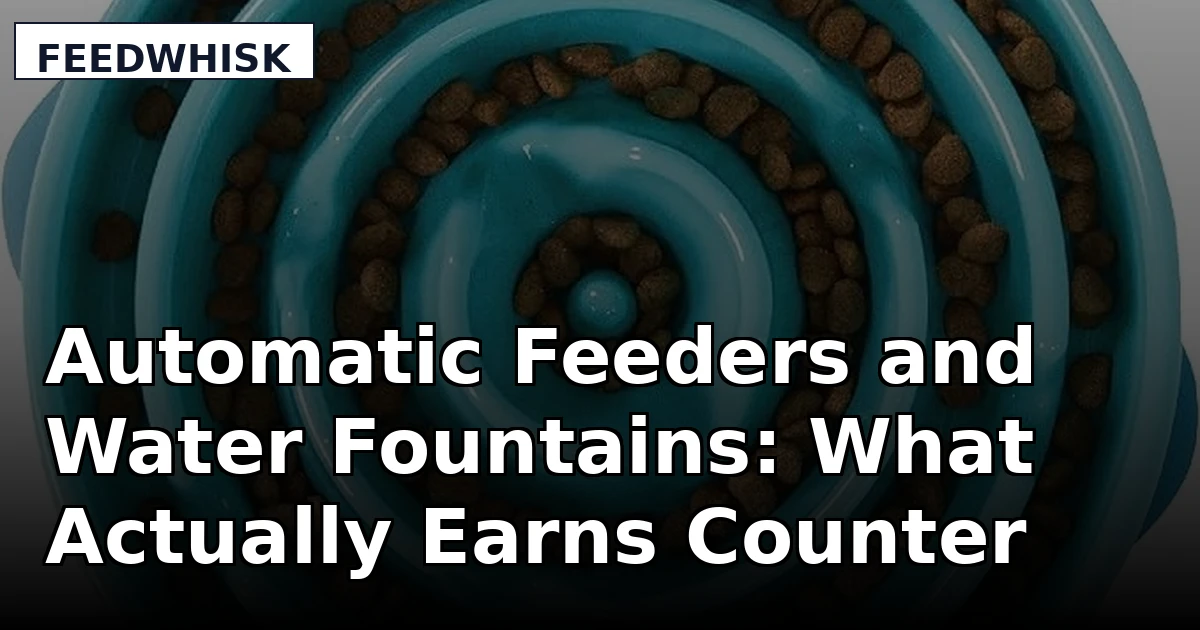
The fast-eater fix: Outward Hound Fun Feeder Slo Bowl
Be skeptical of a "slow feed mode" on an automatic feeder that dispenses once a day. That is a diet plan, not a slow feeder, because the food still lands in a pile and disappears in one motion. A patterned bowl forces the dog to work around ridges for every bite, which is why it belongs in the same conversation as the electronics. The trade-off is that deep patterns can be awkward for dogs with very flat faces, so watch the first few meals and consider a shallower pattern if your dog struggles to reach the food.
The app-connected fountain: PETLIBRO Cat Water Fountain Stainless Steel Tray
Two details deserve attention before you buy. First, the 2.4 GHz requirement: if your router broadcasts only on 5 GHz, the monitoring layer may not connect, and you should decide whether you are comfortable with that before you rely on it. Second, ask what the fountain does when the network drops. A fountain that keeps circulating water is fine without a phone; the app should be an extra set of eyes, not the thing keeping the pump running. The stainless steel tray is the more consequential feature for most homes, since it gives you a non-porous drinking surface that does not hold onto odors the way scratched plastic can.
The tip-proof ceramic fountain: iPettie Tritone Ceramic Cat Water Fountain
Ceramic is the material that survives a determined cat and loses to a tile floor. It is heavy enough that a shoulder check will not move it, and that same weight is what you lift to the sink every time you clean it, which is the real trade-off. If you have ever dropped a ceramic bowl while rinsing it, you know the math. What ceramic does well is stay put and stay non-porous, and for a cat that has declared war on still water, that combination is often worth the care it demands.
Prices and availability may change. Product images, names, and retailer links must be matched by verified ASIN. Do not state a current price, rating, stock status, or measured result without current evidence.
How an automatic feeder actually dispenses food
Almost every automatic feeder uses one of two mechanisms, and the difference explains most failures. A portion wheel is a rotating compartment that scoops a set volume of kibble and drops it into the bowl, one chamber per meal. An auger is a rotating screw that pushes kibble toward the opening until the programmed amount has moved through. Both depend on kibble that behaves predictably, which is why the hopper matters as much as the motor. A sealed hopper keeps humidity, dust, and pantry pests out of the food, and damp kibble is sticky kibble, which is how augers start jamming.
This is also why the app is a feature and the mechanism is the product. A connected feeder can tell you a meal was served, but it cannot unjam itself, and the parts most likely to fail are the cheapest ones: plastic gears, loose tolerances, and a lid that a clever animal can open. When you evaluate any feeder, ask three questions. What pushes the food? What happens on a power loss? And what does the portion actually weigh? That last one is easy to check yourself with a kitchen scale over the first week, and it will tell you more than any product page.
There is one more category worth naming so you can avoid it. A gravity feeder is a bowl with a reservoir on top that refills itself as the pet eats. For a grazing cat, that is a reasonable design. For a dog that eats like a shop vacuum, it removes the only thing standing between the dog and an entire day of food, which is portion control.
Why a fountain changes drinking behavior
Cats are light drinkers by nature, and many of them show far more interest in moving water than in a still bowl. A fountain keeps the surface agitated, which cuts down on the stale, hair-flecked film that develops in a bowl left out all day, and the sound and motion are often what gets a reluctant cat drinking in the first place. That is not a reason to buy the most complicated fountain. It is a reason to buy one you will actually keep clean.
Material is the second variable. Plastic scratches, scratches hold onto oils and odor, and a bowl that smells wrong is a bowl a cat may avoid. Stainless steel and ceramic are non-porous and rinse clean, which is why they show up in fountains aimed at cats with sensitive chins. The third variable is pump access. If you cannot reach the pump and impeller with a small brush, the fountain will grow a slime layer whether or not the water looks clear. Cleaning time is a health feature, not a convenience.
- Name the behavior problem first: fast eating, missed meals, low water intake, or a bowl that gets moved.
- Check the mechanism before the feature list, and look at the hopper seal and the lid closure.
- Weigh the first several portions on a kitchen scale to confirm the feeder matches its programming.
- Time a full disassembly and clean of any fountain before you commit to weekly maintenance.
- Confirm the return window and keep the packaging until the device has run a full week in your home.
Practical guidance for a routine that holds up
- Match kibble size to the feeder: very small or very large kibble is more likely to bridge or jam in a wheel or auger.
- Place a feeder on a hard, level surface. Carpet shifts under the bowl and turns a clean dispense into a spill.
- Rinse a slow feeder bowl after each meal. Dried food in the pattern ridges defeats the point of the pattern.
- Clean a fountain pump weekly, not monthly, and keep a spare filter or cleaning brush where you will see it.
- Keep a low-tech backup for anything critical: a battery option, a second bowl, or a neighbor who can check in.
- Watch the first week closely. Behavior changes and jammed meals both show up in the bowl, not in an app.
Which option should you choose?
Choose the Outward Hound Fun Feeder Slo Bowl when the problem is the speed of the meal itself, especially for a medium or large dog that finishes before you leave the room. Choose the PetSafe Healthy Pet Simply Feed Auto Feeder when meals need to arrive on a schedule while you are at work, and you want a large hopper and a simple mechanism over connected extras. Choose the PETLIBRO Cat Water Fountain Stainless Steel Tray when you want a stainless steel drinking surface and app monitoring, and you have a 2.4 GHz network you trust. Choose the iPettie Tritone Ceramic Cat Water Fountain when your cat pushes bowls around the floor and you want weight and ceramic construction to end that argument.
One caveat worth stating plainly: the capacities, materials, and connectivity details above come from the manufacturer listings, and this article is not a measured test report. Portion accuracy, jam resistance, and noise are the things you have to verify in your own home, with your own kibble and your own pet, over at least a week.
The bottom line
Automatic feeders and water fountains are worth owning when they match a specific problem, and frustrating when they are bought for the features. A patterned bowl fixes a fast eater for the price of a couple of coffees. A programmable feeder with a 24-cup hopper handles scheduled meals without asking you to trust a cloud account. A fountain with a stainless steel tray or a heavy ceramic body addresses hydration and bowl-tipping at the source. Whatever you pick, judge it on the parts you can see: the mechanism, the seal, the material, and how long a full clean takes. Those are the details that decide whether a device is still in your kitchen six months from now.