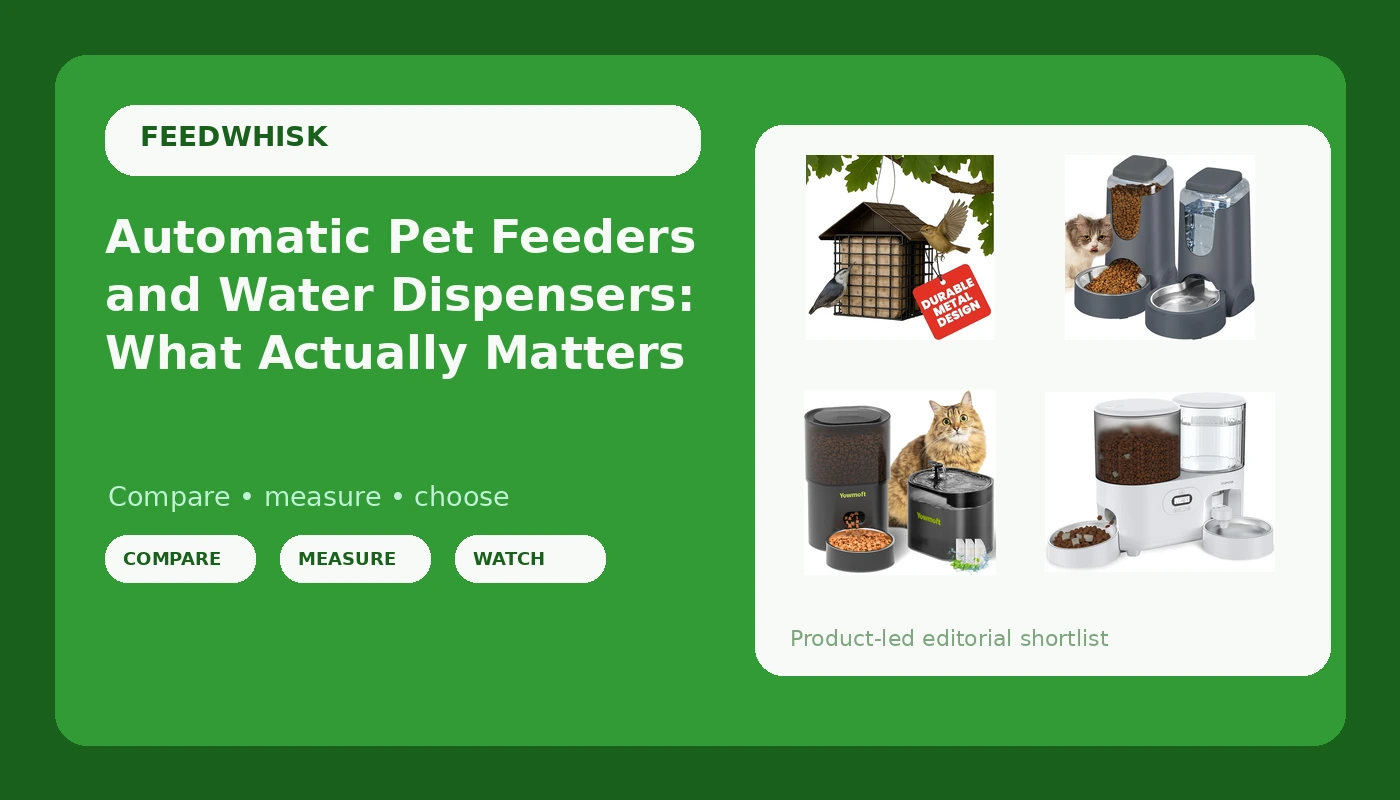
Automatic pet feeders and water dispensers all make the same promise: you fill them, you walk away, and your pet eats and drinks on schedule. The problem is that the category hides two completely different machines under one label. One refills a bowl by gravity and never asks a question. The other meters food in measured portions on a timer. Buy the wrong one for your animal and you get a cat that drains a reservoir in a day, or a dog that inhales three days of kibble in twenty minutes and then looks at you like you did this to him.
The four options on this list are not interchangeable, and one of them is not even a pet product. Here is what each one is actually built to do, and which household each one fits.
Related: Gravity Feeders vs. Portion-Control Feeders: Which One Fits Your Pet? →
Quick answer
There is no single feeder that suits every pet. A large-capacity automatic combo is the practical pick when you want one station holding a lot of food and water for cats. A two-cat station reduces the number of bowls on the floor in a multi-cat home. A compact gravity combo with a stainless steel bowl is the simpler route for kittens, puppies, and small pets that self-regulate. And the suet feeder here is a wild bird feeder, not a pet feeder, so it belongs in a completely separate conversation. Before buying any of them, confirm what the listing actually describes: capacity, materials, and whether the design meters food or simply refills a bowl.
4 useful options
| Model | Best fit | What stands out |
|---|---|---|
| Yuposl Automatic Cat Feeder and Cat Water Dispenser, 10L Large Capacity | Cats left alone for long stretches | A single feeder and waterer combo with 10L of capacity stated in the listing |
| Automatic Cat Feeder and Water Dispenser for 2 Cats | Homes with two cats | Sold specifically as a two-cat food and water station |
| Automatic Cat Feeder and Water Dispenser with Stainless Steel Bowl Dog Gravity Food Feeder and Waterer for Small Medium Pets Puppy Kitten 1 Gallon x 2 | Kittens, puppies, and small pets | Stainless steel bowl plus two 1-gallon reservoirs in a gravity design |
| More Birds Double Suet Cake Feeder, Weather Guard, Steel Construction | Backyard birds, not indoor pets | Steel body, weather guard, and room for two suet cakes |
Large-capacity combo: Yuposl Automatic Cat Feeder and Cat Water Dispenser, 10L Large Capacity
The trade-off with any combo unit is that you clean one object instead of two, but you also lose the ability to size the food side and the water side independently. If your cat drinks heavily and eats lightly, a combined station may run dry on the wrong side first. Measure how much your cat actually drinks in a day before you assume a big number means a long trip.
Two-cat station: Automatic Cat Feeder and Water Dispenser for 2 Cats
If one of your cats is on a prescription diet or needs medication in food, a shared station is the wrong tool no matter how it is advertised. Two cats eating from one supply means two cats eating the same food, and you cannot track who ate how much. Separate stations, or a microchip-controlled feeder, are the honest answer for that situation.
Small-pet starter combo: Automatic Cat Feeder and Water Dispenser with Stainless Steel Bowl Dog Gravity Food Feeder and Waterer for Small Medium Pets Puppy Kitten 1 Gallon x 2
Two 1-gallon reservoirs is roughly 7.6 liters total, split across food and water. That is a genuinely useful amount for a cat or a small dog, and it is also exactly the amount a determined large dog can destroy in one sitting. Gravity feeders are for grazers. If your dog eats like a shop vacuum, this design hands him the entire supply and trusts him to pace himself, which is a bet you will lose.
Backyard bird feeder: More Birds Double Suet Cake Feeder, Weather Guard, Steel Construction
If you keep chickens, rabbits, or other outdoor animals, this is still not the unit for them. Suet cakes are rendered fat cakes formulated for wild birds, and the feeder is sized for those cakes, not for pellets or kibble. It is a good product in its own category and a wrong answer in this one.
Prices and availability may change. Product images, names, and retailer links are matched to verified listings. No current price, rating, stock status, or measured result is stated here without current evidence.
How gravity feeders and portion-control feeders actually differ
A gravity feeder is a reservoir sitting above a bowl. As your pet eats, more food slides down to replace it. There is no timer, no motor, and no portion wheel. The upside is that it cannot jam, because there is nothing to jam. The downside is that it cannot ration, because there is nothing to ration with. Whatever you pour in is available until it runs out.
A portion-control feeder works the other way. You program a time and a serving size, and a mechanism, usually an auger or a rotating portion wheel, moves a measured amount of kibble into the bowl. The dispense mechanism is the product. The app, if there is one, is a feature layered on top. If the mechanism jams, the app is worthless, and if the unit depends on a network connection to feed, then your cat's dinner depends on your router.
The units on this list lean toward the gravity and combo end of that spectrum. None of the listings describe programmable portion sizes, so treat them as free-access stations rather than diet tools. If your cat or dog needs weighed meals at fixed times, you are shopping in a different category.
There is also a middle ground worth knowing about: the slow-feed bowl. If the actual goal is slowing down a fast eater rather than automating a schedule, a bowl with obstacles in it costs a fraction of a feeder and does the job without any mechanism to fail.
What to check before you buy
- Count the meals and decide who is feeding them. If someone is home most days, a feeder solves a convenience problem. If nobody is home, it solves a scheduling problem, and that changes which features matter.
- Decide whether your pet can be trusted with free access. Grazers do fine with gravity. Speed eaters and food-obsessed dogs do not.
- Do the capacity math against your actual trip length. Add up what your pet eats and drinks per day, multiply by the days you will be away, and compare that to the reservoir sizes stated in the listing.
- Check what touches the food and water. Stainless steel bowls are easier to keep clean than scratched plastic, and scratched plastic holds odor and biofilm.
- Read the return policy before you order. Feeders are the kind of product people buy, use for two weeks, and discover does not fit their animal. An easy return turns a mistake into an inconvenience.
Practical guidance for the first month
- Wash water reservoirs every two to three days. Standing water grows biofilm fast, and a slimy waterer is a health problem, not a cosmetic one.
- If your cat tips bowls, weight or secure the base before you blame the cat. A tipped bowl is often a cat asking for moving water.
- Introduce the new station next to the old bowl for about a week so your pet connects it with food before you remove the familiar one.
- Keep a manual backup for any unit that depends on power or a network. A feeder that stops feeding during an outage is a feeder that stops feeding.
- Watch the first few days closely for overeating, under-eating, or guarding. Multi-pet households show problems in the first week, not the first month.
- Photograph the setup and note the model before you commit. If you do return it, you will want the details handy.
Which option should you choose?
Choose the Yuposl Automatic Cat Feeder and Cat Water Dispenser, 10L Large Capacity when you want one large-capacity station and the listed 10L is a better match for your absence length than two smaller reservoirs. Choose the Automatic Cat Feeder and Water Dispenser for 2 Cats when you have two cats sharing a feeding area and want a single station built around that. Choose the Automatic Cat Feeder and Water Dispenser with Stainless Steel Bowl Dog Gravity Food Feeder and Waterer for Small Medium Pets Puppy Kitten 1 Gallon x 2 when you have a kitten, puppy, or small pet that self-regulates and you want a stainless steel bowl and a straightforward gravity design. Choose the More Birds Double Suet Cake Feeder, Weather Guard, Steel Construction only if you are feeding wild birds, because it is not a pet feeder at all.
The honest limitation here is that listings describe products, not performance. Capacity numbers do not tell you how a mechanism behaves after a month of daily use, whether a reservoir seals properly, or how long a full clean takes. Verify the specifics on the current listing page, and treat any claim about portion accuracy or quiet operation as something to confirm rather than assume.
The bottom line
The right automatic feeder or water dispenser is the one that matches how your animal actually eats. A grazing cat does well with a gravity combo and its stainless steel bowl. A two-cat home benefits from a station designed for two cats, though it will not fix resource guarding or a prescription diet. A long absence calls for capacity, which is where the large combo earns its place. And the suet feeder stays outside, for the birds, where it belongs. Match the design to the animal first, then compare listings, and check current Amazon price and availability before you buy.