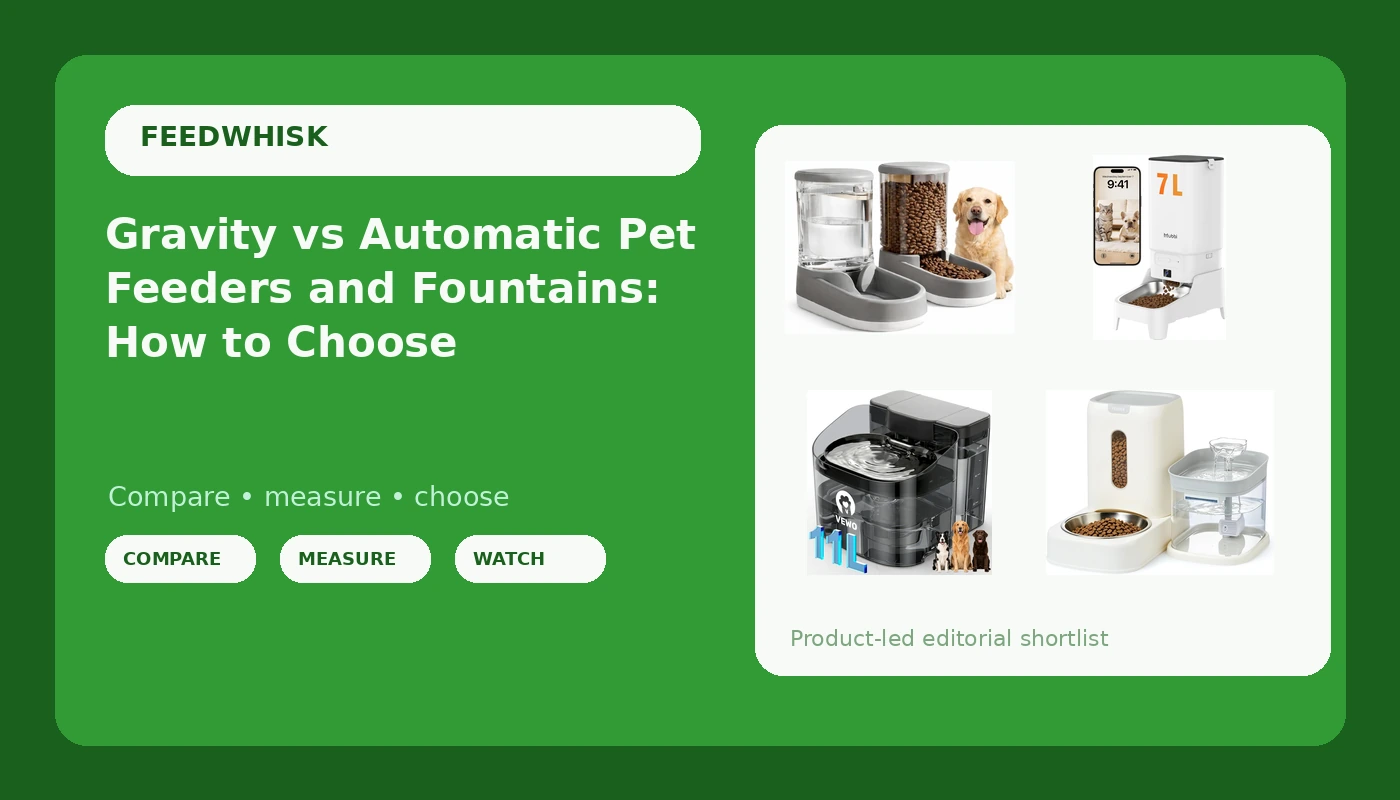
Shopping for automatic pet feeders and water fountains gets confusing fast, because the same word covers two very different machines. A gravity feeder is a reservoir that refills a bowl by physics: the pet eats, the kibble level drops, more food falls in. A timed feeder holds kibble in a hopper and pushes a measured portion into a bowl at set hours, which is portion control, not convenience. Water splits the same way. A gravity dispenser drains a reservoir into an open bowl, while a fountain runs a pump and a filter so the water keeps moving.
The mistake most owners make is buying the category that matches the product photo instead of the behavior happening in their own kitchen. A cat that nibbles six times a day is a different animal from a dog that inhales a bowl in ninety seconds and then looks for more. A cat that drinks from the tap is different from a dog that empties a bowl after every walk. Get that part wrong and no app, camera, or filter will fix it.
Related: How Often Should You Feed a Cat? Building a Schedule That Actually Works →
Quick answer
Match the device to your pet's eating and drinking behavior, not to the label on the box. A pet that grazes all day and a cat that prefers moving water do well with a gravity feeder plus a gravity dispenser, since neither needs electricity, an app, or a battery. A pet that needs measured meals at consistent times needs a timed feeder with a real portion mechanism, and a house with a heavy drinker needs a fountain large enough that you are not refilling it twice a day. For many homes the practical split is a timed feeder for food and a filtered fountain for water, then a camera model only if you genuinely want to watch or talk to your pet during meals.
4 useful options
| Model | Best fit | What stands out |
|---|---|---|
| Automatic Cat Feeder Set with Water Fountain and Gravity Food Feeder | Small pets and first-time setups | Feeder and fountain together, with a stainless steel bowl |
| Gravity Pet Feeder and Water Dispenser Set, 8L (4L + 4L) | Grazers and power outages | See-through reservoirs, no electricity, listed as leak-proof and anti-jam |
| Automatic Cat Feeder with Camera, 7L / 29 Cups | Scheduled meals you want to monitor | 1 to 15 meals per day over 5G WiFi, 1080p night vision, two-way audio |
| 11L Large Dog Water Fountain | Big drinkers and multi-pet homes | 11L / 372oz basin, multi-layer filtration, BPA-free, deep basin |
The portion-control pick: Automatic Cat Feeder with Camera
The trade-off here is dependency. Anything scheduled through WiFi depends on the network staying up and the app staying supported, so it is worth confirming that the unit keeps its program locally if the connection drops. A 7L hopper also holds enough food that freshness becomes a real question: kibble sitting in a hopper for weeks picks up humidity and stale fats, so a smaller refill on a two to three week cycle is usually better than filling it to the brim. The elevated bowl is a genuine plus for cats and for older pets that do better eating with the head slightly up.
The large-dog hydration pick: 11L Large Dog Water Fountain
Big reservoirs buy time, but they also hide problems. Water that sits still and unfiltered grows biofilm, which is the slick layer you feel on the inside of any fountain that has gone a week too long. Multi-layer filtration helps only as long as the filter is changed on schedule and the pump is reachable. Before buying any fountain, look at how the pump comes out: if the impeller sits in a compartment you cannot open with your fingers, cleaning turns into a chore you will skip. A deep basin also matters more than total volume for large dogs, because a 75 pound dog drinking from a shallow dish tends to splash half of it onto the floor.
The no-electricity pick: Gravity Pet Feeder and Water Dispenser Set, 8L
Gravity equipment is the right answer for one specific animal: the grazer that self-regulates and walks away when it is full. It is the wrong answer for the other one. A food-motivated dog will park itself at a gravity feeder and eat until the reservoir is empty, and no amount of "anti-jam" engineering changes that, because the mechanism is doing exactly what it is supposed to do. Water is friendlier, since most pets drink to thirst rather than to boredom. Two practical notes: open reservoirs collect dust and airborne kitchen particles, so a rinse every few days beats a deep clean once a month, and gravity water left in a warm room is not the same as filtered, circulating water when it comes to taste and freshness.
The starter set pick: Automatic Cat Feeder Set with Water Fountain and Gravity Food Feeder
The stainless bowl is the detail worth noticing here. Plastic bowls scratch, and scratched plastic both traps bacteria and is associated with feline chin acne in cats sensitive to it, which is why stainless or ceramic is the usual recommendation for the food side. Because the food half of this set is gravity fed, it carries the same limitation as the set above: it is a grazer's tool. For a small pet like a rabbit, that is usually fine and even desirable. For a cat on a weight management plan, it is the opposite of what you want, and the fountain half is the part that earns its space.
Prices and availability may change. Product images, names, and retailer links here are matched to the specific models listed; no current price, rating, or stock status is stated.
Gravity versus timed: what the two feeding styles actually do
Gravity feeding moves food by weight. Kibble sits in a reservoir, the bowl level drops as your pet eats, and more kibble slides down to replace it. There is no portion, no schedule, and no record. That is a feature for a cat that eats twelve small meals a day and a hazard for a dog that eats like a vacuum. Timed feeding uses a hopper and a metering mechanism, usually a rotating portion wheel or an auger, to deliver a defined amount at defined hours. The mechanism is the product. A feeder with a beautiful app and a sloppy portion wheel delivers the wrong amount beautifully.
This is why the useful question is not "automatic or manual" but "does my pet need a limit?" If the answer is yes, you need a metered feeder and you should verify two things before buying. First, whether the portion sizes are adjustable in small enough increments to hit your target. Second, whether the unit keeps its schedule without the network, because a feeder that stops dispensing when the WiFi drops is a feeder that skipped a meal.
Water: dispensers, fountains, and why cleaning decides everything
Water equipment divides on the same line. A gravity dispenser is a bottle or reservoir that drains into an open bowl, no parts to fail and nothing to plug in. A fountain adds a pump, which keeps the water moving, and usually a filter, which catches hair, dust, and food crumbs. Moving water tends to get more drinking out of cats, who evolved to distrust still water, and filtration keeps a larger volume tasting fresher between refills.
The catch is maintenance. Every fountain has three consumable parts: the filter, the pump, and the surfaces the water touches. Filters have a change interval that most owners ignore. Pumps collect hair around the impeller and get louder or stop. Surfaces grow biofilm, that slippery film you can feel but not always see. A fountain you clean properly once a week is better for your pet than an expensive fountain you clean every three weeks, so buy the one you can disassemble in the sink without tools.
- Count how many times a day your pet currently asks for food or water.
- Decide whether your pet self-regulates portions or needs a hard limit.
- Choose gravity for free-feeding grazers and metered feeders for everyone else.
- Measure your pet's daily water intake and pick a reservoir size that covers it with margin.
- Check the cleaning routine before you buy: pump access, filter cost, and dishwasher safety.
Practical guidance
- Wash gravity reservoirs and bowls every two to three days, since open food and water collect dust and crumbs.
- Replace fountain filters on the interval the manufacturer states, and rinse the pump housing at every water change.
- Test a new feeder's portions on a kitchen scale for the first week rather than trusting the printed number.
- Keep a backup plan for any WiFi or app-controlled feeder, so a dropped connection never means a missed meal.
- Introduce a fountain or feeder beside the old bowl for a few days instead of swapping abruptly, especially with cats.
Which option should you choose?
Choose the Automatic Cat Feeder with Camera when your pet needs meals at specific times and you want to see or speak to them while you are away. Choose the 11L Large Dog Water Fountain when your household drinks enough that capacity and filtration matter more than anything else. Choose the Gravity Pet Feeder and Water Dispenser Set, 8L when you have a self-regulating grazer and want a setup with no electricity, no app, and no failure points. Choose the Automatic Cat Feeder Set with Water Fountain and Gravity Food Feeder when you want to test moving water and free feeding with a small pet before committing to a larger system.
One caveat applies to all four: the specifications above come from the product listings, not from a measured test. Portion accuracy, real-world noise, and how long a filter lasts will vary with your pet, your home, and how faithfully you clean the unit.
The bottom line
There is no single right answer, because feeding and hydration are two separate decisions. Food is about limits: grazers can free feed from a gravity reservoir, while portion-limited pets need a timed mechanism that works whether or not the WiFi does. Water is about volume, movement, and cleanliness: a big filtered fountain suits heavy drinkers, a circulating fountain coaxes reluctant cats, and a gravity dispenser wins on simplicity if you are willing to rinse it often. Pick by behavior first, then by capacity, then by how easy the thing is to take apart and wash, because that last factor is the one that decides whether the setup is still clean three weeks from now.