Feeding a pet on a schedule sounds simple until you are the person who has to be home at 6 a.m. and again at 6 p.m., every day, without fail. Automatic pet feeders exist because that schedule eventually collides with a commute, a shift change, or a weekend away. But the category covers several different machines: timer-based feeders that dispense measured meals, gravity feeders that refill a bowl from a reservoir, and slow feed bowls that change how fast a meal disappears rather than when it arrives. After eight years of pet sitting and a long run of failed feeders in my own apartment, I can tell you the wrong one creates more work than it removes. The right one depends entirely on the animal in front of you.
Related: How to Check Whether Your Feeder's Portions Are Accurate →
Quick answer
Match the device to the eating problem, not to the product photo. If a pet needs meals at set times in measured amounts, a programmable automatic feeder is the right tool. If a cat grazes through the day and simply needs food available, a gravity feeder handles that with no electronics and no power cord. If a dog empties a bowl in under a minute, a slow feed bowl addresses the speed directly and costs far less than any feeder. A combined feeder and water dispenser suits households that want both bowls handled by one unit. These options solve different problems rather than competing on the same scale.
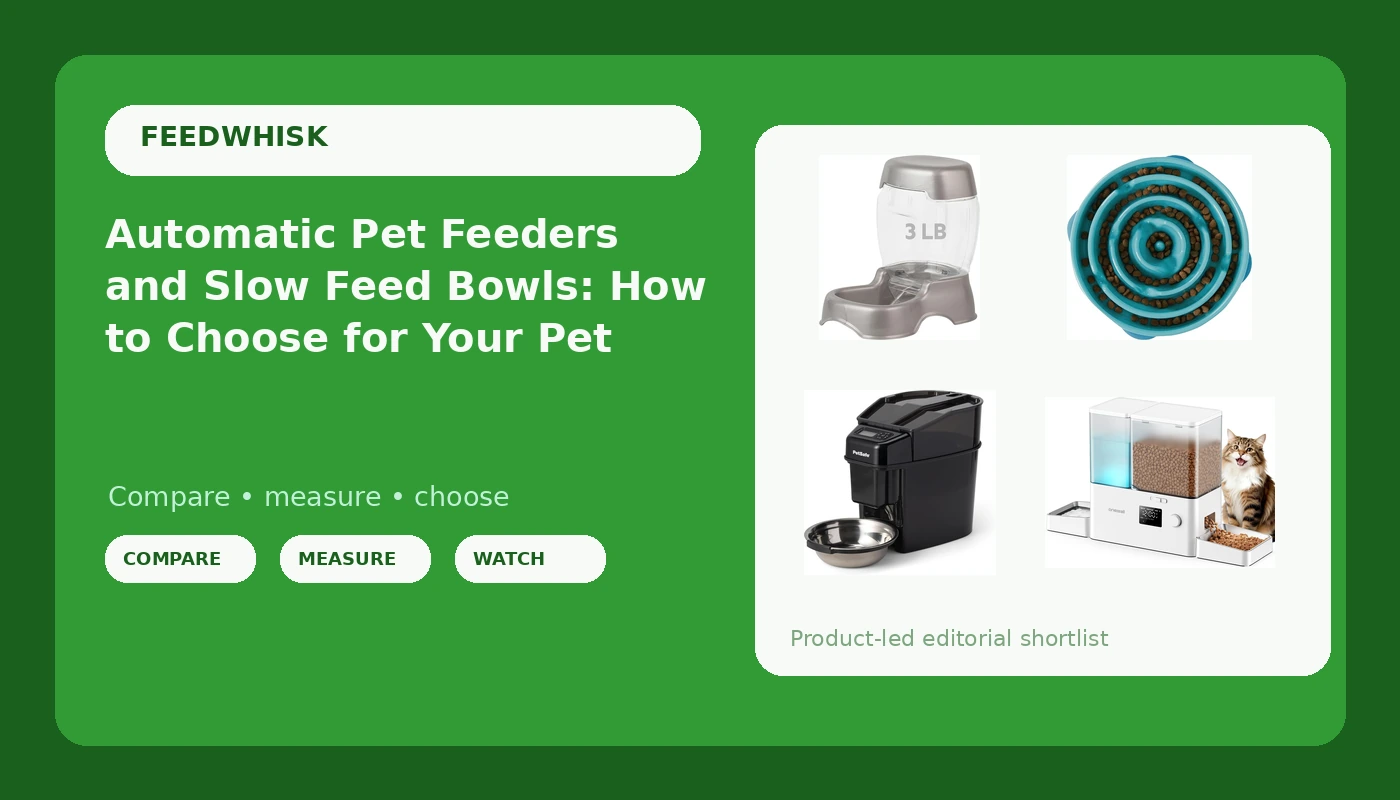
Four useful options
| Model | Best fit | What stands out |
|---|---|---|
| PetSafe Healthy Pet Simply Feed Auto Feeder, Programmable, Holds 24 Cups | Scheduled, measured meals | Programmable schedule and portions, listed 24-cup hopper |
| oneisall Automatic Cat Feeder and Water Dispenser, 36Cups/8.5L | Food and water in one unit | Feeder and dispenser combined, listed 36 cups / 8.5 L |
| Petmate Pet Cafe Feeder for Dogs and Cats, Pearlescent | Free-feeding grazers | Gravity refill design, no electronics, no power needed |
| Outward Hound Fun Feeder Slo Bowl, Large 4‑Cup Capacity, Slow Feeding, Medium to Large Dogs, Non‑Slip, Turquoise, Drop Pattern | Dogs that eat too fast | Drop pattern, listed 4-cup capacity, non-slip base |
Scheduled meals: PetSafe Healthy Pet Simply Feed Auto Feeder
The reason this style of feeder costs more than a bowl is the mechanism, not the plastic. A programmable unit has to move kibble out of a hopper and into a bowl in consistent amounts, meal after meal, and that job falls to a rotating part that either works or jams. When a feeder fails in a client's home, the failure is almost always mechanical: kibble bridging in the hopper, a portion wheel that overfills, an auger that stops turning. The listed 24-cup capacity matters in a practical way too, because a larger hopper means fewer refills and less chance of running dry while you are away. The trade-offs are honest ones. This is the most expensive option in this group, it needs power, and the hopper and dispense area still need a cleaning routine.
Feeder and water together: oneisall Automatic Cat Feeder and Water Dispenser
Combination units get judged on the weaker half, and in my experience the water side is the one that needs attention first. Standing water collects dust and saliva, and a reservoir that holds a large volume is also a reservoir that sits unchanged for a long time if you are not disciplined about rinsing it. That is not a knock on this design, it is a description of what owning one requires. The upside is real: one product, one spot on the floor, one routine to remember before you leave the house. If you already know you will not clean two separate devices on two separate schedules, a single combined unit removes a decision from your day, and that consistency is worth more than any feature list.
Free feeding for grazers: Petmate Pet Cafe Feeder
This is the category I am most cautious about, and the caution is entirely about the animal rather than the product. A gravity feeder has no portion control by design. Food is available whenever the pet wants it, which is exactly right for a cat that nibbles six small meals a day and exactly wrong for a dog that treats every bowl like a race. Free feeding a speed eater can mean a large volume of kibble eaten in a few minutes, and that is a problem no reservoir can solve. For a calm grazer in a single-pet home, though, a gravity feeder is the least complicated way to keep food available, and there is nothing to program, plug in, or troubleshoot.
Prices and availability may change. Details such as current price, rating, and stock status should be confirmed on the retailer listing before you buy, and the product you receive should match the exact model described here.
Fast eaters: Outward Hound Fun Feeder Slo Bowl
A slow feed bowl does not solve scheduling, and it is not supposed to. It solves speed. The geometry of the bowl forces a dog to navigate around raised shapes to get to the food, which stretches a meal from seconds into minutes and gives the stomach time to register what is arriving. The non-slip base matters more than it sounds, because the dogs who need this bowl most are also the dogs most likely to push it across the floor. Two caveats worth knowing before you buy: some determined dogs learn to flip or tip a bowl, and a slow feed bowl is not a portion control device, so you still measure what goes in.
How automatic feeders, gravity feeders, and slow feed bowls differ
A timer-based automatic feeder answers the question of when and how much. You program meal times and portion sizes, and the machine handles delivery whether you are home or not. The important part of that sentence is not the timer, it is the dispense mechanism. Kibble is not a uniform material; pieces vary in size, they settle, and they can bridge across an opening. Any feeder that meters food has to defeat that problem reliably, which is why a portion wheel or auger is the part worth understanding before you buy. An app or a display is a convenience layered on top of that mechanical job.
A gravity feeder answers a different question: is food available. There is no timer and no portion control, because the bowl refills itself from a reservoir as the pet eats. That suits grazing cats and calm dogs in single-pet households. It does not suit a speed eater, a pet on a measured diet, or a multi-pet home where one animal would eat everything.
A slow feed bowl changes pace rather than timing. It does nothing about your schedule and nothing about how much food is available. What it changes is how long a meal takes, which is often the actual problem owners are trying to solve when they start shopping for a feeder.
Combined feeder and water units sit across these categories. They handle both bowls in one product, which simplifies the routine and the footprint, at the cost of a single cleaning schedule that has to cover two very different jobs. Water needs refreshing far more often than dry kibble needs replacing.
Five steps to pick the right setup
- Name the actual problem in one sentence. "I am not home at lunch" points to a programmable feeder. "She eats so fast she vomits" points to a slow feed bowl. "He needs food available all day" points to a gravity feeder. Shopping without that sentence is how people end up with a device that does not fit.
- Measure one real meal before you buy anything. Use a kitchen scale and a measuring cup to see what your pet actually eats per meal, not what the bag suggests. That number tells you whether a listed 4-cup bowl is the right size and whether the portion sizes a feeder offers will even be useful.
- Map your week honestly, including the days that break the pattern. A feeder that covers four days out of seven still leaves you scrambling. Count how many meals per day you actually miss and how long your longest absence runs.
- Match listed capacity to that longest absence. A larger hopper or reservoir means fewer refills and less risk of an empty bowl while you are away, but it also means more food sitting in storage and a bigger device in your kitchen.
- Decide the cleaning plan and check the return window before you commit. Any feeder or dispenser you own will need regular cleaning, and the return policy is part of the spec. Devices that are annoying to clean get cleaned less often, and that is a health issue rather than a convenience one.
Practical guidance for the first month
- Run the new device while you are still home for meals. You learn its quirks, its noise, and its failure modes before anything depends on it.
- Weigh dispensed portions for the first week. Compare what comes out to what you programmed, using the same scale you used to measure a meal. This is the single most useful test you can run.
- Keep a manual backup for power outages and connectivity gaps. If a device needs electricity, assume it will eventually lose it.
- Introduce a slow feed bowl as a straight swap for the old bowl. Do not add it alongside a full meal, or you are feeding twice.
- Rinse and refill the water side on a shorter cycle than the food side. Water sits, collects debris, and needs more frequent attention than dry kibble.
- Keep the packaging and receipt until the return window closes. A device that fails in week two should cost you time, not money.
Which option should you choose?
Choose the PetSafe Healthy Pet Simply Feed Auto Feeder, Programmable, Holds 24 Cups when meals need to arrive at set times in measured amounts and you want a listed 24-cup hopper covering longer stretches away. Choose the oneisall Automatic Cat Feeder and Water Dispenser, 36Cups/8.5L when you want food and water handled by one unit in one spot and you will keep up with a combined cleaning routine. Choose the Petmate Pet Cafe Feeder for Dogs and Cats, Pearlescent when you have a calm grazer in a single-pet home and you want food available with no electronics at all. Choose the Outward Hound Fun Feeder Slo Bowl, Large 4‑Cup Capacity, Slow Feeding, Medium to Large Dogs, Non‑Slip, Turquoise, Drop Pattern when speed, not scheduling, is the problem and you want the simplest, least expensive fix.
There is an honest limitation running through all of this. Nothing here replaces a conversation with your veterinarian about how much your pet should eat, and no device fixes a feeding problem caused by a medical issue, a multi-pet household where one animal guards food, or a diet that requires exact gram-level control. If your pet is on a prescription diet or a measured weight-loss plan, treat any feeder as a delivery tool that has to be verified with a scale rather than trusted.
The bottom line
The three categories here are not competing versions of the same product, so there is no single winner. A programmable feeder buys you scheduling and portion control, and the mechanism that dispenses food is the part that decides whether it holds up. A gravity feeder buys you availability with zero electronics and zero portion control. A slow feed bowl buys you a longer meal for a few dollars and solves nothing about timing. If you want one product covering both food and water, a combined unit simplifies the routine but puts the water side on the same schedule as the food side, which is usually the wrong schedule for water. Start with the sentence that describes your actual problem, measure one real meal, and pick the device that answers it.