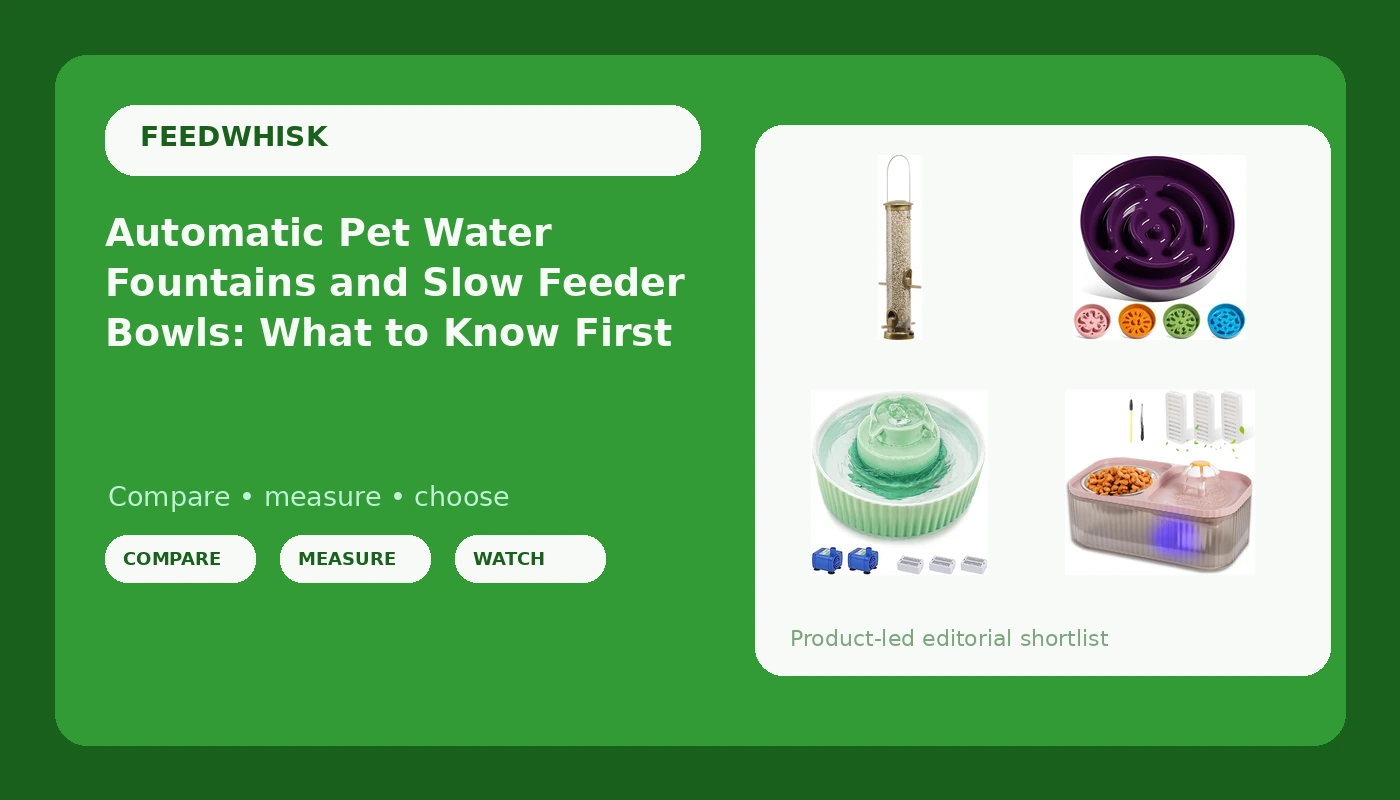
Feeding gear tends to fail in two predictable ways. Either the water sits still, goes flat, and the cat stops drinking it, or the food disappears in forty seconds and comes back up on the rug ten minutes later. Automatic pet water fountains and slow feeder bowls are the two most common fixes, and they are not interchangeable. One is about hydration, the other is about pace, and buying the wrong one wastes money and solves nothing. This guide covers four specific products, what each one is actually built for, and where each one falls short, so you can match the product to the animal in front of you instead of the one in the marketing photo.
Related: How to Slow Down a Dog That Inhales Its Food →
Quick answer
Match the product to the problem. For a cat that ignores still water, a circulating fountain keeps water moving through a filter, and the Marchul fountain-and-bowl set bundles a 100oz/3L reservoir with a stainless steel food bowl in one purchase. The Lawfery is the ceramic fountain option, useful when a cat shoves lightweight plastic around the floor. For a small dog or cat that finishes a meal in under a minute, the LE TAUCI ceramic slow feeder spreads the same food across a puzzle surface. The Aspects 395 is a different category entirely: it is a wild bird seed tube feeder for the yard, not an indoor pet bowl, and it belongs in this list only because a lot of pet owners shop for both.
Four useful options
| Model | Best fit | What stands out |
|---|---|---|
| Marchul Cat Water Fountain and Stainless Steel Food Bowl | Households that want water and food covered in one order | 100oz/3L reservoir, stainless steel food bowl, three replacement filters included |
| Lawfery Ceramic Cat Water Fountain | Cats that push or tip lightweight bowls | Ceramic body, 2.1L/71oz capacity, cupcake-shaped design |
| LE TAUCI Ceramic Slow Feeder Dog Bowl | Small dogs and cats that eat too fast | Ceramic puzzle bowl, 0.6 cup capacity, purple finish |
| Aspects 395 Quick-Clean Seed Tube Feeder | Backyard bird feeding | Antique brass finish, medium size, quick-clean tube design |
The all-in-one setup: Marchul Cat Water Fountain and Stainless Steel Food Bowl
The useful thing here is the pairing. Stainless steel is the material most often chosen for cats that develop chin irritation from plastic bowls, and having a stainless food dish arrive in the same box as the fountain removes a second shopping trip. The 3L reservoir is generous for a single cat, which means fewer refills, though you should still refresh the water regularly rather than treating capacity as a reason to leave it standing for a week.
The trade-off is that a combined unit shares one footprint and, in most setups, one power source. If the pump ever stops, the food bowl still works fine and the reservoir still holds water, so the pet is not cut off entirely. That is a better failure mode than a device that does everything through one mechanism. The pink finish is a look, not a function, and the "super quiet" wording comes from the listing rather than from any measurement taken here, so treat it as a claim to evaluate in your own kitchen.
The ceramic fountain: Lawfery Ceramic Cat Water Fountain
Ceramic changes the physics of the bowl. It is heavier than plastic, so a cat that paws at the rim or leans its weight on the edge is less likely to send the whole thing across the floor. For a household that has mopped up one too many puddles, that weight is the entire point of paying more for ceramic.
The same weight cuts the other way. A ceramic fountain is heavier to lift, heavier to rinse, and unforgiving if it slips out of your hands onto a tile floor during a cleaning session. If you already know you clean fountains at the sink rather than at the bowl's location, plan for the lift. The 2.1L/71oz reservoir sits between the compact fountains and the larger 3L units, which is plenty for one or two cats with regular refills.
The pace setter: LE TAUCI Ceramic Slow Feeder Dog Bowl
A slow feeder does not change how much you feed. It changes how long the meal takes. The ridges and channels force the pet to nuzzle food out of crevices instead of scooping a mouthful, which stretches a thirty-second meal into several minutes and gives the digestive system time to catch up. For a cat that bolts its food and vomits afterward, or a small dog that eats like it is being timed, that pacing is the whole intervention.
Capacity is the honest limitation. At 0.6 cups, this bowl fits a small breed or a cat portion cleanly, but it is not a meal bowl for a large dog, and it should not be treated as one. Ceramic construction keeps it planted on the floor while the pet works at it, which matters because a slow feeder that slides gets pushed into a corner and abandoned. Flat-faced pets can find deep puzzle channels frustrating, so watch the first few meals and confirm your pet can actually reach the food.
The backyard feeder: Aspects 395 Quick-Clean Seed Tube Feeder
This one is on the list because pet owners frequently feed birds too, and the search results overlap. It is not an indoor product and it will not help a cat drink more water. What it does is hang outdoors, hold seed, and open up for cleaning, which is the feature that matters most in a bird feeder. Wet seed left to sit in a tube grows mold, and moldy seed is the fastest way to make your yard a bad place for birds.
The practical requirement is a mounting point: a pole, a bracket, or a branch that keeps the feeder off the ground and away from where a determined dog can reach it. Antique brass is a finish choice rather than a durability claim, and the quick-clean design is worth using on a schedule rather than only when the feeder looks dirty.
Prices and availability may change. Product images, names, and retailer links are matched to verified listings. No current price, rating, stock status, or measured result is stated here without current evidence.
Moving water and slowing meals solve different problems
Cats evolved as desert-adjacent hunters that got most of their moisture from prey, which is one reason many of them drink less from a bowl than owners expect. Moving water draws attention in a way still water does not, and a fountain with a filter also keeps hair and dust out of the reservoir between refills. That is the case for a fountain: not that it makes a cat drink a specific amount, but that it removes two common reasons a cat walks away from the bowl.
Fast eating is a separate issue with a separate set of consequences. Dogs and cats that swallow meals whole take in air along with food, and that is commonly associated with regurgitation shortly after eating. In large, deep-chested dogs, eating speed is also one of the factors discussed in relation to bloat, a sudden stomach condition that is a medical emergency and not something a bowl can prevent. If your dog eats fast and then seems uncomfortable, distended, or retches without producing anything, that is a vet call, not a product decision. A slow feeder is a management tool for a pet that eats quickly and keeps it down, not a treatment for anything.
The two categories also fail differently. A fountain that stops circulating still holds water, so the pet has something to drink. A slow feeder has no moving parts at all, which makes it the lowest-risk purchase in this article: the only thing that can go wrong is that your pet refuses to use it.
How material, capacity, and cleaning change daily use
Material matters more than most listings admit. Plastic is light and cheap, and it scratches over time, and scratches hold residue that is hard to rinse out. Stainless steel is the usual recommendation for cats prone to chin irritation, and it cleans quickly. Ceramic is heavy, which is exactly what you want under a cat that tips bowls, but it is also the material most likely to chip or shatter if dropped, and it generally goes in the sink rather than the dishwasher rack.
Capacity is a math problem, not a marketing number. A 3L reservoir holds roughly 100oz, which is several days of drinking for one cat on paper, and a 2.1L reservoir is about 71oz. In practice you should still refresh and rinse well before the reservoir runs dry, because standing water in a warm kitchen is not improved by volume. The number to actually check is your pet's meal size: 0.6 cups is a full meal for a cat or a small breed and a snack for anything bigger.
Before you buy, run this sequence:
- Name the actual problem. Is your pet avoiding water, or eating too fast? These need different products.
- Measure a real meal. Use a measuring cup or a kitchen scale on your pet's normal portion, then compare it to the capacity on the listing.
- Match the material to the animal. Tippers and pawers get heavier ceramic or stainless. Cats with chin irritation get stainless or ceramic over plastic.
- Count the recurring cost. Fountains use filters, and filters are a subscription whether or not anyone calls them one.
- Ask what happens when it stops. If the pump dies or the power goes out, does your pet still have water and food? If the answer is no, keep a second water source on the floor.
Practical guidance for the first month
- Rinse the reservoir and food bowl daily and do a full clean weekly, including the pump housing, because a fountain you dread cleaning becomes a dirty fountain fast.
- Keep at least one plain water bowl down even after the fountain arrives, especially in summer or in a multi-pet home.
- Place the fountain away from the food dish if your cat seems uninterested, since many cats prefer to drink away from where they eat.
- Replace fountain filters on the schedule the manufacturer specifies rather than when the water starts to smell.
- For slow feeders, portion the food before it goes in and never top up a puzzle bowl to free-feed, or you lose the pacing benefit entirely.
- For the bird feeder, dump and clean it whenever seed gets wet, and scrub it on a regular schedule rather than seasonally.
Which option should you choose?
Choose the Marchul Cat Water Fountain and Stainless Steel Food Bowl when you want a circulating fountain and a stainless food dish handled in one order and you like the idea of a 3L reservoir. Choose the Lawfery Ceramic Cat Water Fountain when your cat pushes bowls around and you would rather have weight and ceramic than app features. Choose the LE TAUCI Ceramic Slow Feeder Dog Bowl when your small dog or cat finishes a 0.6-cup meal too quickly and you want the meal to take longer. Choose the Aspects 395 Quick-Clean Seed Tube Feeder when the actual goal is feeding wild birds in the yard.
None of these are measurements taken here. The quietness wording on the Marchul listing is the seller's claim, the capacities are the stated specifications, and the cleaning guidance is general practice rather than a timed result. Verify current listing details, dimensions, and filter compatibility for your specific pet before you order.
The bottom line
Water and food pace are two separate jobs, and the fastest way to waste money is to buy a fountain for a pet that needs portion control or a slow feeder for a pet that needs to drink more. If you want one purchase that covers hydration and a stainless food dish, the Marchul set does both. If your cat is a bowl tipper, ceramic is the material that resists it. If your small dog or cat eats like the bowl is about to be taken away, the LE TAUCI puzzle bowl is the cheapest fix in this article and the one with nothing to break. And if you are really shopping for the yard, the Aspects tube feeder is the right tool for that job, just not for the cat.