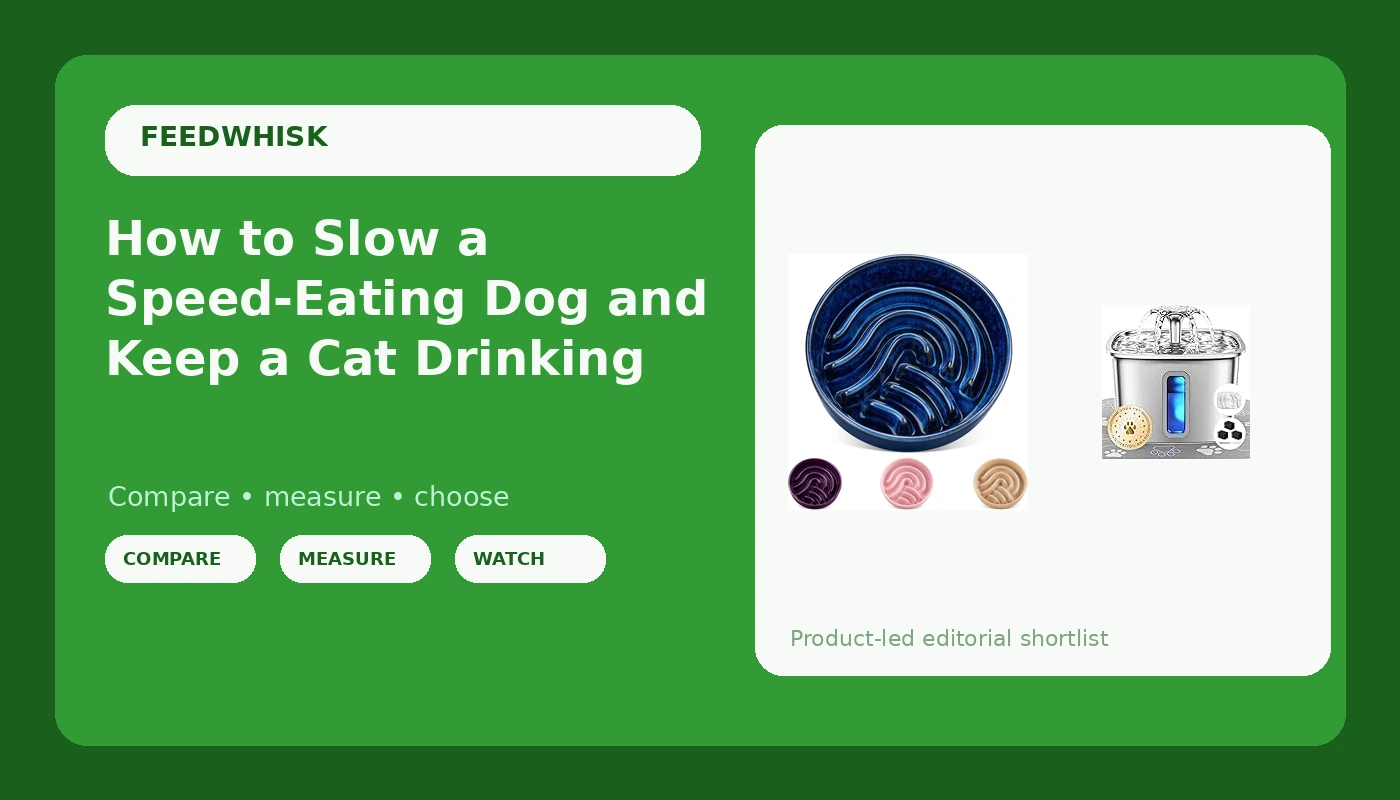
Most feeding problems I get called about are not equipment problems. They are delivery problems. A dog that inhales a bowl of kibble in three breaths and a cat that treats still water as a personal insult both get sold the wrong fix. The dog gets an automatic feeder with a "slow feed" setting that drops one meal a day. The cat gets a second bowl, which she tips over by dinner. A slow feeder dog bowl and a stainless steel cat water fountain cost less than either mistake, and they solve the actual problem instead of the marketing version of it.
I am Luis. I have been pet sitting and walking dogs in Pacific Beach for eight years, and my client list has grown past 60 households. At home I have Mochi, a tortoiseshell who tips water bowls on purpose, and Tank, a 75-pound lab mix who eats like a shop vac and has learned to body-slam gravity feeders until they dump the whole hopper. In the last 14 months I returned four automatic feeders, including one that quit feeding when the Wi-Fi hiccuped, before I kept a single one. That is why every unit now spends a full month in my apartment with Mochi and Tank before I will recommend it to a client's home.
This is the routine I use for both problems, in the order I would set it up.
Why you should trust me
Eight years of other people's pets teaches you what a spec sheet cannot. I have watched a diabetic cat miss a meal because a feeder jammed, and I have watched a beagle chew through the lid of a feeder at 3 a.m. because the latch was plastic and the dog was bored. Those calls are why I test the way I test.
My rules are simple and I do not bend them. No feeder gets recommended without a full month in my house. No fountain gets recommended unless I can clean the pump in under five minutes, because a fountain that is a pain to clean is a dirty fountain by Friday, and a dirty fountain is a health problem wearing a convenience label. No portion claim goes in writing unless I have checked it on a kitchen scale across a month, and no "quiet" claim goes in writing without a decibel reading at dispense time.
I am not a veterinarian and I do not play one in articles. Everything below is behavior and equipment. If your dog's fast eating started suddenly, or your cat's water intake changed, that is a vet conversation first.
How I picked and how I tested
Both items here are the cheap end of the solution, which is exactly why I like them. Before I recommend a $120 automatic feeder to fix a speed eater, I want to know the owner has already tried changing the bowl. Most of the time, they have not.
My test for a bowl is whether the dog has to work for each mouthful and whether the bowl stays where I put it. Tank pushes with his nose, and a light plastic bowl ends up against the wall with kibble scattered across the tile. I also check the capacity against a real meal, because a slow feeder that is too shallow does nothing and one that is too deep frustrates the dog into flipping it.
My test for a fountain is Mochi. She has tipped over every open bowl in my kitchen, so a fountain has to be heavy enough to survive her and simple enough that I actually clean the pump weekly. I check three things: can she move it, can I see the pump without disassembling the whole unit, and does the water stay moving when the level drops. A fountain that only circulates when it is filled to the top is a fountain that stops working on day four, right when you forget about it.
The numbers I care about are boring ones. Cleaning time per unit. How many pieces come apart. Whether replacement filters are a standard size. Whether the pump sits in a compartment I can reach with my hand instead of a screwdriver. Those decide whether the thing is still running in six months.
The bowl that actually slows Tank down
If your dog eats too fast, the first change is the delivery, not the electronics. A slow feeder is not a diet plan and it is not a puzzle toy you scatter on the floor. It is the bowl, with structure built into it.
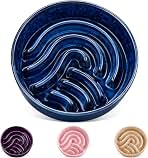
Best for speed eaters: vancasso Slow Feeder Dog Bowl, 1.5 Cup Ceramic Slow Feeding Food Dish for Small and Medium Breed, Puzzle Dog Food Bowl for Fast Eater, Blue
 Visit on Amazon →
Ceramic is the part that matters most here. Plastic slow feeders are light, and a determined dog slides them across the floor or flips them, which defeats the entire design. This one has enough weight that Tank cannot walk it into the wall mid-meal, and the ridges and pockets force him to slow down and actually chew instead of vacuuming the whole bowl in one motion.
The 1.5 cup capacity is a real number to plan around. That covers a small or medium breed meal. If your dog eats more than that per sitting, split it into two servings rather than piling kibble over the ridges, because a bowl that is overfilled is just a regular bowl again. It also matters for the dog's muzzle: this is a bowl for dogs that can reach into a pocket, not for a flat-faced breed that cannot.
Cleaning is the easy part, which is why I keep using it. Ceramic does not hold odors the way scratched plastic does, and it goes in the sink like any other dish. The trade-off is that ceramic breaks. One drop on tile and you are buying another one, so I treat it like a plate and not like a toy.
Flaws but not dealbreakers: It is heavy, and heavy means a dog with a nose-pushing habit can still scoot it a few inches across a hard floor. A rubber-backed mat under it ends that. It is also not a chew toy. A dog that redirects frustration onto the bowl needs a different approach, not a sturdier bowl.
Anyone with a small or medium dog that finishes a meal in under a minute should start here before spending money on anything with a cord.
The fountain that keeps Mochi from tipping
Cats evolved to distrust standing water, which is why a tipped bowl is not naughty behavior. It is a cat telling you she wants moving water. The fix is a fountain, and the fix for the fix is picking one she cannot knock over.
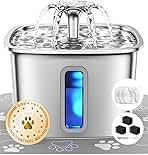
Best for bowl tippers: Veken Innovation Award Winner Stainless Steel Cat Water Fountain, 108oz, C1
 Visit on Amazon →
Stainless steel is the reason I put this one ahead of the plastic fountains in the same price band. Mochi got chin spots from a plastic bowl years ago, and my vet at the time told me what every cat owner eventually learns: plastic scratches, scratches hold bacteria, and bacteria shows up on the cat's chin. Stainless does not scratch the same way, and it does not hold the smell of old water the way plastic does either.
The 108oz reservoir is the other practical selling point. That is enough water that I am not refilling it twice a day for one cat, and it holds a level that keeps circulating instead of running dry while I am at a client's house. For a household with two cats it still buys you real time between refills.
The pump is the part I judge a fountain on, and this one is reachable. I can pull it, wipe the impeller, and have it back together in well under my five minute rule, which means I actually do it weekly instead of promising myself I will. If you cannot see the pump without tools, the pump does not get cleaned, and that is how fountains get a reputation for slime.
Flaws but not dealbreakers: It is a plug-in appliance, so a power outage means still water. I keep a plain ceramic bowl filled as a backup for exactly that reason, and so should you. Filters are a recurring cost you have to plan for, not a one-time purchase. And it is not self-cleaning no matter what the listing implies. Weekly hands-on cleaning is the deal you make when you buy any fountain.
Anyone with a cat that tips bowls, or a cat that barely drinks from a still bowl, will get more out of this than out of any other $30-ish purchase for the animal.
The routine, step by step
Equipment does not fix behavior by itself. This is the order I set it up in for a client, and the order I would use in your house.
One: measure what a meal actually is. Put the kibble on a kitchen scale before you change anything. A scoop is not a portion, and cup lines on a plastic cup are a suggestion. If your vet gave you a number, that number is the target, not whatever fits in the bowl.
Two: time the current meal. Watch one feeding and note how fast it disappears, whether your dog gulps air, burps, or vomits afterward. Speed is only half the problem. The other half is what the speed does to the dog.
Three: switch the bowl first. Before you shop for electronics, change the delivery. The vancasso bowl spreads a meal across ridges and pockets, which adds pauses and forces chewing. Give it a full week before you judge it. Most dogs figure it out in two meals and eat noticeably slower by day three.
Four: match the bowl to the meal size. This bowl holds 1.5 cups. If your dog's meal is larger, feed it in two rounds instead of overfilling the ridges. An overfilled slow feeder is a normal bowl with extra steps.
Five: anchor the bowl. Ceramic is heavy, but a nose-pushing dog can still move it. A rubber-backed mat under the bowl keeps it in place and keeps kibble off your baseboards.
Six: separate the water from the food. Cats drink more when the water is not parked next to the food bowl. Put the fountain in a different room, or at minimum a few feet away and not under a cabinet where the pump noise bounces.
Seven: give the fountain a full day. Some cats drink from a new fountain within an hour. Others need the old bowl left out beside it for a week while they decide. Do not panic and return it on day one.
Eight: pick a cleaning day and keep it. Pump out, impeller wiped, bowl scrubbed, water changed. Put it on the same day as something you already do weekly, like trash night, or it will not happen.
Nine: track it for a month. Weigh portions weekly. Note gulping, vomiting, stool changes, and how much water disappears. For cats, litter box clumps are the easiest hydration proxy you have.
Ten: change one thing at a time. Bowl first, then water, then anything else. If you swap three things in a week and the dog gets worse, you have no idea which one did it.
Where this breaks down
A slow feeder is not right for every dog. Flat-faced breeds like bulldogs and pugs cannot reach into deep ridges comfortably, and forcing them to try is not enrichment. Dogs with a history of bloat or GDV need a veterinarian's input before you change how they eat, full stop. In a multi-dog home, a slow feeder can become a guarding flashpoint, so feed separately or skip it.
Ceramic chips. Inspect the bowl every wash, and retire it the moment the rim goes rough. A chipped edge near a dog's mouth is not a cosmetic issue.
A fountain is not a hydration cure. If your cat's water intake jumped or dropped, or if she is straining in the litter box, that is a vet visit and not a product swap. A fountain also does nothing for a cat that will not drink from a fountain, which is a real category of cat. Keep a clean still bowl available and let her choose.
Finally, the fountain stops in a power outage, and filters run out. Both of those are planning problems, not product failures, but they are the reasons people end up with a dry pump and a stressed cat on a Tuesday.
What lost, and why
Gravity feeders are the most common wrong answer for a speed eater. They refill themselves by gravity, which means a dog like Tank gets an unlimited supply and body-slams the reservoir until it dumps. Fine for a grazing cat. Genuinely dangerous for a dog that eats too fast.
Automatic feeders with a "slow feed" mode are the second wrong answer. Dispensing one meal a day is a diet schedule, not a slow feeder. If the auger jams, your dog eats nothing, and the app will not tell you until you look.
Plastic fountains with hidden pump compartments lose on maintenance. If the pump is buried behind a cover that needs tools, the cleaning interval stretches from weekly to monthly, and the fountain becomes a biofilm farm with a pleasant trickle sound.
Puzzle toys and snuffle mats are good additions and bad replacements. They slow a meal down, but they do not deliver a measured portion twice a day, and they add laundry to your week.
What this all costs
The shape of the cost matters more than the sticker. The bowl is a one-time purchase with no consumables, which is why I start there. The fountain is a one-time purchase plus filters, plus the electricity of a small pump, plus the fifteen minutes a week you spend cleaning it. The real cost of a fountain is your cleaning discipline, not the box.
Compare either one to the alternative. One emergency vet visit for a bloat scare or a urinary blockage costs more than both items together, and that math is not close. Both of these are the cheap version of the fix, and they are the version I would try first in my own kitchen.
Check current Amazon price on the bowl and the fountain before you commit, since both move around, and buy from a seller with an easy return policy. I have returned four feeders in fourteen months. Returns are part of the spec, and a seller who makes them painful has told you something about the product.
Do the bowl first. Add the water second. Give it a month, weigh the portions, and clean the pump on a schedule you will actually keep. That is the whole routine, and it works on the two most common feeding problems I get paid to solve.