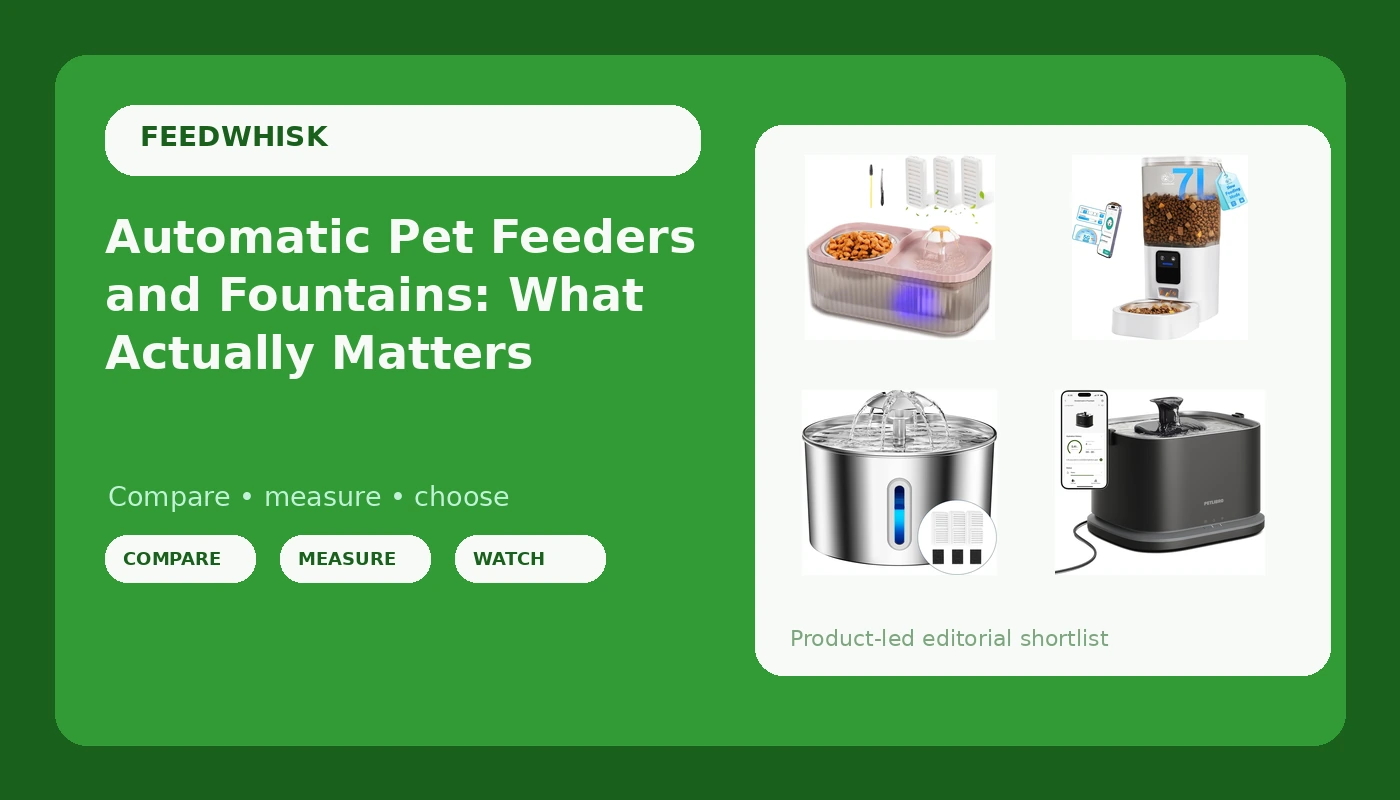
Automatic pet feeders and fountains solve two of the oldest problems in a pet household: meals that arrive at the same time every day, and water that keeps moving while you are at work. The hard part is that the numbers printed on the box are rarely the numbers that decide whether a unit survives your kitchen. Capacity tells you how often you refill. It says nothing about whether the dispense mechanism jams, whether the pump comes apart for cleaning, or whether the device still feeds when your Wi-Fi drops. This guide walks through four current options and the handful of design details that separate a unit you keep from one you return.
Related: How to Choose an Automatic Pet Feeder for a Multi-Pet Home →
Quick answer
For most households, a Wi-Fi feeder with a sealed hopper handles scheduled meals, and a stainless steel fountain handles water. Match capacity to how long you are actually away, and check two things before buying: whether the food or water path comes apart for cleaning, and whether the device keeps its schedule without a working app connection. None of the four options below is universally better than the others. They differ by capacity, material, and how much control lives in an app.
4 useful options
| Model | Best fit | What stands out |
|---|---|---|
| Marchul Cat Water Fountain and Stainless Steel Food Bowl | Small households that want a fountain and a food bowl in one purchase | 100oz/3L reservoir, smart pump, three replacement filters included, stainless steel food bowl |
| Automatic Cat Feeder with 5G WiFi | Owners who want scheduled meals with app and voice control | 7L / 29-cup hopper, 5G WiFi, Alexa support, slow feed setting, detachable parts |
| Cat Water Fountain Stainless Steel 74oz/2.2L | Single-cat homes or small dogs that need a compact fountain | 74oz/2.2L capacity, stainless steel drinking surface, three filters included |
| PETLIBRO Dockstream 2 | Owners who want app monitoring alongside a stainless steel tray | 3L/101oz capacity, stainless steel tray, app monitoring, 5G WiFi |
The combo pick: Marchul Cat Water Fountain and Stainless Steel Food Bowl
The trade-off here is size and intent. A 3L reservoir is generous for one cat and workable for a small dog, but it is not meant to cover a multi-dog household through a long trip. The included food bowl is a still bowl, not a feeder, so it does not portion meals or hold a day of kibble for a pet that free-feeds aggressively. If your household needs scheduled meals, pair this with a feeder rather than expecting the bowl to do that job. The stainless steel drinking and eating surfaces are the practical win: they resist the scratches and odor retention that plastic develops over months of daily use.
The app-controlled feeder: Automatic Cat Feeder with 5G WiFi
Two things decide whether a feeder like this earns its place. The first is the dispense mechanism. Feeders move kibble either with an auger, a rotating screw that pushes food toward the opening, or with a portion wheel, a rotating compartment that drops a set amount per meal. Augers handle irregular kibble shapes but are the part that jams when crumbs and dust pack into the tube. Portion wheels are more consistent on uniform kibble but can be thrown off by very large or very small pieces. The second is what happens offline. A feeder that stores its schedule on the device keeps feeding when the router reboots; one that depends on a live connection does not. The 7L hopper is large enough that refill frequency is a weekly or biweekly question rather than a daily one, which matters for anyone who travels. Note also that "slow feed" here describes how a meal is delivered, not a substitute for a slow feeder bowl if your dog inhales food.
The compact fountain: Cat Water Fountain Stainless Steel 74oz/2.2L
The smaller reservoir is the whole point and the whole limitation. A 2.2L fountain is easier to place in a tight kitchen, easier to lift to the sink, and easier to empty and rinse than a 3L unit. It also means more frequent refills, and in a hot month with a large dog drinking heavily, that difference shows up fast. Stainless steel is the material choice worth paying attention to. Plastic bowls develop micro-scratches that hold onto oils and odor, and some cats develop chin irritation on plastic; stainless cleans down more completely and does not hold a smell. The three included filters cover the first months of ownership, after which filters become a recurring cost you should budget for.
The monitored fountain: PETLIBRO Dockstream 2
Monitoring is genuinely useful in one specific scenario: a pet home where nobody is there for long stretches, or a cat with a history of urinary issues where you want to know that water intake has not quietly dropped. It is not a substitute for cleaning. A sensor tells you the reservoir level, not whether biofilm has built up in the pump housing or whether the filter is spent. Budget the same weekly rinse and pump cleaning as you would with any other fountain, and treat the app as an early warning system rather than maintenance.
Prices and availability may change. Product images, names, and retailer links are matched to verified listings. No current price, rating, stock status, or measured result is stated here without current evidence.
How automatic feeders actually move food
Every automatic feeder is a storage bin, a mechanism, a controller, and a bowl. The mechanism is the product; everything else is packaging. Auger-driven units push kibble along a tube with a rotating screw. They tolerate a wide range of kibble sizes, but the tube is where dust, crumbs, and oil accumulate, and packed debris is the most common cause of a jam. Portion-wheel units rotate a compartment that fills and then dumps a fixed volume per meal. They are mechanically simpler and usually more consistent on uniform kibble, but very small pieces can slip past the wheel and very large pieces can bridge across it. Either design depends on kibble that flows, so a bag with a lot of fines at the bottom is a real risk regardless of which one you buy.
The controller matters for a different reason. A schedule stored on the device and a schedule stored in the cloud behave very differently when your internet goes down at 6 a.m. Before buying, find out whether the unit can be programmed at the device itself, and whether it retains its schedule through a power blip. A feeder that needs a live connection to remember that your cat eats at seven has a single point of failure that has nothing to do with feeding.
What a fountain is really doing
A fountain is a pump, a reservoir, a filter, and a drinking surface. The pump is what keeps water moving, and moving water is the entire reason a cat that ignores a still bowl will drink from a fountain. The filter catches hair, dust, and food particles before they recirculate, which is why filters are a consumable and not an accessory. The drinking surface decides how the fountain feels to your pet and how easy it is to keep clean. Stainless steel and ceramic resist scratching and odor; plastic is lighter and cheaper but degrades faster and holds onto smells.
The detail that separates a fountain you maintain from one you resent is pump access. If the pump sits in a compartment you cannot easily open, debris collects out of sight and the water quality drops between cleanings. Before buying, look at how the unit comes apart: how many pieces, whether the pump housing opens without tools, and whether the impeller can be reached. A fountain you can fully rinse in a few minutes gets cleaned weekly. One that requires disassembly and reassembly does not.
- Measure your longest realistic absence. A weekend trip, a 12-hour workday, and a two-week vacation are three different products.
- Count the animals. Two cats sharing one fountain drain a 2.2L reservoir far faster than one cat, and multi-pet homes need more water stations, not bigger ones.
- Check the food path. Look for a hopper that seals against humidity and a dispense mechanism you can open, inspect, and clear without tools.
- Confirm offline behavior. Find out whether the schedule lives on the device, so a router reboot does not become a missed meal.
- Price the consumables. Filters and replacement pumps are recurring costs; factor them in before comparing two units on purchase price alone.
Setting up a routine that holds up
- Place the fountain away from the food bowl. Cats often prefer to drink away from where they eat, and separation increases intake.
- Run a new fountain for a full cycle and rinse it before your pet uses it, then repeat weekly whether or not the water looks cloudy.
- Disassemble the pump every time you clean. The impeller and intake are where hair and film collect, and that is the part you cannot see from outside.
- Test a feeder with a kitchen scale for the first week. Weigh what actually lands in the bowl against what you programmed, then adjust.
- Keep a backup plan for power and internet outages. A gravity bowl of fresh water and a measured portion of kibble covers the gap.
Which option should you choose?
Choose the Marchul Cat Water Fountain and Stainless Steel Food Bowl when you are setting up a first station for a cat or small dog and want the bowl and the fountain handled in one purchase. Choose the Automatic Cat Feeder with 5G WiFi when scheduled meals are the actual problem, whether because of a work schedule, a diet plan, or a pet that needs portions measured instead of poured. Choose the Cat Water Fountain Stainless Steel 74oz/2.2L when counter space is tight and a single cat or small dog is drinking from it. Choose the PETLIBRO Dockstream 2 when you are away for long stretches and want the reservoir level reported to your phone instead of discovered by eye.
Two caveats are worth stating plainly. First, none of these listings includes a verified runtime, decibel reading, or portion-accuracy figure here, so treat marketing claims about quiet operation or precision as claims to test in your own home. Second, a feeder or fountain is a supplement to care, not a replacement for it. Any pet with a medical condition that depends on timed meals or measured water intake needs a plan that accounts for power outages, jams, and app failures.
The bottom line
The right automatic feeder or fountain is the one whose weakest part you can live with. If the dispense mechanism jams, a smart app will not save the meal. If the pump is buried in a housing you cannot open, the water will be dirtier than you think by the end of the week. Match capacity to your longest real absence, favor stainless steel where your pet eats and drinks, and confirm that the device keeps working when the internet does not. That set of checks will tell you more about which of these four fits your home than any capacity number on a box.