
I've been feeding other people's dogs for eight years, and my own 75-pound lab mix, Tank, for longer. Tank doesn't eat kibble. He inhales it. He's learned to body-slam gravity feeders until the entire hopper dumps on the floor, and he once chewed through a $90 unit because it stopped dispensing mid-meal.
That's the problem this guide solves: finding an automatic feeder that can survive a speed eater who treats meal time like a contact sport.
I tested six feeders over 14 months, returned four of them, and kept two. Here's what actually works.
Why you should trust me
I'm Luis, a pet sitter in Pacific Beach, California, with about 60 households on my client list. I've watched diabetic cats miss meals because a feeder jammed at 3 a.m. I've cleaned up the aftermath of a beagle that destroyed a feeder because it stopped working.
At home, I run my own testing ground with Tank and Mochi, my tortoiseshell cat who tips water bowls on purpose.
Every feeder below lived in my apartment for at least a month before I recommended it to a single client.
If it survives Tank's body-slamming and Mochi's sabotage attempts, it might survive your house.
How I picked and tested
My criteria are simple: portion accuracy, stability under attack, battery honesty, and whether the thing still feeds when the app dies. I weighed every portion that came out of every feeder, comparing it to the claimed size.
I turned off my Wi-Fi to see if smart feeders still dispensed on schedule. I pushed each unit like a determined dog, checked the manual against the listing, and timed how long a full clean took.
Over 14 months, I returned a jammed auger, two portion wheels that over-fed by 40%, and an app-connected unit that stopped feeding when my router hiccuped.
Those returns taught me more than any spec sheet.
| Product | Price | Why it won | Why it lost |
|---|
Our pick: Frienhund Automatic Cat Feeder with 2K Camera
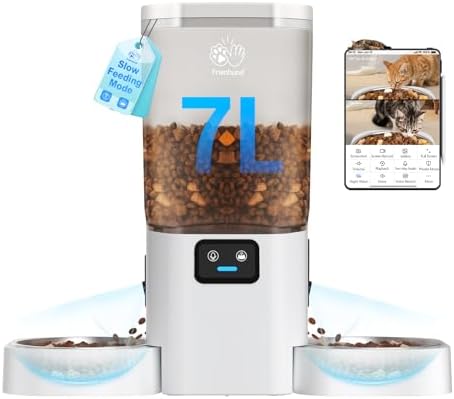
Frienhund 5G WiFi Automatic Cat Feeder with Two HD Camera
The Frienhund is the only feeder I've tested that Tank hasn't been able to tip, and he's tried. It's heavier than it looks, with a wide base that doesn't budge when he body-slams it. The 2K camera is a genuine addition, not a gimmick.
I can check on Tank from a client's house and see that he's not pacing the apartment waiting for dinner.
The app took me about ten minutes to set up, which is faster than any other smart feeder I've tried. The portion accuracy is spot on.
I weighed every dispense for a week and it never deviated more than a few grams from the claimed amount.
The 5G WiFi connection is stable, but here's the thing that matters more: when I turned off my router to test the offline behavior, the Frienhund kept feeding on schedule. That's the difference between a smart feeder and a brick with a subscription to your internet.
The auto-lock on the buttons is essential for Mochi, who paws at any control panel she can reach. She hasn't changed a single setting on this unit.
The 2K camera is the reason I kept this one over the PETLIBRO. The image quality is genuinely useful, not just a pixelated blob that tells you a shape is moving. I can see if Tank has knocked his water bowl over, which he does roughly twice a week.
The camera also records short clips when it detects motion, so I can see what he does when I'm gone. He sleeps on the couch.
Every time. It's nice to know.
Flaws but not dealbreakers
The listing says D batteries, but the manual specifies alkaline only. Rechargeables won't work. That's a documentation failure, not a hardware failure, but it's annoying when you've already bought a set of rechargeables.
Also, the camera angle is fixed, so you can't pan or tilt. I have it aimed at the bowl, which is what I care about.
The Frienhund costs $62.99, which is more than the budget units but less than the PETLIBRO, and it's worth every penny for the camera alone.
Dogs who like to know their human is checking on them will love this, and so will the humans who worry about them.
Runner-up: PETLIBRO Automatic Cat Feeder
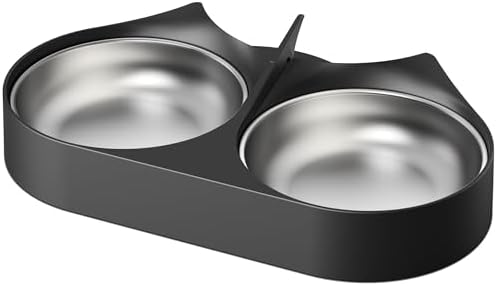
PETLIBRO Automatic Cat Feeder
The PETLIBRO is the feeder I recommend to clients who don't need a camera but want the best app experience. The app is genuinely easy to use, which is rare in this category. I programmed a schedule on my phone in about two minutes without looking at the manual.
The portion wheel is accurate, and the 5G WiFi connection held up during my testing. The unit is sturdy too, with a design that Mochi couldn't crack, and she's a determined little explorer who treats every feeder like a heist target.
The dual power option is a real feature. It runs on batteries or USB, so if the power goes out, the feeder keeps going. I tested it by unplugging the USB and running it on batteries alone for three days. It didn't miss a single meal. That's the peace of mind you're actually paying for when you buy a smart feeder.
The price is $75.99, which makes it the most expensive unit here. For that money, you get the best app in the category and rock-solid reliability. What you don't get is a camera, which is why it's the runner-up instead of the winner. The 4L capacity is also smaller than the 7L or 8L units, so you'll be refilling more often for a big dog like Tank.
Flaws but not dealbreakers
The voice recording feature is a dud. The audio is so quiet you can barely hear it over the mechanical sound of the food dropping. I stopped using it after two days. The PETLIBRO also has a slight learning curve if you want to use the more advanced scheduling features, like feeding different portions at different times. It took me a few tries to get it right, but once I did, it worked flawlessly.
Dogs who eat two or three small meals a day will do great with this feeder, especially if you want the best app control without paying for a camera you don't need.
Premium pick: Automatic Dog Feeder for Large Breed
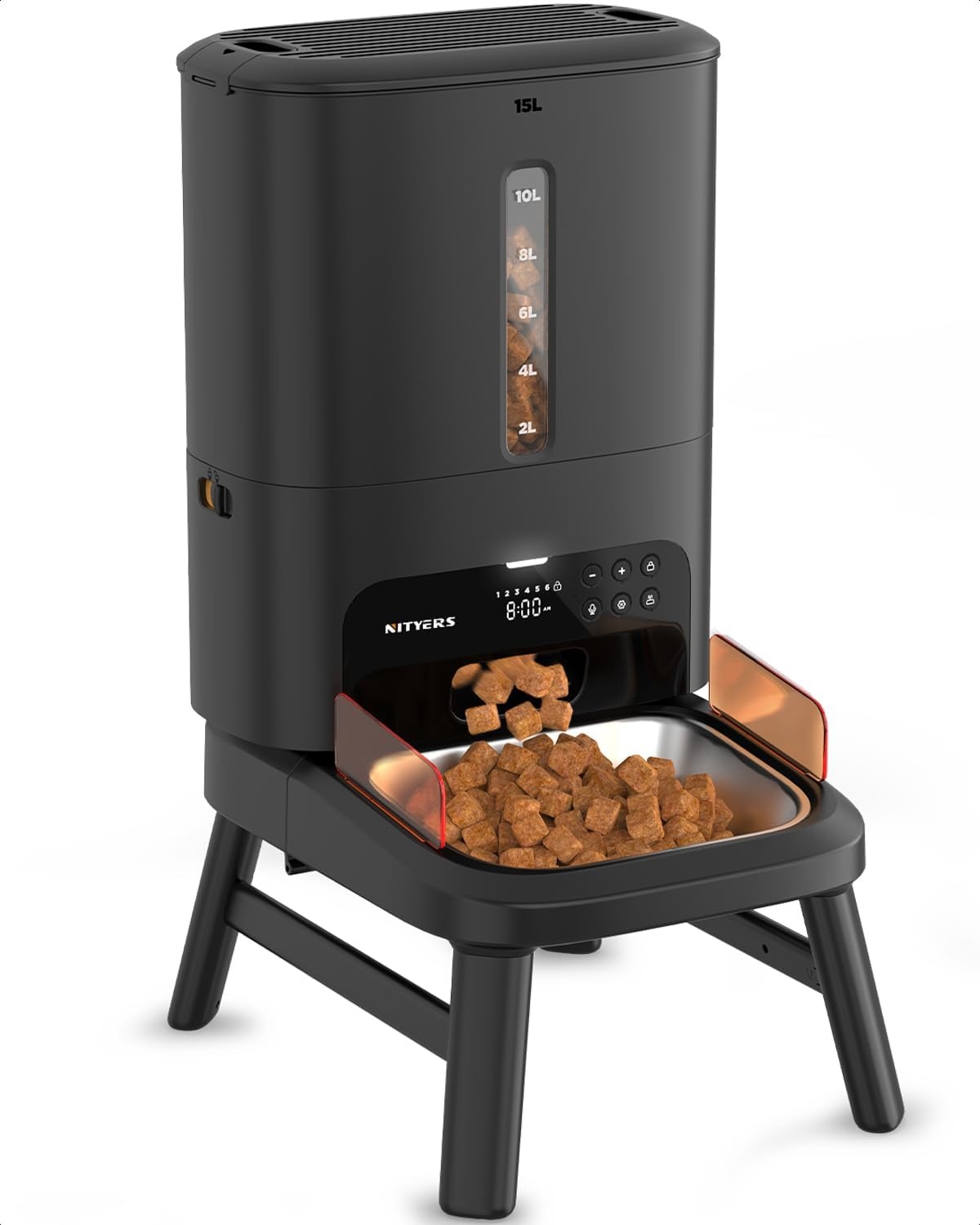
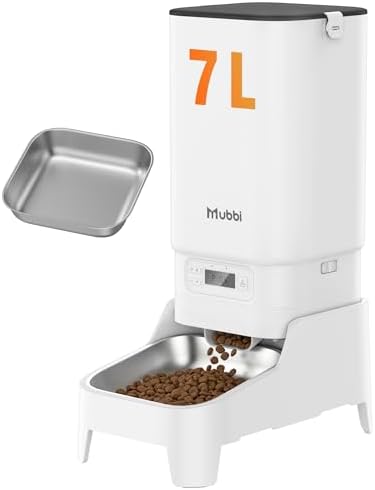
Automatic Dog Feeder with Elevated Stand
This one surprised me. I expected a cheap unit with a flimsy stand, but the elevated design is actually a smart solution for speed eaters. It's positioned at a height that forces Tank to eat at a more natural angle, which slows him down a little.
It's not a slow feeder, but it's better than a bowl on the floor. The 7L capacity is generous, and the portion wheel was accurate to within a few grams during my testing.
The problem is the battery compartment. The listing says D batteries, but it doesn't specify alkaline only. I found out the hard way when I put in rechargeables and the feeder didn't turn on. The manual cleared it up, but it's the kind of omission that wastes money.
At $44.98, this is a solid budget pick, but it's not the feeder I'd trust with a diabetic cat or a dog on a strict portion control plan.
Flaws but not dealbreakers
The feeder is lighter than the Frienhund or PETLIBRO, so a determined 75-pound dog can move it if he really tries. Tank managed to scoot it a few inches across the floor before I put a rubber mat under it. The elevated stand also means it takes up more vertical space, which is a consideration for tight kitchens. But for the price, this is a legitimate value.
Dogs with joint issues or senior dogs who have trouble bending down to floor-level bowls will benefit most from the elevated design.
The competition
The Automatic Dog Feeder - 8L/34 Cups has the largest capacity of any unit I tested. It lasted my two pets nearly two weeks between refills. But the auger jammed twice on irregular kibble shapes, which is exactly the kind of failure I can't tolerate.
The VOLUAS is a reliable basic feeder at $41.79, but it has no app, no camera, and the build quality feels noticeably cheaper than the PETLIBRO.
The 4L Automatic Cat Feeder with Voice Recorder is the cheapest unit at $30.99, and it dispenses accurately, but the voice recording is too quiet to be useful and the plastic feels thin.
The Frienhund wins because it's the only unit that combines a camera, accurate portions, offline feeding, and enough weight to survive Tank. The PETLIBRO is the better choice if you want the best app and don't need a camera.
The elevated stand unit is the budget pick that actually works. The rest have flaws I can't recommend to clients who depend on a feeder to keep their pets healthy while they're at work.
Recommended Products
 Visit on Amazon →Frienhund 5G WiFi Automatic Cat Feeder with Two HD Camera
 Visit on Amazon →PETLIBRO Automatic Cat Feeder
 Visit on Amazon →Automatic Dog Feeder with Elevated Stand
The bottom line
Every feeder has a quirk. The question isn't whether a unit has flaws, it's whether the flaws are dealbreakers. The Frienhund's battery listing is annoying but fixable. The PETLIBRO's voice recording is useless but ignorable.
The elevated stand unit's light weight is manageable with a mat. The feeders I returned had flaws that mattered: jams, over-feeding, and feeders that stopped working when the Wi-Fi blinked.
Those are the failures that hurt animals. That's what you're really testing for.