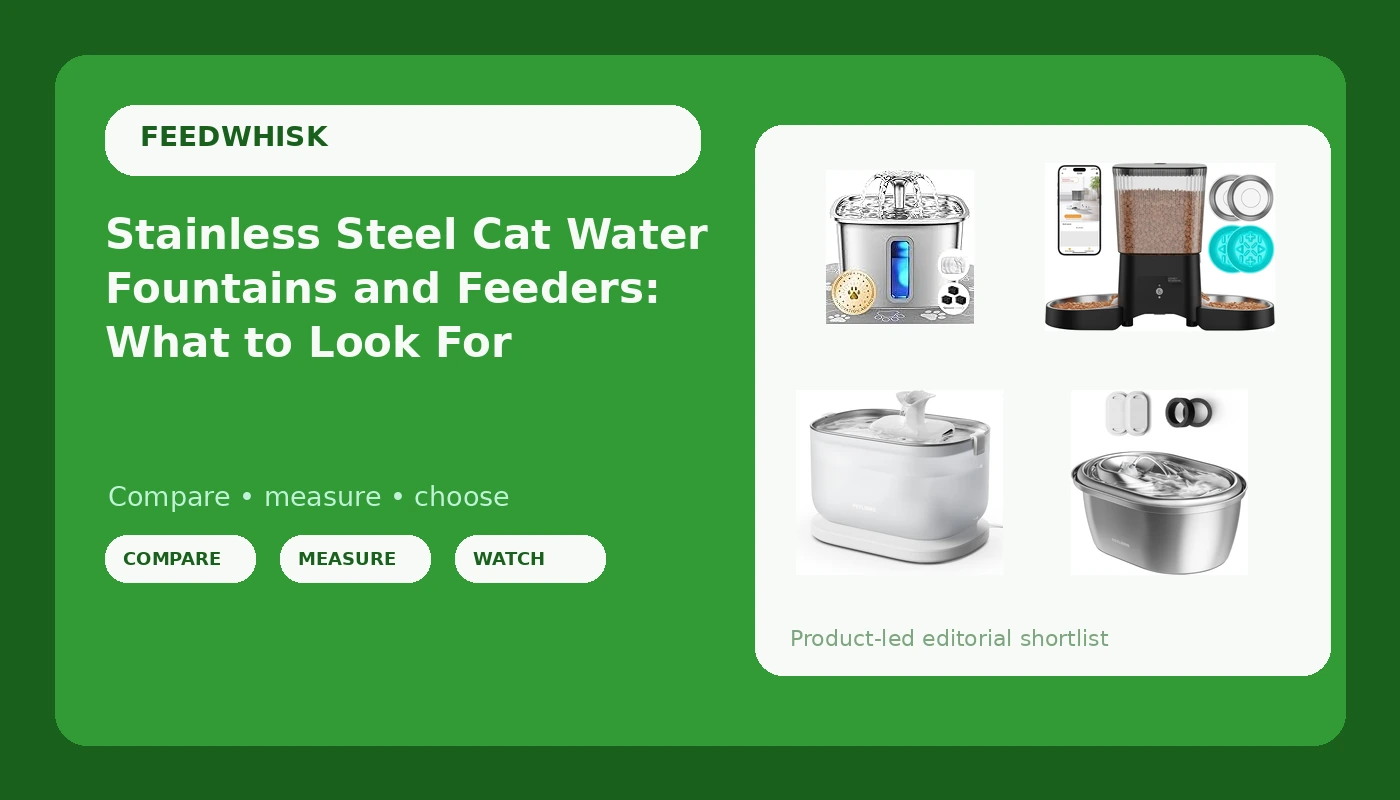
Most cats drink less than they should, and the water they ignore in a bowl often gets their attention the moment it starts moving. A stainless steel cat water fountain addresses both halves of that problem: circulation that encourages drinking, and a non-porous drinking surface that does not hold onto bacteria the way scratched plastic does. An automatic feeder answers a different question entirely, which is not whether the cat will drink but whether the cat gets fed at 6 a.m. when nobody is home.
I have spent eight years as a pet sitter and dog walker in Pacific Beach, and I have watched more feeding routines fall apart than I can count. The failures are almost never about the app. They are about a mechanism that jams, a reservoir that runs dry, a pump compartment nobody wants to open, or a bowl a determined animal can tip. That is the lens I use on the four products below: three stainless steel fountains and one WiFi feeder built for two cats.
Related: Automatic Pet Feeders: How Portion Control Actually Works →
Quick answer
Buy a fountain if your cat ignores standing water, and prioritize three things: a stainless steel drinking surface, a pump you can reach and clean in a few minutes, and a capacity that matches the number of cats in the house. Buy an automatic feeder if meals need to land on a schedule you cannot always keep, and prioritize the dispense mechanism and the power-failure plan over app features. The Veken C1 and the two PETLIBRO fountains cover the stainless fountain category at different capacities and designs, while the HoneyGuaridan covers scheduled meals for a two-cat setup. Nothing in these listings supports calling any single unit the quietest or the best, so treat words like "ultra quiet" as claims to check against current owner reviews.
Four useful options
| Model | Best fit | What stands out |
|---|---|---|
| Veken Innovation Award Winner Stainless Steel Cat Water Fountain, 108oz, C1 | Households that want one large stainless reservoir and fewer refills | Listed 108oz capacity with stainless steel construction |
| HoneyGuaridan Automatic Cat Feeder for 2 Cats, 2.4G/5G WiFi APP Control | Two-cat homes that need scheduled, app-managed meals | Dual-band 2.4GHz and 5GHz WiFi plus app control |
| PETLIBRO Cat Water Fountain Stainless Steel Tray, Wireless Pump, 2.5L | Owners who want the fastest possible disassembly at cleaning time | Wireless pump, stainless steel tray, dual flow design |
| PETLIBRO Stainless Steel Cat Water Fountain, 101oz/3L | Cats and small dogs that need adjustable flow from a larger reservoir | 3L capacity, adjustable flow, two filters included |
Large-capacity fountain: Veken Innovation Award Winner Stainless Steel Cat Water Fountain, 108oz, C1
Capacity is the entire pitch here, and it is worth doing the math. A ten-pound cat takes in only a few ounces of water a day directly, but that number climbs with dry food, warm weather, and kidney or thyroid issues. A 108oz reservoir means refills are infrequent, and it also means that when you do clean it, there is more surface area and more water to handle at the sink. Large reservoirs hide slow problems: if the pump starts losing flow, the water level barely moves and you may not notice for a day or two. Check the intake weekly and listen for a change in pitch. The innovation award wording in the name is a marketing credential, not a performance specification, so weigh it accordingly.
Two-cat feeder: HoneyGuaridan Automatic Cat Feeder for 2 Cats, 2.4G/5G WiFi APP Control
The spec line that matters most is the dual-band WiFi support. Plenty of smart pet devices only speak 2.4GHz, and if your router splits bands or you run a mesh system, setup can turn into an entire afternoon of troubleshooting. Beyond connectivity, ask what happens when the network drops. A feeder should hold the schedule it was already given rather than going silent until the router comes back, so check the listing for battery backup or offline operation before you commit. It is also worth understanding what "for 2 cats" typically means in this category: a split bowl or two dispense points, not a device that keeps one cat out of the other's portion. If your cats eat different food or one is on medication, a microchip-reading feeder is a different product class altogether.
Easy-clean fountain: PETLIBRO Cat Water Fountain Stainless Steel Tray, Wireless Pump, 2.5L
On most fountains the pump sits in the basin with a cord running out the back, so cleaning means unplugging the unit, draining it, and dragging a wet cord across the counter. A pump that lifts out with the tray shortens that routine considerably, and a shorter routine is one you will actually repeat on a Sunday instead of postponing to next week. The trade-off is that a cordless pump still needs power, usually through contact points or a charging arrangement, so read the current listing to see how the unit is powered and what maintenance that adds. As for the "ultra quiet" wording, that is a claim rather than a measured result. Noise is most noticeable when the water level drops, so scan recent reviews for how owners describe it near the low-water mark.
Adjustable-flow fountain: PETLIBRO Stainless Steel Cat Water Fountain, 101oz/3L
Adjustable flow matters for cats that shy away from a hard stream. Some cats drink happily from a bubbling spout; others treat a fast-moving surface as something to swat. Being able to dial the pump back gives you a way to test both without buying a second fountain. The two included filters are a genuine part of the value, but they are also the beginning of a recurring cost: filters need replacing on a schedule, and a clogged filter makes the pump work harder and run louder. Buy a set of spares when you buy the fountain so you are never improvising. The larger reservoir and the small-dog listing make sense together, though a dog that plays with water can move 3L faster than most people expect, so check the level daily in a multi-pet house.
Prices and availability may change. Product images, names, and retailer links must be matched by verified ASIN. Do not state a current price, rating, stock status, or measured result without current evidence.
What stainless steel does and does not fix
Stainless steel earns its place in a fountain because it is non-porous and does not develop the fine scratches that plastic does. Those scratches are the problem: they give biofilm a place to settle, they hold onto odor, and they are difficult to scrub out completely. In cats, chin acne is commonly associated with plastic food and water dishes, which is why so many owners make the switch. Stainless also tolerates hot water and dishwasher cycles better than most plastic parts.
What stainless does not fix is the rest of the fountain. Read the listing closely to see what the water actually touches. Many units pair a stainless tray with a plastic housing, plastic spout, and plastic impeller cover, and those interior parts still collect slime. The pump is the real weak point in any fountain. If the pump sits in a compartment you have to disassemble with a screwdriver, the fountain will be dirty more often than it is clean. If you can pull the pump, rinse the impeller, and reassemble in a couple of minutes, you will keep it clean.
How feeders dispense, and why the mechanism outranks the app
Automatic feeders come in two broad types. Gravity feeders let kibble fall into a bowl as the level drops, which is fine for a grazing cat and a poor fit for a dog that eats like a shop vac, since there is nothing metering the portion. Portioned feeders use either an auger, a rotating screw that pushes kibble toward the opening, or a portion wheel, a rotating compartment that drops a set volume per meal. Augers are the part that jams, usually because of kibble size, crumbs, or humidity. Portion wheels are generally more predictable, but accuracy varies by kibble shape and density.
That is why the app should never be your first question. An app is a scheduling convenience. The mechanism is the product, and the power plan is the insurance. Ask what the feeder does when the WiFi drops and when the battery dies, because a device that forgets its schedule during an outage is a device that misses meals.
- Count the animals and measure what they actually eat or drink before you buy capacity you do not need.
- On a fountain, check what the water touches, not just the color of the top tray.
- Walk through a full cleaning in your head: how many parts, does the pump lift out, is there a cord to wrestle.
- On a feeder, confirm the dispense type and the behavior during a power or WiFi failure.
- Add the consumables to the budget: filters, replacement pumps, and desiccant packs if the hopper uses them.
Keeping a fountain or feeder from becoming a chore
- Rinse and refill a fountain every two to three days, and do a full teardown with a brush once a week.
- Keep the water station away from the food bowl, since cats often prefer to drink away from where they eat.
- Replace filters on the manufacturer's schedule rather than when the water starts tasting off to you.
- Store kibble in the hopper only as long as it stays fresh, and remember that coastal humidity works against any container that does not seal.
- Keep a manual backup plan: a bowl, a measured scoop, and written instructions for whoever covers your pets when you travel.
Which option should you choose?
Choose the Veken Innovation Award Winner Stainless Steel Cat Water Fountain, 108oz, C1 when you want one large stainless reservoir and the fewest possible refills. Choose the HoneyGuaridan Automatic Cat Feeder for 2 Cats, 2.4G/5G WiFi APP Control when two cats need meals on a fixed schedule and your home network is the thing you want the device to be compatible with. Choose the PETLIBRO Cat Water Fountain Stainless Steel Tray, Wireless Pump, 2.5L when cleaning speed is your deciding factor and you want a tray that lifts off without unplugging anything. Choose the PETLIBRO Stainless Steel Cat Water Fountain, 101oz/3L when you want a larger reservoir plus adjustable flow, and you are willing to keep filters on a schedule.
A caveat worth stating plainly: every detail above comes from the manufacturer's product listings, not from my own bench measurements. Capacity, flow settings, WiFi bands, and included filters are all claims you should confirm on the current listing, and noise or quietness claims in particular should be checked against recent owner reviews before you decide.
The bottom line
Fountains and feeders fail for unglamorous reasons: a pump nobody cleans, a reservoir nobody refills, a dispense mechanism that jams on the wrong kibble. Pick the fountain whose cleaning routine you will actually perform, at a capacity that matches your household, and pick the feeder whose mechanism and power plan you trust more than its app. All four products here are reasonable starting points for those decisions, and the details that matter most are the ones you can verify on the listing today.