A cat that flips its water bowl is not being naughty. It is asking for moving water, and it will keep asking until you give it some. I learned that the expensive way with Mochi, my tortoiseshell, who watched me fill her bowl one too many times and decided still water was an insult.
An automatic cat feeder and water fountain setup solves two problems at once: it keeps water moving so your cat actually drinks, and it keeps food available so you are not the one who has to be home at 6 a.m. But the gear is only half the job. The other half is placement, capacity, and a cleaning routine you will actually keep, which is where most of these setups fall apart by the second week.
I have been a pet sitter and dog walker in Pacific Beach for eight years, with a client list past 60 households. Here is how I set up a feeding and watering station so it survives the cat, the dog, and your Tuesday.
Why you should trust me
I have walked, fed, and cleaned up after other people's pets in Pacific Beach for eight years, and most of those households have handed me a key and a feeding sheet at some point. I have returned four automatic feeders in fourteen months: one with a jammed auger, two with portion wheels that overfed by 40 percent, and one app-connected unit that stopped feeding the day the Wi-Fi hiccuped. That education matters more here than any spec sheet.
At home I run the same gear through the same abuse. Mochi is a tortoiseshell who tips water bowls on purpose. Tank is a 75-pound lab mix who inhales kibble like a shop vac and has learned to body-slam a gravity feeder until it dumps its contents on the floor. If a station survives those two, it survives your house.
Two rules come out of that. A feeder a determined pet can break will be broken, so design for the animal, not the marketing photo. And a fountain you dread cleaning is a dirty fountain by Friday, which makes ease of cleaning a health feature rather than a convenience.
How I picked and how I tested
When a unit comes into my apartment, it gets the same four checks. Can Mochi tip it or Tank break it? Does the portion come out accurate when I weigh it on a kitchen scale instead of eyeballing it? How long does a full clean take, and will I really do it weekly? And what happens when the power or the app dies: does the device still feed, or still hold water?
For fountains, the cleaning timer is the one that decides it. I pull the pump apart, rinse every surface the water touches, and if the whole job runs past five minutes I stop recommending that fountain to clients who travel, because they are not going to do it. Any fountain with a hidden pump compartment is a slime trap, and if I cannot see the pump, I do not buy the fountain.
For feeders, the dispense mechanism matters more than anything printed on the box. The auger is the product; the app is a feature. If the dispense mechanism jams, the Wi-Fi is worthless. I also weigh portions across a month, because a portion wheel that overfeeds by 40 percent is a diet that fails quietly.
What your cat needs before you buy anything
Three facts drive every decision below.
Cats are bad at drinking. A cat evolved to get most of its moisture from prey, which is why so many house cats run chronically low on water and end up at the vet with urinary trouble. Moving water triggers a drinking response in a lot of cats in a way a still bowl does not. That is the entire argument for a fountain, and it is a better argument than any feature list.
Cats do not like their water next to their food. In the wild, a water source beside a kill is a water source that might be contaminated. Most cats drink more from a fountain placed a few feet from the food station than from one sitting right beside the bowl. It sounds fussy. It is the easiest change you can make.
Food style decides the feeder. A grazer who nibbles all day does fine with a gravity reservoir that refills the bowl as it empties. A cat on a weight-loss plan, a cat with diabetes, or a cat in a multi-cat house where one animal eats everything needs measured portions on a schedule, and a gravity reservoir is the wrong tool for that job. Gravity feeders are for grazing cats. Dogs that eat like Tank need portion control or they need a vet bill.
The gear this setup needs
You need two things: a water source that moves, and a food source that does not run out on the day you get stuck at work. Everything else is optional.
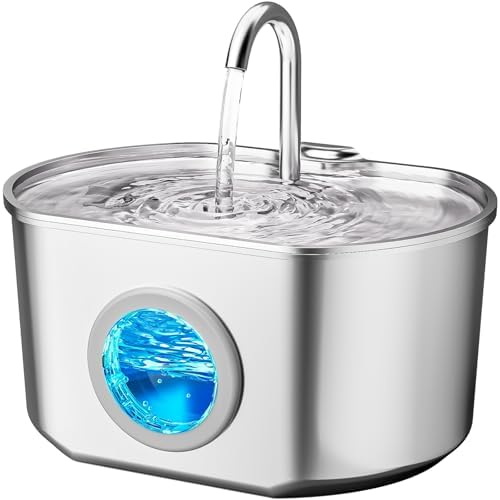
Our pick for water: Cat Water Fountain Stainless Steel: 74oz/2.2L Cat Fountain for Drinking
 Visit on Amazon →
Stainless steel is the reason I point people here before any plastic fountain. Plastic scratches, scratches hold bacteria, and a scratched plastic bowl is one of the usual suspects behind feline chin acne. I have watched a cat's chin clear up after her owner swapped plastic for steel, and I have never seen the reverse. Steel also does not hold odors the way plastic does, which matters more than it sounds when the bowl sits in a warm kitchen.
The capacity is the second thing to like. At 74 ounces, a little over two liters, you are not topping it up twice a day, and a weekend trip does not leave your cat with a dry pump grinding away. The fountain design keeps the surface moving, which is the part that gets finicky cats drinking.
What to verify when it arrives: take the pump apart before the first fill and look at every surface the water will touch. Rinse the basin and the pump housing, run it for a few minutes, and dump that first fill. Manufacturing dust is real.
Flaws but not dealbreakers: Stainless steel fountains are lighter than ceramic, which means a determined cat can still shove one across a tile floor. A silicone mat underneath stops the sliding, and if your cat has already sent a bowl flying, put this one in a corner with the cord routed behind it.
Who it is for: cats that ignore still water, cats with chin acne, and anyone who wants a fountain they can fully clean in a few minutes.
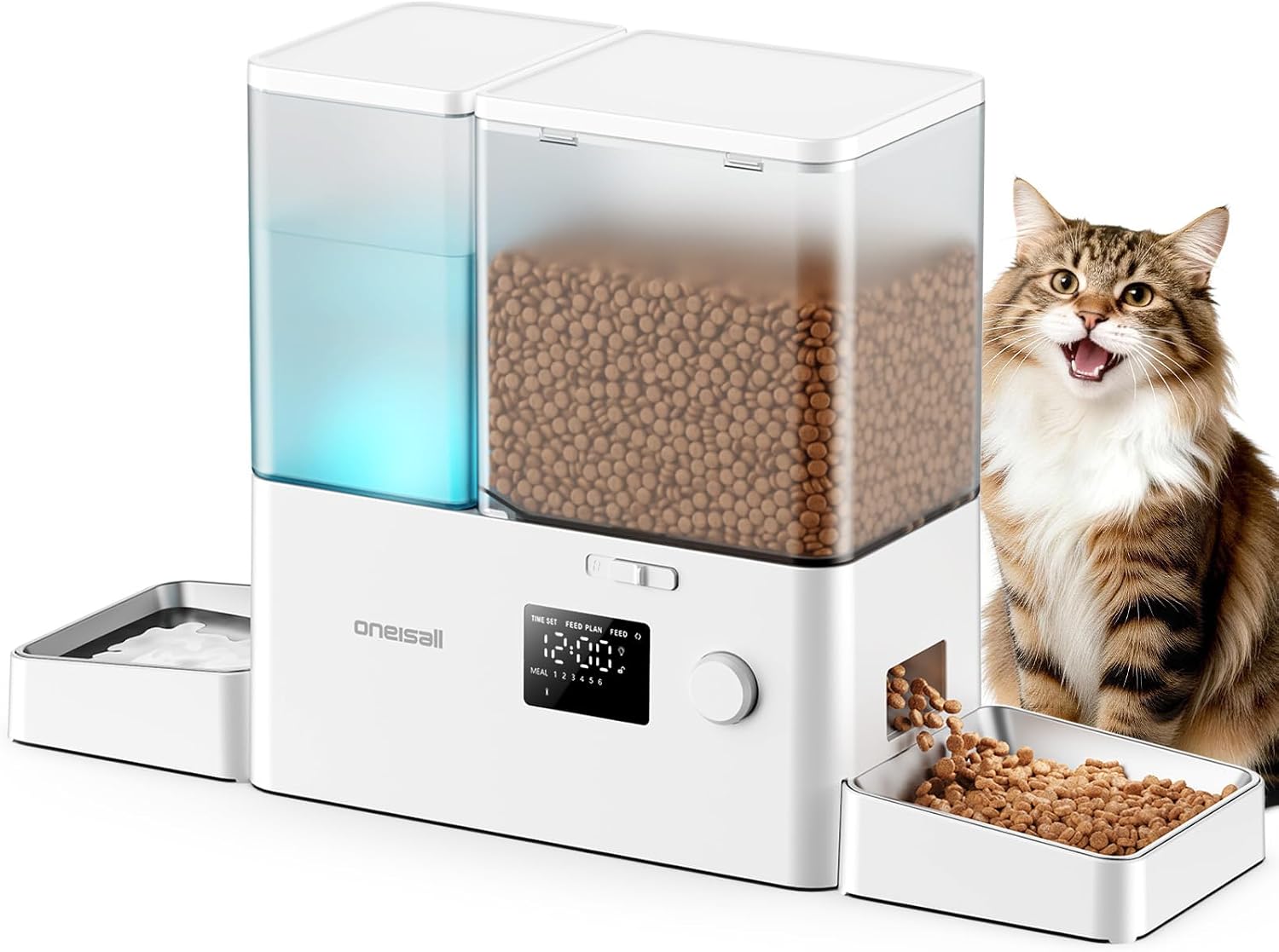
Our pick for food: oneisall Automatic Cat Feeder and Water Dispenser, 36Cups/8.5L
 Visit on Amazon →
This is the grazing setup: a large dry food reservoir paired with a water dispenser, sized at 36 cups or 8.5 liters. That is a lot of kibble and a lot of water, and it is the right shape for a household that wants the station to keep working through a long workday, a weekend away, or a stretch of overtime when you are not getting home on schedule.
Two things to know before you buy it. First, this is a reservoir-and-bowl design, not a portioned dispenser. It refills as the bowl empties, so it suits a cat that self-regulates and it is the wrong choice for a cat on measured meals, a cat with diabetes, or a multi-cat house where one cat camps the bowl. If you need grams per meal on a timer, you need a portioned feeder and this is not that product. Second, because the reservoir is large, food sits in it for a while. Keep the top sealed and keep the unit out of humid rooms, because kibble that has gone soft is kibble a cat walks away from.
Where this earns its place is the pairing. A grazing cat gets a full bowl all day and the water side stays full, which is the whole point of an automatic station: fewer things that depend on you being home at 6 p.m.
What to verify when it arrives: check that the food outlet cannot be widened by a paw, check that the water reservoir seats firmly, and put the whole thing against a wall. Tank has taught me that anything with a tall reservoir is a body-slam target, and a full 8.5-liter reservoir is a lot of water to mop up.
Flaws but not dealbreakers: A reservoir does not tell you how much your cat ate today. If your vet has asked you to track intake, put a portioned feeder on the list instead.
Who it is for: grazing cats, single-cat homes, and anyone who wants a station that does not need a daily refill.
The actual setup workflow
Now the part you came for. This works with any fountain and any reservoir feeder, and it takes about 30 minutes.
Step one: Pick the wall before you pick the outlet. You want the station out of foot traffic, away from the litter box, and near an outlet that is not directly under a counter edge where a spill can run into it. Water and electricity in the same corner deserve some paranoia. Route cords along the baseboard and tape them down if your cat chews cords.
Step two: Split the food and the water. Put a few feet between the two. This is the cheapest upgrade in the whole article and it costs nothing.
Step three: Wash everything before the first fill. Basin, pump housing, reservoir, bowl. Rinse twice, then dump the first fill of water after the pump has run a few minutes.
Step four: Fill the water side and prime the pump. Keep the pump fully submerged. A pump that runs dry is a pump that dies, and it dies quietly while you are at work.
Step five: Fill the food reservoir and watch the outlet. Set the bowl under the chute, confirm food actually flows, and watch the first bowl fill. Check it again an hour later, because a reservoir that empties too fast is a reservoir that dumps.
Step six: Anchor and shove-test both units. Push the fountain into a corner, put a mat under it, and give the feeder a real shove. If a 75-pound dog can move it, a bored cat can move it.
Step seven: Transition the cat. Keep the old bowl next to the new station for about a week, then remove it. Cats are suspicious of new objects, so a cat that ignores the fountain for three days is normal. A cat that never touches it usually has the fountain next to the food or next to a noisy appliance.
Step eight: Track the output, not the input. For the first two weeks, watch how fast the water level drops and how many clumps land in the litter box. Those two numbers tell you whether your cat is actually using the station, and they are the numbers your vet will ask about.
Where this setup fails
Power is the first failure. When the outlet dies, a fountain stops moving water while a reservoir keeps feeding. Know which half of your station depends on electricity and have a plain bowl in the cabinet for the day it matters.
Hard water is the second. Mineral scale kills pumps and clogs filters faster than any cat will. If your tap water leaves spots on a glass, plan on a filter change schedule and a vinegar soak for the pump, and check the manual for what the manufacturer actually recommends.
Multi-pet homes are the third. The reservoir setup here is for grazing cats in a house where nobody guards the bowl. Add a dog that eats like Tank and a large reservoir becomes an all-you-can-eat buffet. In that house, portion control on the food side is not optional.
And the fourth is your cat's health, not the hardware. A cat with diabetes, a cat on a prescription diet, or a cat the vet wants weighed monthly needs measured meals, not a reservoir. No feeder replaces a vet's plan.
What this setup actually costs you
Skip the sticker math and think about the ongoing cost, because that is where these stations earn or lose their keep. A fountain costs you filter replacements and about ten minutes of cleaning a week, and that ten minutes is non-negotiable. Skip it and you are running a bacteria culture with a nice waterfall sound. A reservoir feeder costs you almost nothing after purchase, just a wipe-down of the bowl and a check that the kibble has not gone stale in the bin.
Electricity for a small fountain pump is negligible, and the food side of this station draws no power at all, which is exactly why it keeps working when the Wi-Fi does not.
For the exact numbers, check the listings: Check current Amazon price for the stainless steel fountain, and Check current Amazon price for the oneisall feeder and dispenser. Both are one-time purchases against a daily job, and the daily job is the part that matters.
The bottom line
A working station is two moving parts and one habit. Put a moving water source a few feet from a food source that does not run dry, anchor both so Mochi cannot tip them and Tank cannot body-slam them, and clean the water side on a schedule you will keep. Do that and the setup stops being a gadget and starts being the reason your cat drinks more and your 6 a.m. alarm stops being a feeding bell.
Your cat was never going to ask nicely for running water. Give it the fountain, then get on with your day.