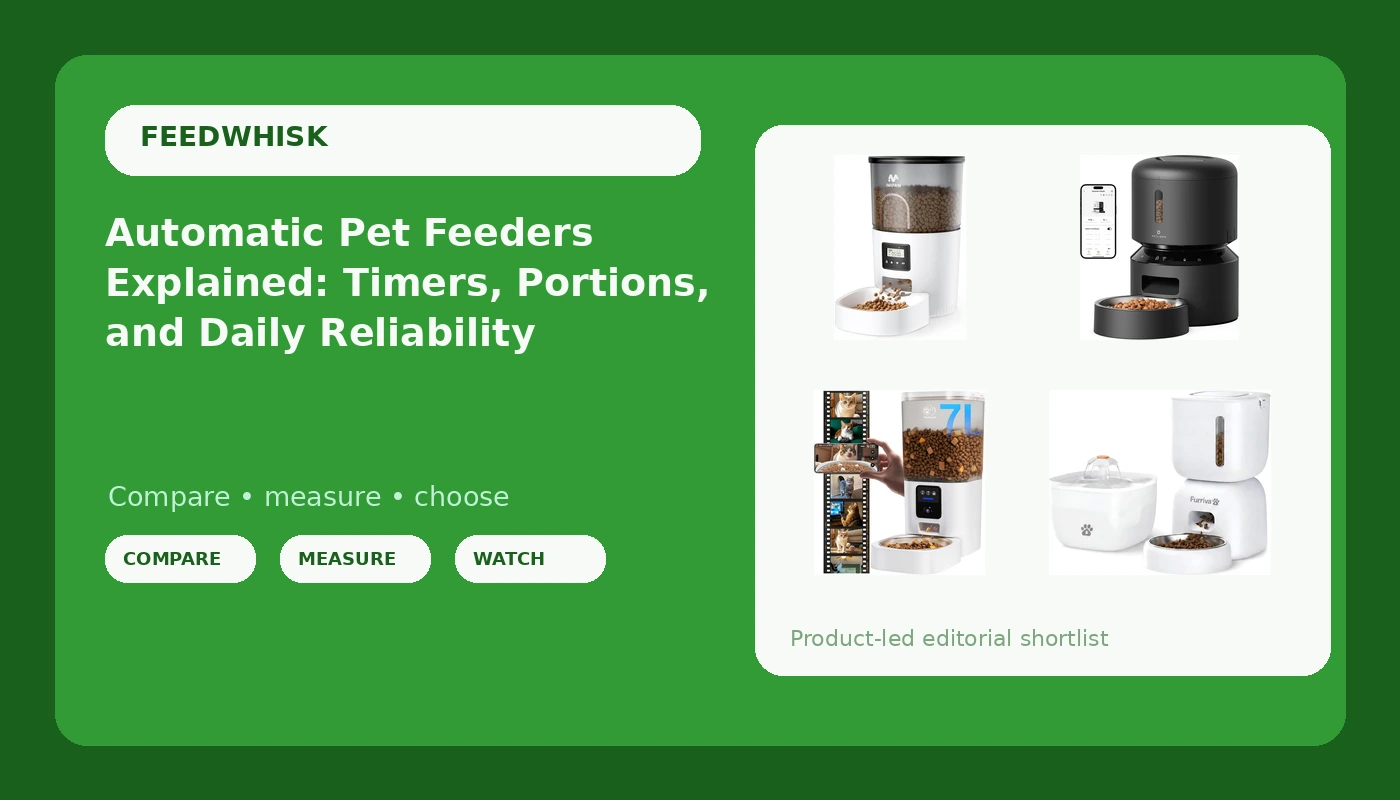
An automatic pet feeder makes a simple promise: food shows up on time whether or not you are home. The catch is that automatic pet feeders differ enormously in how they keep that promise, and the difference is almost never the app. It is the dispense mechanism, the hopper seal, the portion programming, and what happens when the power or the Wi-Fi drops. After eight years of pet sitting around Pacific Beach, I have learned that the calls I get are rarely about features. They are about a missed meal. This explainer walks through what the four options below actually specify, which details matter for cats versus dogs, and how to match a feeder to the animal in your house instead of the photo on the box.
Related: How to Build a Feeding Schedule That Survives a Weekend Away →
Quick answer
For most timed dry-food routines, a programmable dispenser with a sealed hopper, a locking or well-fitted lid, and battery backup covers the essentials. The four options below differ mainly in meal count, portion programming, food capacity, and whether they add Wi-Fi, a camera, or a fountain. If your cat tips bowls or your dog inhales a full day of kibble in ninety seconds, choose on bowl design, lid security, and portion control first, and treat camera and app extras as secondary. A feeder manages timing and portions; it does not replace a veterinarian's feeding plan.
Four useful options
| Model | Best fit | What stands out |
|---|---|---|
| Automatic Cat Feeder and Water Fountain Set, White - 3L Feeder & 2L Fountain, Stainless Steel Bowl, Locking Lid, Plug-in/Battery Powered, 4 Meals/Day, 10s Voice Recorder for Cats and Small Dogs | Households that want feeding and watering handled by one setup | 3L feeder plus 2L fountain, stainless steel bowl, locking lid, plug-in or battery power, up to 4 meals per day |
| IMIPAW Automatic Cat Feeders, Timed Cat Dry Food Dispenser with Desiccant Bag, Dual Power Supply, Programmable Portion Size, 6 Meals, 20 Portions Per Day, Auto Pet Feeder for Cats and Small Dog, White | Owners who want a straightforward programmable schedule | Desiccant bag for freshness, dual power supply, programmable portions, 6 meals and up to 20 portions per day |
| PETLIBRO Automatic Cat Feeder, 5G WiFi Pet Feeder with Freshness Preservation, Timed Cat Feeders for Dry Food, Up to 48 Portions 10 Meals Per Day, Granary Pet Feeder for Cat/Dog | Remote scheduling on a 5G Wi-Fi network | Freshness preservation and a granary design, up to 48 portions across as many as 10 meals per day |
| Frienhund Automatic Cat Feeder with 2K Camera: 5G WiFi Automatic Dog Feeder with Night Vision,Cat Food Dispenser with 7L Large Food Storage Container for Multiple Pet,Detachable for Easy Clean -29 Cup | Multi-pet homes that want a visual check-in | 2K camera with night vision, 7L (29 cup) storage, detachable parts for cleaning |
Feeder and fountain set
The appeal here is consolidation: one plug, one corner of the kitchen, and a stainless steel bowl that does not hold onto oils the way scratched plastic can. The trade-off is scheduling headroom. Four meals per day is plenty for a standard twice-daily routine, but it is not the right pick if you want six or ten smaller servings for a pet on a weight management plan. The fountain half of the set is where maintenance lives, so look at how the pump comes apart before you buy. A fountain you dread cleaning becomes a dirty fountain by Friday, and that is a health issue, not a convenience one.
Programmable multi-meal feeder
This is the profile a lot of people actually need: set the meals on the unit, walk away, and skip the account creation, the router band questions, and the notifications. Six meals with up to 20 portions per day gives you room for a small multiple-serving schedule. The dual power supply matters more than it sounds, because the failure mode that ruins a feeder is not a bad app, it is a dead outlet during an afternoon thunderstorm. The desiccant bag is a small detail with real consequences in a coastal climate, where humidity turns a hopper of kibble soft long before the bag is empty.
Wi-Fi feeder with freshness preservation
Ten meal slots and up to 48 portions per day make this the most flexible schedule of the group, which helps if you are splitting small servings across the day for a cat that grazes or a dog on a measured plan. The catch with any networked feeder is the same one I have seen bite clients: when the home network drops, does the device keep its stored schedule or wait for instructions? Check that behavior before you rely on it for a pet that needs food at a fixed time, such as a diabetic cat on twice-daily meals. Freshness preservation helps the kibble, but it does not substitute for a fallback plan.
Camera-equipped large-capacity feeder
The 7L container is the headline number for multi-pet homes, because fewer refills means fewer chances for a human to forget. The camera is the feature people ask me about most, and it is genuinely useful for one narrow job: confirming the bowl actually filled. What it does not tell you is whether your dog ate the food or your cat did, so in a mixed household you still need separate feeding stations or a microchip-controlled bowl. Detachable parts are the quieter advantage here, since a hopper and chute you can take apart is a hopper and chute you will actually wash.
Prices and availability may change. Product images, names, and retailer links must be matched by verified ASIN. Do not state a current price, rating, stock status, or measured result without current evidence.
How a feeder actually dispenses food
Two mechanisms do almost all the work. An auger is a rotating screw that pushes kibble toward the opening, and it is the part most likely to jam when kibble pieces are too large, too small, or broken into dust. A portion wheel is a rotating compartment that meters a fixed volume per turn, and its accuracy depends on how consistently kibble fills the compartments. When people tell me a feeder over-served, the story usually ends at one of these two parts rather than at the app.
Gravity feeders are a third category and a different risk profile. They refill a bowl from a reservoir with no timing and no portion limit, which suits a grazing cat and is a poor match for a dog that eats like a shop vac. If your dog finishes a day of food in a minute, portion control is not a nice feature, it is the reason to buy a feeder at all.
If you want to know how accurate a dispenser is in your home, weigh a few dispensed portions on a kitchen scale against the portion size you programmed. That is a five minute test, and it tells you more than any marketing claim about anti-jam engineering.
What the app and camera add, and what they do not
Wi-Fi and app control let you change a schedule from work, confirm a meal happened, and get low-food or error alerts. Those are real conveniences. They are also the parts that depend on your router, your internet provider, and a company's servers. A feeder with stored on-device programming keeps feeding when the network does not.
Cameras add a visual confirmation layer, and night vision matters if your pet eats after dark. What a camera cannot do is control portions, unjam an auger, or tell two pets apart at the same bowl.
When you compare options, prioritize in this order.
- Confirm the feeder dispenses the portions you need, in the number of meals per day you actually feed.
- Check the power arrangement, including whether battery backup keeps the schedule during an outage.
- Look at the hopper and lid, because a sealed, securely closing hopper protects kibble from humidity and a determined pet.
- Read how the unit is cleaned, and whether the hopper, chute, and bowl come apart without tools.
- Decide whether Wi-Fi and camera features earn their keep for your routine, or whether a timer alone is enough.
Practical guidance before you buy
- Match capacity to your refill habits. A larger container means fewer top-ups, but kibble sitting for weeks can go stale regardless of the hopper.
- Keep dry food dry. Desiccant bags and sealed lids help in humid coastal air, and they need replacing.
- Verify kibble size against the dispenser. Very small or irregular pieces are the usual cause of jams.
- Set a low-tech backup. A neighbor, a second feeder, or a gravity bowl for emergencies protects a pet if the power fails.
- Clean on a schedule. Wash the bowl and chute weekly and the fountain pump at least as often, because slime builds where you cannot see it.
- Introduce the feeder slowly. Some pets need a few days with the device in the room before they trust it.
Which option should you choose?
Choose the Automatic Cat Feeder and Water Fountain Set when you want feeding and watering handled by one plug-in or battery setup with a stainless steel bowl. Choose the IMIPAW Automatic Cat Feeders when you want programmable portions and multiple meal slots without relying on Wi-Fi. Choose the PETLIBRO Automatic Cat Feeder when you need the largest meal count and remote scheduling over a 5G network. Choose the Frienhund Automatic Cat Feeder when a large 7L container, a camera with night vision, and detachable parts for cleaning matter most.
One caveat applies to all four. The specifications above describe what each product is built to do, not how any individual unit will perform in your kitchen. Portion accuracy, jam behavior, noise at dispense time, and long-term durability vary with kibble type, pet behavior, and how the feeder is maintained. Return and warranty terms are worth reading before you commit, because they are part of the spec.
The bottom line
The dispense mechanism is the product; the app is a feature. Start with how many meals your pet needs, how much food the hopper holds, and what the feeder does when the power or the network drops. Then decide whether Wi-Fi scheduling, a fountain, or a camera adds something your routine is missing. Any of the four options here can keep a schedule, but the one that fits your pet's eating style and your cleaning habits is the one that will still be running in six months.