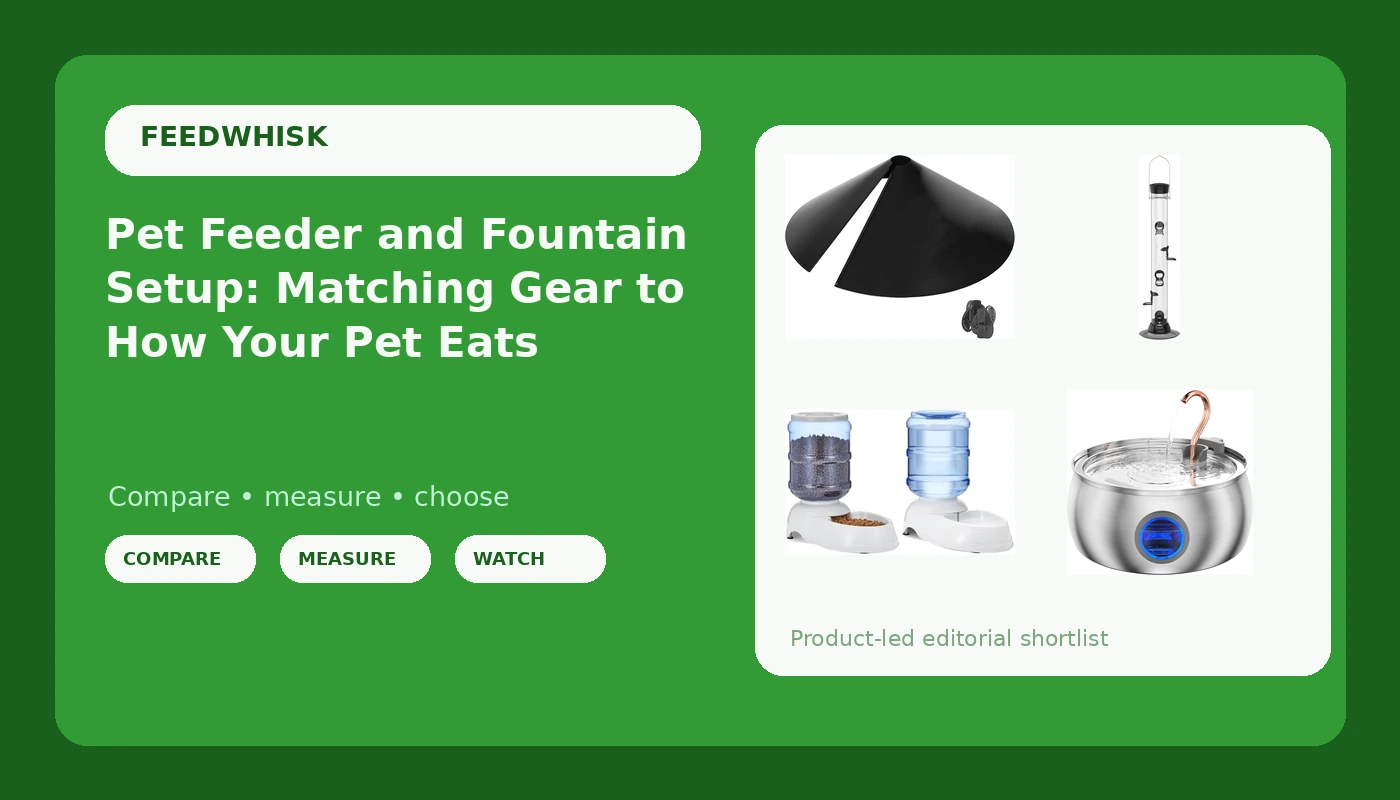
A pet feeder and fountain setup is really two decisions wearing one coat: how the food gets out, and how the water stays fresh enough that your pet actually drinks it. Get the food side wrong and you either overfeed a speed eater or leave a grazer staring into an empty bowl at 5 a.m. Get the water side wrong and a cat that refuses still water stays mildly under-hydrated for months, which is the kind of slow problem nobody notices until a veterinarian does.
This guide covers four pieces of gear that solve different halves of that problem, including the half pet owners tend to forget: the outdoor half. A seed feeder on the patio and the baffle that protects it belong to the same household routine as the bowl in the kitchen, especially in a home where pets and backyard birds share a fence line. Below you will find a quick answer, a comparison table, and a plain explanation of the mechanisms involved, so you can match the equipment to how your animal actually behaves.
Related: Why Your Cat Ignores the Water Bowl →
Quick answer
The short answer is that the mechanism should match the animal, not the product photo. A gravity dispenser and waterer set is the simplest option for a cat or small dog that grazes through the day, because it refills itself with no power, no pairing, and no firmware. A pump-driven stainless steel fountain is the fit for a cat that ignores still water, since movement is what gets many cats drinking. Outdoors, a well-built seed feeder handles the birds, and a wrap-around metal baffle is what stops squirrels from treating that feeder as a personal buffet. No single product covers all four jobs. The right choice depends on how your pet eats, where the gear sits, and how much cleaning you will realistically do every week.
Four useful options
| Model | Best fit | What stands out |
|---|---|---|
| Amazon Basics Automatic Pet Water Dispenser and Gravity Food Feeder Set for Cat and Dog, Easy to Clean, 152fl.oz food feeder, 135.3fl.oz water dispenser, Small, Pack of 2 | Free-feeding cats and small dogs, indoors | A two-piece set with a 152 fl oz food reservoir and a 135.3 fl oz water reservoir, no power required |
| Droll Yankees Onyx Clever Clean and Fill Mixed Seed Bird Feeder, 6 Feeding Ports, 24-Inch, Black | Backyard seed feeding | 24-inch feeder with 6 feeding ports and a design built for quick opening and refilling |
| Cat Water Fountain Stainless Steel -135oz/4.0L Cat Fountain for Drinking | Cats that ignore still water | Stainless steel drinking surface with a 4.0 L reservoir |
| More Birds Squirrel-X Wrap Around Metal Squirrel Baffle Protects Bird Feeders From Squirrels, 18-Inch | Protecting a pole-mounted feeder | 18-inch metal baffle that wraps around the feeder pole |
The simple indoor starter: Amazon Basics Automatic Pet Water Dispenser and Gravity Food Feeder Set
Gravity is the oldest trick in feeding equipment and still the most misunderstood. There is no motor and no portion wheel, which means there is also no portion control: the food level in the bowl is set by your pet, not by a schedule. That makes this set a natural fit for a cat or small dog that nibbles across the day, and a poor fit for a dog that inhales a bowl in forty seconds and then looks for more. If your pet eats like a vacuum cleaner, portioned feeding or a vet-guided plan is the safer conversation. The other trade-off is exposure: kibble sitting in a hopper and bowl is open to household humidity, so plan on washing both pieces regularly and keeping the hopper lid seated.
The outdoor half: Droll Yankees Onyx Clever Clean and Fill Mixed Seed Bird Feeder
Bird feeders fail in a boring, predictable way: they get disgusting because they are annoying to open. Damp seed cakes, mold, and droppings accumulate in any tube feeder that takes ten minutes to disassemble, and a dirty feeder is a health problem for the birds using it, not just an eyesore. A feeder whose whole selling point is quick cleaning and filling gets cleaned more often, which is the only feature that matters at week six. The 24-inch, six-port format also spreads birds out instead of stacking them on one perch, which reduces the squabbling you hear on a crowded feeder. The catch is that any outdoor feeder is only as good as what is holding it up, which brings us to the next item.
The indoor water upgrade: Cat Water Fountain Stainless Steel -135oz/4.0L
Cats are famously unimpressed by still water, and the usual explanation is behavioral: a bowl that never moves reads as a bowl that might be stale. Whatever the reason, a fountain is the standard fix, and the two details worth caring about are the surface material and the pump. Stainless steel does not scratch the way plastic does, and scratched plastic is where biofilm likes to hide; some cats also develop chin irritation from plastic bowls. The pump is the part that will need attention, so the practical question before buying any fountain is whether you can pull the impeller and rinse the housing without tools or a tutorial. A 4.0 L reservoir buys you days between refills, which matters more than it sounds in a household with two or three cats drinking from the same unit.
The squirrel solution: More Birds Squirrel-X Wrap Around Metal Squirrel Baffle, 18-Inch
A baffle is the least glamorous product in this guide and often the one that decides whether the other outdoor item is worth owning. Squirrels do not defeat feeders with strength; they defeat them with routes, and a wrap-around shield removes the pole route by making the climb physically awkward. It only works if the geometry around it cooperates. A baffle mounted low, or within easy leaping distance of a fence, a low branch, or a roof edge, just becomes a slightly inconvenient step on a longer path. Position matters as much as the product, which is why the installation notes below matter more than the spec sheet.
Prices and availability may change. Product images, names, and retailer links must be matched by verified ASIN. Do not state a current price, rating, stock status, or measured result without current evidence.
How gravity feeding works, and where it stops working
A gravity feeder is a reservoir sitting above a bowl with a chute between them. As your pet eats, the level in the bowl drops, the column of food above it settles, and more kibble slides down to refill the gap. There is no timer, no motor, and nothing to program, which is exactly why it survives power outages and Wi-Fi outages alike.
The failure points are equally simple. First, kibble shape matters: very small or irregular pieces can bridge across the chute opening and stop the flow, while large pieces can jam in a narrow throat. Second, moisture is the enemy. An open hopper in a humid kitchen lets kibble soften at the bottom of the pile, and soft kibble clumps. Third, and most important, there is no metering. Free feeding works for many cats and some small dogs, but a dog that eats everything in sight will eat everything in sight on a gravity feeder too, just faster. If your pet has a weight or digestive condition, the feeding plan should come from your veterinarian, not from a product listing.
The counterpoint is that portioned feeders have their own failure mode: the auger or portion wheel. A mechanism that measures food is a mechanism that can jam, and a jam at 7 a.m. while you are at work is a missed meal. Gravity removes that entire category of risk, at the cost of giving up control over how much goes in.
Why water movement and material matter
Water is where the details are less about convenience and more about health. Many cats drink noticeably more from a moving source than from a still bowl, and increased water intake is one of the few levers an owner has over urinary and kidney issues that show up later in a cat's life. A fountain does not guarantee anything, but it removes one common excuse a cat has for not drinking.
Material matters for a different reason. Plastic bowls scratch, and scratched surfaces hold onto oils and bacteria even after a rinse. Stainless steel and ceramic are the usual alternatives, with stainless being lighter and harder to break. If your cat has had chin irritation or acne, switching away from plastic is a reasonable first experiment.
Then there is the pump, which is the part nobody thinks about until it starts rattling. Every fountain needs its impeller cleared of hair and its housing rinsed, and the fountains that get maintained are the ones where that takes a minute or two. Before you buy, look for how the pump is reached: a removable top and a pump you can lift out beats a housing you have to disassemble with a screwdriver. A fountain with a pump you cannot see is a fountain you will stop cleaning.
A five-step way to choose
- Watch your pet eat for two days and decide which type you have: a grazer who returns to the bowl all day, or a meal-eater who finishes in one sitting. Gravity suits the first; portioned feeding suits the second.
- Decide indoor or outdoor before comparing anything. A gravity set, a fountain, a seed feeder, and a baffle are not alternatives to each other, they are four different jobs.
- Match water delivery to your cat's actual behavior. If she drinks from a still bowl without complaint, a fountain is optional. If she tips bowls or ignores them, moving water is the fix worth paying for.
- Trace the cleaning path for every item before you buy it. Can you open the hopper without a fight? Can you reach the pump? Does the feeder tube come apart for a wash? Cleaning frequency is a design feature, not a personality trait.
- Check the return window and whether replacement parts exist. Pumps wear out, and a fountain whose pump cannot be replaced becomes a bowl with extra steps.
Practical guidance for the first month
- Set the gravity feeder and water dispenser on a hard, level surface away from vents and direct sun, and check the food level each morning for the first week to confirm it is actually flowing.
- Wash the food hopper and bowl weekly with warm soapy water and let them dry fully before refilling. Kibble residue turns rancid faster than people expect.
- Keep the fountain reservoir out of direct sunlight to slow algae growth, and rinse the stainless surface every few days even when the reservoir is still full.
- Mount a squirrel baffle at least four to five feet up the pole and keep the feeder eight to ten feet away from fences, low branches, and roof edges, since squirrels reach feeders by launching from nearby objects rather than by climbing alone.
- Clean a seed feeder on a schedule, not when it looks bad. A quick disassembly and a scrub with a diluted bleach solution, followed by a thorough rinse and full dry, is the standard routine for tube feeders.
- Introduce a fountain by leaving the old bowl in place for a few days. Some cats switch immediately, and some need to see both options before they commit.
Which option should you choose?
Choose the Amazon Basics Automatic Pet Water Dispenser and Gravity Food Feeder Set when you want food and water handled with no power, no app, and no moving parts, and your pet is a grazer rather than a speed eater. Choose the Cat Water Fountain Stainless Steel -135oz/4.0L when your cat ignores or tips a still bowl and you want a metal drinking surface with a reservoir large enough to skip daily refills. Choose the Droll Yankees Onyx Clever Clean and Fill Mixed Seed Bird Feeder when the goal is a backyard feeder that is quick to open, fill, and wash, so the cleaning actually happens. Choose the More Birds Squirrel-X Wrap Around Metal Squirrel Baffle when a pole-mounted feeder keeps getting emptied by squirrels and you want to solve it with geometry rather than with a gadget.
One caveat worth repeating: the capacities and materials described here come from the product listings, not from measurements taken in a test setting, and no product is right for every household. A pet with a medical condition, a multi-cat home with a food thief, or a yard with an aggressive squirrel population may need a different approach entirely.
The bottom line
Feeding and watering gear is not one purchase, it is a set of small decisions about mechanism, material, and cleaning. Gravity handles free-feeding cats and small dogs with almost nothing to break. A stainless steel fountain handles the cat that will not drink from a still bowl. Outdoors, an easy-to-clean seed feeder and a properly mounted metal baffle work as a pair, because a feeder that squirrels can reach is a feeder you are paying for twice. Match the mechanism to the animal in front of you, plan the cleaning routine before the box arrives, and the gear will do its job quietly for years.