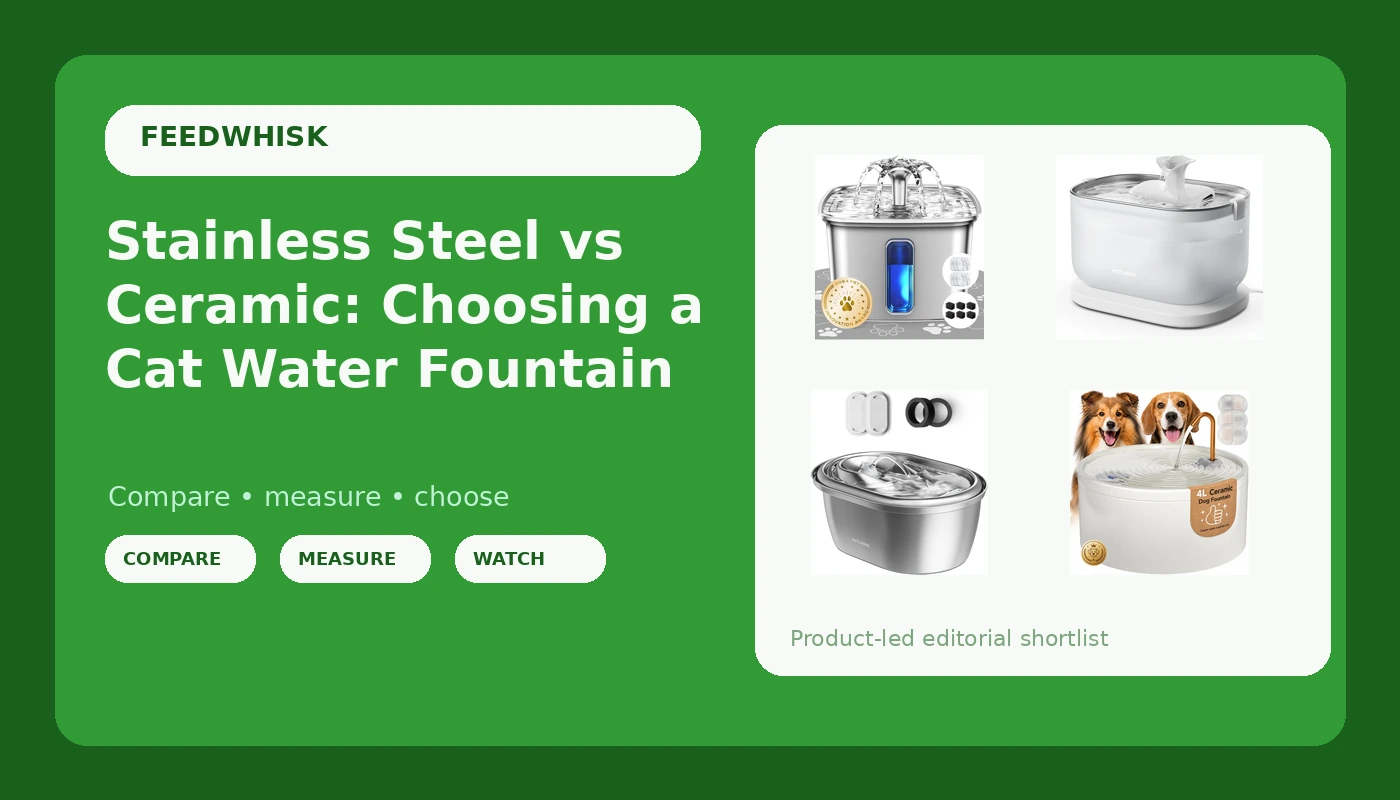
A cat that ignores a still bowl will often drink from a running tap, and that is the premise behind the modern cat water fountain. Circulating water stays more appealing to many cats than a bowl that sits untouched for hours, and a fountain keeps a larger volume moving so nothing goes stale and lukewarm while you are at work. The catch is that fountains are not interchangeable. Material, capacity, and how easily you can reach the pump decide whether you actually keep the unit clean, and a fountain that is a chore to clean becomes a fountain you skip. The four models here cover the main design paths available now: a large-capacity stainless steel fountain, a wireless-pump design, an adjustable-flow stainless unit, and an all-ceramic fountain with a copper spout.
Related: How to Build a Two-Cat Feeding Station That Actually Works →
Quick answer
There is no single best cat water fountain, because the deciding factors are personal: how many pets drink from it, whether your cat has reacted badly to plastic, how much floor space you have, and how much time you will honestly spend on a weekly deep clean. Stainless steel and ceramic are the two materials most often recommended for cats with chin acne or plastic sensitivity, and capacity matters most in multi-pet homes. Match the fountain to your cleaning habits and your pet count first, then compare features. Do not assume a listing's description of quiet operation or capacity means the same thing in your kitchen; those details come from the manufacturer, not from a measurement taken in your home.
Four useful options
| Model | Best fit | What stands out |
|---|---|---|
| Veken Innovation Award Winner Stainless Steel Cat Water Fountain, 108oz, C1 | Households that want a big stainless reservoir and a wide drinking area | 108oz stainless steel body |
| PETLIBRO Cat Water Fountain Stainless Steel Tray, Wireless Pump Cat Fountain, Ultra Quiet Pet Water Fountain, 2.5L Automatic Water Dispenser for Cats, Dual Flow Cat Water Dispenser Easy to Clean | Buyers who want the pump separated from a cord in the water path | Wireless pump with a stainless steel tray and dual flow outlets |
| PETLIBRO Stainless Steel Cat Water Fountain, 101oz/3L Automatic Water Dispenser for Cats Indoor, Quiet Pet Water Dispenser with 2 Filters, Adjustable Flow Cat Fountain Also for Small Dogs | Homes where a cat and a small dog share one fountain | 101oz / 3L capacity, two filters, adjustable flow |
| MISFANS Ceramic Dog Water Fountain, All-Ceramic Body, Pure Copper Spout | Cats that slide or tip lightweight fountains | All-ceramic body with a pure copper spout |
Large capacity stainless: Veken Innovation Award Winner Stainless Steel Cat Water Fountain, 108oz, C1
The trade-off with a reservoir this size is that a full unit is heavy to lift to the sink, and the bigger the bowl, the more surface area collects hair and dust between cleanings. Capacity is a genuine benefit in a two-cat home, but only if you are willing to carry it. If your cat is a bowl tipper, note that a large stainless fountain is still lighter than ceramic.
Wireless pump: PETLIBRO Cat Water Fountain Stainless Steel Tray, Wireless Pump Cat Fountain, Ultra Quiet Pet Water Fountain, 2.5L Automatic Water Dispenser for Cats, Dual Flow Cat Water Dispenser Easy to Clean
A wireless pump changes the cleaning routine more than any other feature on this list, because there is no cord to route around a wet bowl or unplug at the wall. The counterpoint is that any pump, corded or not, still needs the impeller cleared of hair and mineral film on a regular schedule. The 2.5L capacity is on the smaller side if more than one pet drinks heavily.
Adjustable flow: PETLIBRO Stainless Steel Cat Water Fountain, 101oz/3L Automatic Water Dispenser for Cats Indoor, Quiet Pet Water Dispenser with 2 Filters, Adjustable Flow Cat Fountain Also for Small Dogs
Adjustable flow sounds like a minor feature until you have a pet that drinks tentatively and a pet that slaps the water. Being able to soften the stream can matter for a nervous cat. Two filters in the box also means you are not ordering replacements the week the fountain arrives, though filters are a recurring cost on every filtered fountain.
Ceramic build: MISFANS Ceramic Dog Water Fountain, All-Ceramic Body, Pure Copper Spout
The honest trade-off with ceramic is handling. It is heavy to lift, and a drop on a tile floor can end the fountain in one motion. Ceramic also needs a check for chips along the rim over time, since a chipped edge is a place for residue to collect. In exchange you get a fountain that a determined cat is unlikely to relocate.
Prices and availability may change. Product images, names, and retailer links are matched to verified listings. No current price, rating, stock status, or measured result is stated here without current evidence.
Why moving water gets cats drinking
Cats are descended from animals that hunted small prey in dry environments, and they evolved to get much of their moisture from food rather than from drinking. That history shows up in the average house cat's weak thirst drive. Many cats simply do not drink enough from a still bowl, which is one reason veterinarians so often bring up hydration during routine visits, particularly for cats with a history of urinary or kidney concerns.
Running water gets attention for a few practical reasons. Movement breaks the surface, which makes the water look fresher to a cat that has learned that stagnant water can taste flat. Some cats also seem to prefer cooler, aerated water. And a fountain holds more volume than a bowl, so the water level does not drop to a shallow puddle by the end of a workday.
None of this is a medical treatment, and a fountain is not a substitute for veterinary advice. It is a simple environmental change that removes one common excuse a cat has for not drinking.
Material, capacity, and pump access
Three specifications decide most of the daily experience with a fountain.
Material. Stainless steel is non-porous, does not hold onto odors the way scratched plastic can, and generally wipes clean quickly. Ceramic is also non-porous and adds weight and stability, at the cost of being heavy and breakable. Plastic is the least expensive option and the one most likely to develop fine scratches over months of use, which is why owners of cats with chin acne are frequently advised to switch away from it.
Capacity. The fountains here run from 2.5L to 108oz, which is roughly the same neighborhood, up to 3L. In a single-cat home that is several days of water. Add a second cat or a small dog and the refill interval shortens fast.
Pump access. This is the spec nobody advertises and everybody notices. If the pump sits in a compartment you have to disassemble with a screwdriver, you will clean it less often than you should.
- Count how many animals will drink from the fountain, and whether any of them is a dog.
- Check your cat's history with plastic bowls, especially any past chin acne or odor retention.
- Measure the floor or counter space and decide where the power cord will run.
- Before buying, look at how the pump is removed and whether the impeller is reachable by hand.
- Set a cleaning cadence you will actually keep, then buy the fountain that fits that cadence.
Cleaning habits that keep a fountain working
- Rinse the drinking tray every day or every other day, since saliva and hair collect there first.
- Dump and refill the reservoir rather than topping it off, so the water does not concentrate.
- Pull the pump and clear the impeller of hair and mineral film on a regular schedule.
- Replace filters according to the manufacturer's instructions, and factor that recurring cost into the purchase.
- Keep the water level above the pump intake, because running a pump dry shortens its life.
- Place the fountain away from the food bowl, since many cats prefer to drink at a distance from where they eat.
Which option should you choose?
Choose the Veken Innovation Award Winner Stainless Steel Cat Water Fountain, 108oz, C1 when you want a large stainless reservoir and a wide drinking area for more than one cat, and you do not mind lifting a full body to the sink. Choose the PETLIBRO Cat Water Fountain Stainless Steel Tray, Wireless Pump Cat Fountain, Ultra Quiet Pet Water Fountain, 2.5L Automatic Water Dispenser for Cats, Dual Flow Cat Water Dispenser Easy to Clean when the cord in the water path is the part of fountain ownership you dislike most and you want the tray to lift out cleanly. Choose the PETLIBRO Stainless Steel Cat Water Fountain, 101oz/3L Automatic Water Dispenser for Cats Indoor, Quiet Pet Water Dispenser with 2 Filters, Adjustable Flow Cat Fountain Also for Small Dogs when a cat and a small dog share one fountain and you want adjustable flow plus spare filters in the box. Choose the MISFANS Ceramic Dog Water Fountain, All-Ceramic Body, Pure Copper Spout when your pet pushes bowls around the floor and weight is the feature you care about most.
Two caveats belong here. Descriptions such as ultra quiet, innovation award winner, and easy to clean come from the product listings rather than from independent measurement, so treat them as manufacturer claims. Capacity figures and filter counts are also taken from the listings, and actual refill intervals depend on how much your pets drink.
The bottom line
A cat water fountain is a cleaning commitment disguised as a convenience product. The material decides how easy the surfaces are to keep fresh, the capacity decides how often you refill, and the pump design decides whether the weekly maintenance actually happens. Stainless steel covers most households well, ceramic solves the specific problem of a pet that moves its bowl, and a wireless pump removes the cord that makes many people put off cleaning. Pick the one whose maintenance routine matches your real week, and the fountain will keep earning its spot on the floor.