Most pets do not drink enough water. Cats especially, because a cat that evolved in dry country reads still water as suspect, and a bowl that has been sitting out since Tuesday does nothing to change her mind. I have watched a tortoiseshell named Mochi slap a full bowl across a kitchen floor because she decided still water was an insult, and I have watched a 75 pound lab mix named Tank drink a fountain down to the intake before lunch.
A pet water fountain setup is not complicated. It is fifteen minutes, one rinse, one assembly, and one honest look at where you put the thing. The hard part is not the setup. The hard part is the Sunday teardown, because a fountain you do not clean is a fountain that grows biofilm, and biofilm is a health problem wearing a convenience product's clothes.
Here is the process I use in my own apartment and in clients' kitchens, plus the two fountains that cover the two most common households I walk into.
Why you should trust me
I have been pet sitting and walking dogs in Pacific Beach for eight years, with a client list that has run past 60 households at once. That is a lot of kitchens, a lot of pumps, and a lot of owners asking me why their cat stopped using the fountain they bought in January. One client had a diabetic cat that needed feeding at the same time every day, and she taught me what the word reliable actually means. A pump that runs 24 hours a day gets held to the same standard.
I also returned four automatic feeders before I kept one, which taught me to read a product by its mechanism instead of its marketing photo. At home I run Mochi, who tips bowls on purpose, and Tank, who drinks like a shop vac. A fountain that survives both of them gets a longer look from me. I do not judge a fountain until I have taken the pump apart at least twice, because the pump is the product and the bowl is just the housing.
How I judge a fountain
Four things, in this order.
Can I see and reach the pump? If the pump hides inside a sealed compartment that needs a stubby screwdriver to open, that is a slime trap, and I will not recommend it.
How long does a full clean take? My rule is five minutes. Anything past that becomes a fountain that gets cleaned every other week, which means it is a dirty fountain by Friday.
Can the pet tip it? Mochi weighs nine pounds and has flipped a wide bowl more than once. Weighted bases and ceramic solve this. Thin, light plastic does not.
What happens when a part fails? Pumps die. Filters clog. If the listing does not sell replacements, the fountain is a disposable object with a cord.
I also check the boring stuff: reservoir size against the number of pets, whether the drinking surface is a material that scratches and holds bacteria, and whether the flow can be turned down for a nervous cat.
What a fountain actually has to do
Circulate water, filter hair and dust, hold enough volume that you are not refilling twice a day, and come apart without tools. That is the entire spec. Everything else, the lights, the app, the "smart" features, is decoration bolted on top of those four jobs.
The two fountains I point people toward
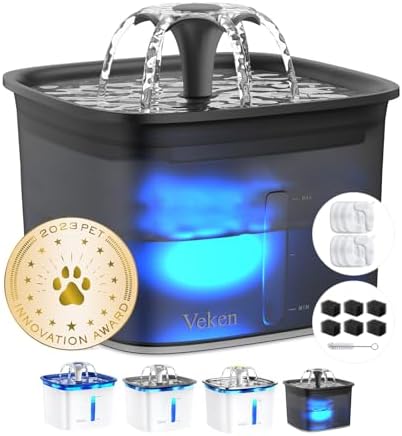
Best for cats: Veken Innovation Award Winner 95oz/2.8L Cat Water Fountain
 Visit on Amazon →
This is the fountain I suggest to a client with one cat in a one bedroom apartment. The reservoir is 95 ounces, which is 2.8 liters, and that matters more than it sounds: a single cat drinking normally will not empty it in a day, so the pump is not sucking air at 2 a.m. because the level dropped below the intake.
The moving water is the point. Mochi ignored bowls for two years and started drinking the moment water started moving, and that behavior shift is what you are actually buying. Check current Amazon price, and check the listing for the filter it takes, because that filter is the recurring cost of owning any fountain and it is the number that decides whether a cheap fountain is truly cheap.
Flaws but not dealbreakers: A lightweight fountain is a fountain a determined pet can shove. Put it on a mat against a wall, not at the edge of a counter, and check the level every morning for the first week until you learn how fast your pet drinks.
Anyone with one or two cats, or a small dog, who wants moving water without a heavy investment should start here.
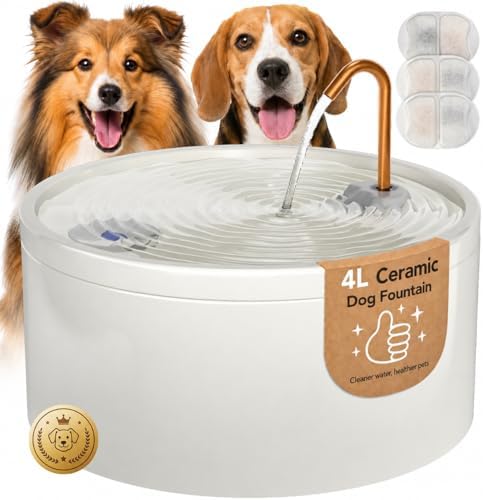
Best for dogs and bowl tippers: MISFANS Ceramic Dog Water Fountain, All-Ceramic Body, Pure Copper Spout
 Visit on Amazon →
Ceramic changes the math. The all-ceramic body gives the fountain enough mass that a cat cannot slide it and a dog cannot body-slam it across the floor, and ceramic does not scratch the way plastic does, which means fewer microscopic grooves for bacteria to live in. The pure copper spout is the other reason I like this one for dogs: copper does not pit or hold odor the way softer materials can, and it is something you can actually scrub.
Check current Amazon price. The tradeoff is real and you should hear it before you buy. Ceramic is heavy to lift and awkward to clean, and one wrong drop onto tile is the end of it. I have cracked a ceramic fountain myself while rinsing it, so I am not pretending this is a free upgrade. Handle it over the sink, not over the floor, and dry your hands first.
Flaws but not dealbreakers: You will not be tossing this into a dishwasher basket and walking away. Plan on a sink, a soft sponge, and a towel on the counter.
Anyone with a big dog, a bowl-tipping cat, or a pet whose chin acne got worse on plastic should look at ceramic first.
The setup, step by step
Step one: Rinse everything before the first fill. New fountains ship with manufacturing dust, and new filters shed carbon fines. Take the whole thing apart, rinse every part in warm water, and skip soap on anything porous.
Step two: Assemble the pump and spin the impeller by hand. Before the pump ever sees water, reach into the intake and turn the impeller with a finger. It should spin freely. If it feels gritty or stuck, you found the problem before it became a 3 a.m. grinding noise.
Step three: Set the flow. Most fountains let you choose between a gentle bubble and a stream. Start low. A cat that is new to moving water usually prefers a soft trickle, and you can turn it up after a week.
Step four: Fill to the marked line and never lower. Running a pump below the minimum water line is how you kill a pump in a month. If your pet drinks a lot, buy the bigger reservoir or accept that you refill twice a day.
Step five: Put it on a hard, level surface with a mat under it. Not carpet, where it tips, and not right next to the food bowl if your cat is one of those cats. Many cats prefer water away from where they eat, which is a quirk worth respecting instead of fighting.
Step six: Watch the first hour. Check for drips at the seams, listen to the pump, and route the cord so nobody chews it. Tank has chewed through a cord before, and a chewed cord is a fire risk, not just an inconvenience.
Step seven: Introduce it without forcing it. Do not hold your cat up to the fountain. Put a few treats nearby, leave the old bowl out for a few days, then move the old bowl away once you see the pet drinking. Some pets switch in an hour. Some take two weeks.
How much water is actually the goal
Your vet can give you a target for your pet's weight and health, and that target moves with diet, because a cat on wet food takes in a lot of water from the food and a cat on dry kibble takes in almost none. What I track in clients' homes is simpler than a number. Does the water level drop every day, and is the litter box output normal. A fountain nobody drinks from is a decoration, no matter how good the flow looks.
Cleaning, the part that actually decides this
Once a week, unplug the fountain and take it apart completely. That means the bowl, the reservoir, the spout, the filter housing, the pump faceplate, and the impeller. Rinse the sponge. Wipe the inside of the reservoir with a soft sponge, because the film on those walls is biofilm and it comes back fast in warm weather.
Once a month, soak the hard water deposits off. San Diego water leaves a white crust on everything, and a vinegar soak breaks it down without scouring the finish. Rinse thoroughly afterward.
Replace the filter on the schedule the listing gives you, and replace the pump when it grinds or loses flow even after a clean. Never run any fountain dry. A dry pump burns out in minutes, and that is a self-inflicted wound.
When the fountain gets loud or stops moving water
Low water is the first suspect, and it is the answer more often than anything else. Gurgling means the intake is pulling air. Humming with no flow usually means hair wrapped around the impeller, which is a two minute fix once you know to look for it. If flow drops but the pump sounds normal, the filter is clogged. If the water smells or feels slick, you skipped a week, and the fix is a full teardown, not a top off.
If your pet still will not drink after two weeks, try a different spot before you try a different fountain. Move it away from the food, away from the litter box, and away from a noisy appliance. Some cats want the fountain in a quiet corner where they can see the room.
The competition and why it lost
Stainless steel fountains are the other serious option, and they are easier to clean than plastic and lighter than ceramic. What they lose on is tip resistance, because a steel bowl with a modest base is still a bowl Mochi can move.
Gravity waterers, the jug on a bowl style, hold a lot of water and cost almost nothing to run. They also do nothing for a pet that ignores still water, and they are a bad idea for a dog that drinks too fast, because nothing about the design slows that dog down.
A plain wide ceramic bowl is still the cheapest answer, and if your pet drinks from it happily, keep it. A fountain solves a specific problem: a pet that wants moving water, or a household that is gone ten hours a day and cannot refill a bowl mid-shift. If you do not have that problem, you do not need this guide.
What this all costs
Check current Amazon price on both fountains before you decide, then do the honest math on the consumables. Filters are the real subscription here, and a fountain that takes a cheap filter you can buy in a multipack costs less over two years than one that takes a proprietary cartridge. Electricity is negligible. Pumps are the wild card, and a replacement pump is usually a fraction of the fountain, which is one more argument for buying a model whose parts are actually sold.
The fifteen minutes of setup is not the investment. The weekly ten minute teardown is. If you will do that, a fountain keeps water moving, keeps it cooler, and gets a stubborn cat drinking. If you will not, buy a wide ceramic bowl and change the water twice a day, because a dirty fountain is worse than no fountain at all.